
Not all grasses handle dry spells the same way. Some turn brown within a week of missed rainfall. Others hold their colour for months with barely a drop of supplemental water. The difference comes down to biology, and if you choose the right species from the start, you can save yourself a great deal of time, water, and worry. Drought tolerant grass is not a single variety but a group of species that share certain physical traits allowing them to survive extended periods without irrigation.
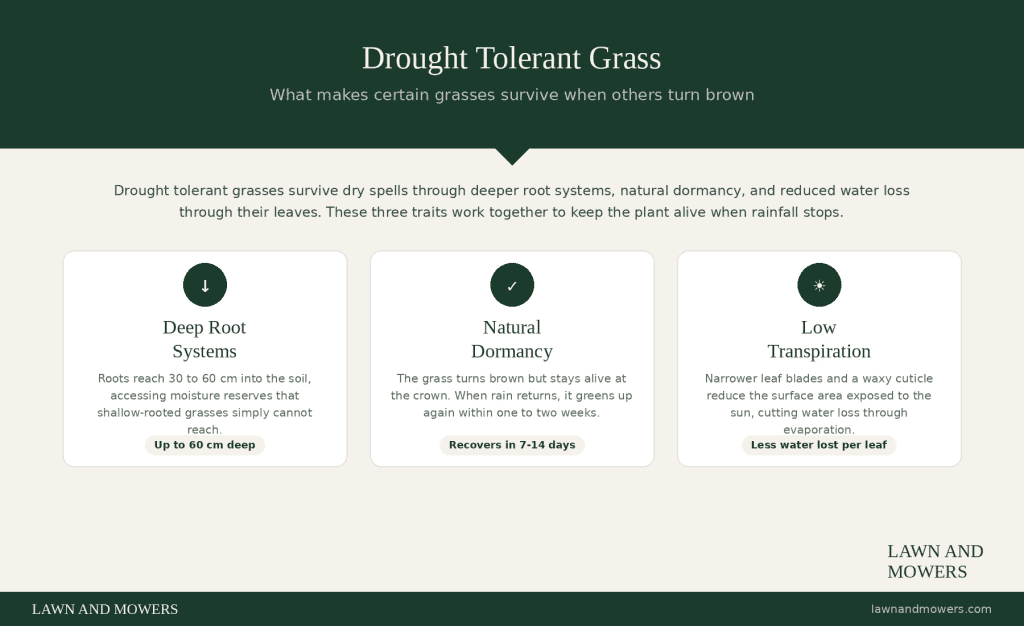
The most significant trait is root depth. Grasses like tall fescue and bermudagrass routinely send roots down 30 centimetres or more, sometimes reaching 60 centimetres in well-prepared soil. That deep root system accesses moisture reserves that shallow-rooted grasses simply cannot reach. When the top 10 centimetres of soil dries out in a heatwave, a deep-rooted grass is still drinking from reserves further below.
The second trait is the ability to enter dormancy. Many drought tolerant grasses will stop growing and turn straw-coloured when water is scarce, but they do not die. The crown of the plant remains alive at the soil surface, and when rain returns, the grass greens up again within one to two weeks. This is a survival mechanism, not a sign of failure. Knowing the difference between dormancy and death is the first step toward a more relaxed approach to summer lawn care.
The third factor is leaf structure. Drought tolerant species tend to have narrower leaf blades that reduce the surface area exposed to the sun, which in turn reduces water loss through transpiration. Some varieties also have a waxy cuticle on the leaf surface that acts as a barrier to evaporation. These adaptations are subtle, but they add up to a significant reduction in water demand over the course of a dry summer.
The Best Drought Tolerant Grass Varieties
Choosing the right drought tolerant grass depends on your climate, your soil, and how you use your lawn. What follows is a breakdown of the most reliable species, grouped into warm-season and cool-season types. Warm-season grasses thrive in temperatures above 25 degrees Celsius and go dormant in winter. Cool-season grasses prefer temperatures between 15 and 24 degrees Celsius and stay green through milder winters, making them the standard choice across the United Kingdom and northern parts of the United States.
Warm-Season Grasses
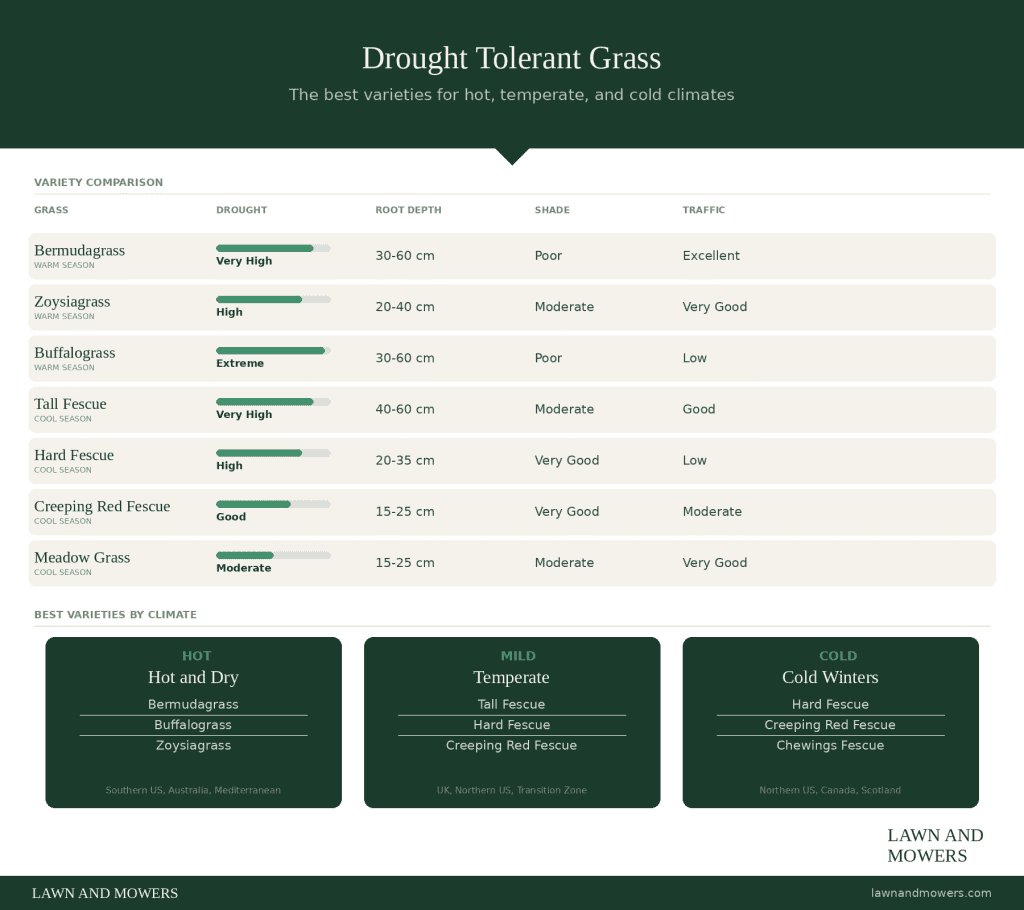
Bermudagrass is the most widely planted warm-season turf in the world, and for good reason. It tolerates extreme heat, recovers rapidly from wear, and survives on remarkably little water once established. Its aggressive spreading habit, through both stolons and rhizomes, means it fills in bare patches quickly. The trade-off is that bermudagrass requires full sun and goes completely dormant in winter, turning brown from late autumn through to mid spring. For lawns in the southern United States, parts of Australia, and Mediterranean climates, it is one of the most dependable choices. Improved cultivars such as TifTuf and Celebration offer better drought performance and finer texture than common bermudagrass.
Zoysiagrass sits between bermudagrass and the cool-season fescues in terms of water needs. It forms a dense, carpet-like turf that resists weeds and handles moderate shade better than bermuda. Zoysia is slower to establish, often taking a full growing season to fill in from plugs, but once it matures, it is extremely drought tolerant. It also handles foot traffic well, making it a good option for families. The main drawback is its slow recovery from damage and its tendency to build thatch if not managed.
Buffalograss is native to the North American prairies and is the most water-economical warm-season turf available. Once established, it can survive on as little as 25 millimetres of water per month, which is less than half what most lawn grasses need. It stays low, rarely exceeding 10 centimetres, so mowing frequency is minimal. The limitations are that it does not tolerate shade, it is slow to green up in spring, and it cannot handle heavy foot traffic. For large, open areas in dry climates where a manicured finish is not the priority, buffalograss is hard to beat.
Cool-Season Grasses
Tall fescue is the standout performer among cool-season grasses for drought resistance. Its deep root system, often reaching 40 to 60 centimetres in good soil, allows it to access water long after the surface has dried out. Modern turf-type tall fescues such as Regenerate, Titanium, and Firecracker SLS have a finer leaf blade than the old pasture types and produce a lawn that looks neat and uniform when mown at 5 to 7 centimetres. Tall fescue is a bunch-type grass, meaning it does not spread by runners. Bare patches will not self-repair the way bermuda or zoysia would, so periodic overseeding is necessary to maintain a thick sward. It performs well across the transition zone of the United States and in warmer parts of the United Kingdom where summers are increasingly dry.
Hard fescue is one of the fine fescue family and is among the most drought tolerant cool-season grasses available. It requires very little fertiliser, tolerates poor soils, and handles shade better than any of the warm-season options. Hard fescue grows slowly, which means less mowing but also slower recovery from damage. It produces a fine-textured, dense turf that works well in low-maintenance settings. For UK lawns with sandy or free-draining soil, hard fescue is a reliable performer, and it blends well with other fescues in a mixed sward.
Creeping red fescue offers a good balance between drought tolerance and visual quality. Its rhizomatous growth habit means it will gradually fill in thin areas, unlike bunch-type grasses. It handles shade and acidic soils well and requires less water than perennial ryegrass, though it does not match hard fescue or tall fescue for outright drought survival. In the UK, creeping red fescue is one of the most commonly used lawn grasses and is found in the majority of quality lawn seed mixes.
Smooth-stalked meadow grass, known as Kentucky bluegrass in North America, has moderate drought tolerance. It will enter dormancy in extended dry spells and recover when watered, but it is not as water-wise as the fescues. Its strength lies in its ability to spread through rhizomes and self-repair, creating a dense, hard-wearing turf. It is best used as part of a blend with fescues rather than as a standalone species in drought-prone areas.
Choosing Drought Tolerant Grass for Your Climate
The best drought tolerant grass for your lawn depends on where you live. There is no single species that works everywhere, and planting the wrong type for your region will create more problems than it solves.
In the southern United States, from Texas across to the Carolinas and south, bermudagrass or zoysiagrass will give the best results. Both handle the heat and can survive on natural rainfall in all but the driest years. In the transition zone, roughly from Virginia to Kansas, tall fescue is the safest choice. It handles both summer heat and winter cold better than either bermuda or bluegrass alone.
In the northern United States and Canada, the fine fescues, hard fescue, creeping red fescue, and chewings fescue, offer the best combination of cold hardiness and drought resistance. They will not match the deep green of a well-watered Kentucky bluegrass lawn, but they will stay alive through water restrictions and hosepipe bans without supplemental irrigation.
In the United Kingdom, where summers are getting warmer and drier, the fescue family is the clear winner. A mix of creeping red fescue, hard fescue, and browntop bent will produce a lawn that handles summer dry spells without turning into a dust bowl. For higher-traffic areas, adding perennial ryegrass to the mix brings wear tolerance, though it will be the first species to show drought stress.
How to Establish a Drought Tolerant Lawn
Planting drought tolerant grass is not fundamentally different from establishing any other lawn, but there are a few points that will make a significant difference to long-term water efficiency.
Start with the soil. Deep root growth, which is the foundation of drought tolerance, requires soil that roots can actually penetrate. Compacted clay or thin topsoil over rubble will prevent even the most drought tolerant species from reaching its potential. Before seeding, aerate compacted areas and incorporate organic matter into the top 15 centimetres. Sandy soils drain quickly but do not hold nutrients. Clay soils hold water but restrict root growth. In both cases, adding well-rotted compost at a rate of one to two centimetres across the surface and working it in will improve the structure.
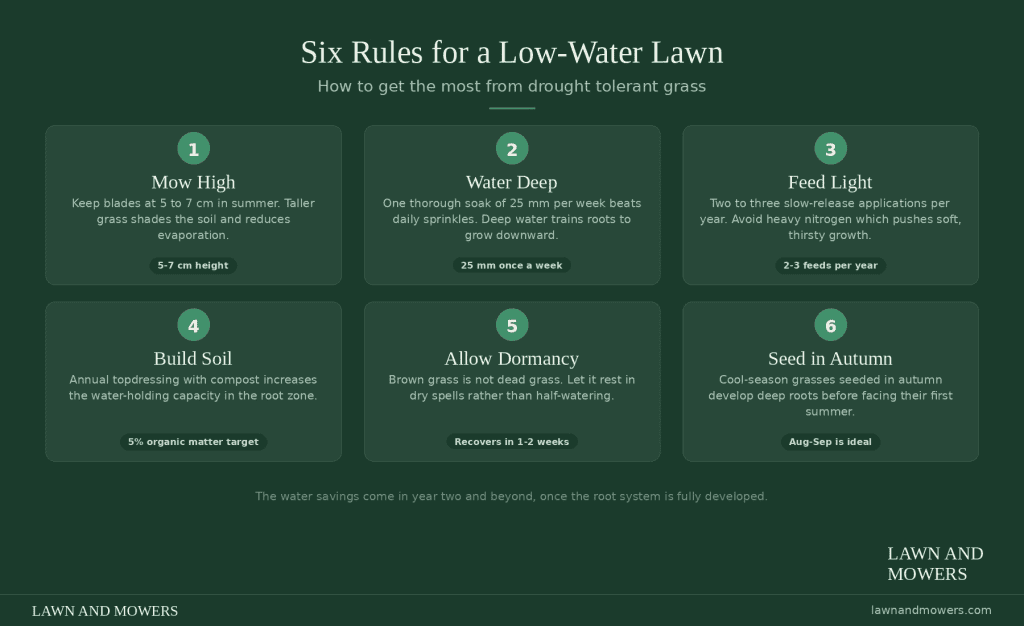
Seed in early autumn if you are planting cool-season grasses, or late spring for warm-season types. Autumn seeding gives cool-season grasses an entire winter and spring to develop root systems before facing their first summer. A lawn seeded in spring has far less time to root deeply and will be more vulnerable to drought in its first year.
Water heavily but infrequently in the establishment phase. This is one of the most valuable habits you can build. Rather than watering lightly every day, which encourages shallow rooting, give the lawn a thorough soak two to three times per week. Each watering session should deliver 20 to 25 millimetres, enough to wet the soil to at least 15 centimetres deep. Once the seedlings are established, after roughly six to eight weeks, begin extending the intervals between watering sessions. The goal is to train the roots to grow downward in search of moisture, not to sit near the surface waiting for the next sprinkle.
Maintaining a Low-Water Lawn
A drought tolerant lawn still needs care. The difference is that the care is designed to reinforce the grass’s natural ability to survive dry conditions rather than compensating for a species that was never suited to them in the first place.
Mowing Height
Taller grass shades the soil surface, which reduces evaporation and keeps the root zone cooler. For most drought tolerant species, a mowing height of 5 to 7 centimetres is ideal in summer. Bermudagrass can be maintained shorter, at 2.5 to 4 centimetres, but raising the cut by a centimetre or two in peak heat will still help. The principle is the same across all species: taller leaf blade means deeper root system and better moisture retention.
Watering Strategy
The single most effective watering practice for a drought tolerant lawn is to water deeply and less often. One thorough soak of 25 millimetres once a week is far more effective than seven light sprinkles of 3 to 4 millimetres each. Deep watering forces the roots down. Shallow watering keeps them near the surface, which is the opposite of what you want.
If water restrictions are in place, or if you simply want to reduce your usage, let the lawn go dormant rather than trying to keep it green with inadequate water. Half-watering, giving just enough to keep the surface damp but not enough to sustain growth, is the worst approach. It encourages shallow roots and fungal disease without actually keeping the grass green. Either water properly or let it rest.
Feeding
Drought tolerant lawns do not need heavy feeding. Excessive nitrogen pushes soft, leafy top growth that increases water demand. A moderate feeding programme, two to three applications per year using a slow-release fertiliser, is sufficient. Apply in early spring, early autumn, and optionally in late spring. Avoid feeding in midsummer when the grass is under heat stress. A potassium-rich autumn feed will help harden the plant for winter and improve drought resilience the following year.
Soil Health
Healthy soil holds more water. It is that simple. Annual topdressing with compost improves the organic matter content, which in turn improves the soil’s water-holding capacity. A soil with 5 per cent organic matter can hold roughly twice the water of a soil with 1 per cent organic matter, and that stored moisture is available to the grass roots between rain events. Regular aeration prevents compaction and keeps the soil structure open, allowing water to penetrate rather than running off the surface.
Common Concerns About Drought Tolerant Grass
We hear the same questions from lawn owners who are switching to drought tolerant varieties. Here are the most frequent concerns and the practical answers to each.
- It does not look as green. This is partly true. Fescues and bermudagrass tend to have a darker, more muted green than the vivid emerald of a heavily watered Kentucky bluegrass or ryegrass lawn. But a drought tolerant lawn that stays green through summer will always look better than a water-hungry lawn that has turned brown. The aesthetic gap narrows quickly once the first dry spell hits.
- It is slow to establish. Some species, zoysia and buffalograss in particular, take longer to fill in than ryegrass or bermuda. Plan for a full growing season before the lawn reaches full density. If you need quick coverage while a slower species fills in, overseed with annual ryegrass as a nurse crop. It will germinate in under a week, provide green coverage, and die off naturally as the permanent grass takes over.
- It will not handle heavy use. This depends entirely on the species. Bermudagrass and zoysiagrass are among the most hard-wearing turf grasses in the world. Tall fescue handles moderate traffic well. Hard fescue and buffalograss are better suited to lower-traffic areas. Match the species to the use, and wear will not be an issue.
- The existing lawn needs ripping out first. Not necessarily. If the existing grass is thin and patchy, you can overseed directly with a drought tolerant mix after scarifying to open up the soil surface. For a complete species change, it is more effective to remove the old turf, but a gradual transition through repeated overseeding over two to three autumns can also work. Each overseeding session introduces more of the new species into the sward, and over time it becomes the dominant grass.
- It cannot survive a real drought. No grass is truly drought-proof. Extended periods without water, beyond eight to ten weeks with no rainfall at all, will test any species. But the grasses listed here will survive conditions that would kill a conventional lawn outright. Bermuda has been documented recovering from 60 days without water. Tall fescue and hard fescue can endure four to six weeks of dormancy and return to full health once rain arrives.
Transitioning an Existing Lawn to Drought Tolerant Grass
If your current lawn is a thirsty mix of ryegrass and Kentucky bluegrass, the idea of starting again with a drought tolerant species can feel like a large project. In practice, there are two approaches, and neither requires you to strip the entire lawn.
The gradual method is the least disruptive. Scarify the lawn in early autumn to remove thatch and open up the soil. Then overseed with a drought tolerant mix at 25 to 35 grams per square metre. Tall fescue and hard fescue are the best candidates for this approach in cooler climates. Water the seed in and maintain moisture for two to three weeks until germination. The following autumn, repeat the process. Over two to three years, the drought tolerant grasses will gradually outcompete the original species, and the lawn will become progressively more water-wise.
The full renovation approach gives faster results. Kill or strip the existing turf, prepare the soil with compost and aeration, and seed the whole area with your chosen drought tolerant species. This is the better option if the existing lawn is in poor condition, heavily compacted, or dominated by weeds. It is more work upfront but gives you a clean start and allows you to address underlying soil problems that no amount of overseeding will fix.
Whichever method you choose, the first year after transitioning is the most demanding. New grass needs consistent moisture to establish, even drought tolerant varieties. The water savings come in year two and beyond, once the root system is fully developed and the grass can sustain itself through dry periods on natural rainfall alone.
Drought Tolerant Grass FAQs
What is the most drought tolerant grass?
Buffalograss is the most water-economical lawn grass available, surviving on as little as 25 millimetres of water per month once established. Among cool-season grasses, hard fescue and tall fescue are the strongest performers, tolerating four to six weeks of drought dormancy and recovering fully when watered.
Can drought tolerant grass grow in shade?
Hard fescue and creeping red fescue both handle partial shade well, making them good choices for lawns with mixed sun and shade. Bermudagrass and buffalograss need full sun and will thin out in shaded areas. Zoysiagrass tolerates light shade but performs best with at least four to five hours of direct sunlight.
Is tall fescue good for drought?
Tall fescue is one of the best cool-season grasses for drought conditions. Its root system can reach 40 to 60 centimetres deep, which allows it to access soil moisture long after shallower-rooted grasses have dried out. Modern turf-type cultivars also have a finer texture and better density than the older pasture varieties.
How often should you water drought tolerant grass?
Once established, most drought tolerant grasses need a deep watering of 25 millimetres once a week in summer, or less if natural rainfall is sufficient. In cooler months, you can often stop supplemental watering entirely. The key is to water deeply and infrequently rather than giving frequent light sprinkles.
Will drought tolerant grass stay green all summer?
With one deep watering per week, most drought tolerant species will stay green through a normal summer. In severe heat or water restrictions, they will enter dormancy and turn brown, but they will recover once conditions improve. This dormancy is a natural survival mechanism and does not harm the plant.
Can I overseed my existing lawn with drought tolerant grass?
Yes. Scarify the lawn to open up the soil surface, then overseed with a drought tolerant mix in early autumn. Repeat for two to three years to gradually shift the species balance. This is less disruptive than a full renovation and works well for lawns that are thin but not beyond repair.
Does drought tolerant grass need fertiliser?
Yes, but less than conventional lawn grasses. Two to three applications per year of a slow-release fertiliser is sufficient. Avoid heavy nitrogen feeds, which push soft growth and increase water demand. A balanced autumn feed with potassium will help harden the grass for winter and improve drought resilience.
Sources
- Royal Horticultural Society. “Drought-Resistant Lawns.” RHS Gardening Advice. https://www.rhs.org.uk/lawns/drought-resistant
- Beard, James B. “Turfgrass: Science and Culture.” Prentice Hall, 1973. Chapters on drought physiology and species selection.
- STRI Group. “Grass Species for Amenity Turf: Selection and Performance.” Sports Turf Research Institute Technical Guidance.
- University of California Agriculture and Natural Resources. “Drought Tolerant Turfgrasses for California Lawns.” Publication 8395.