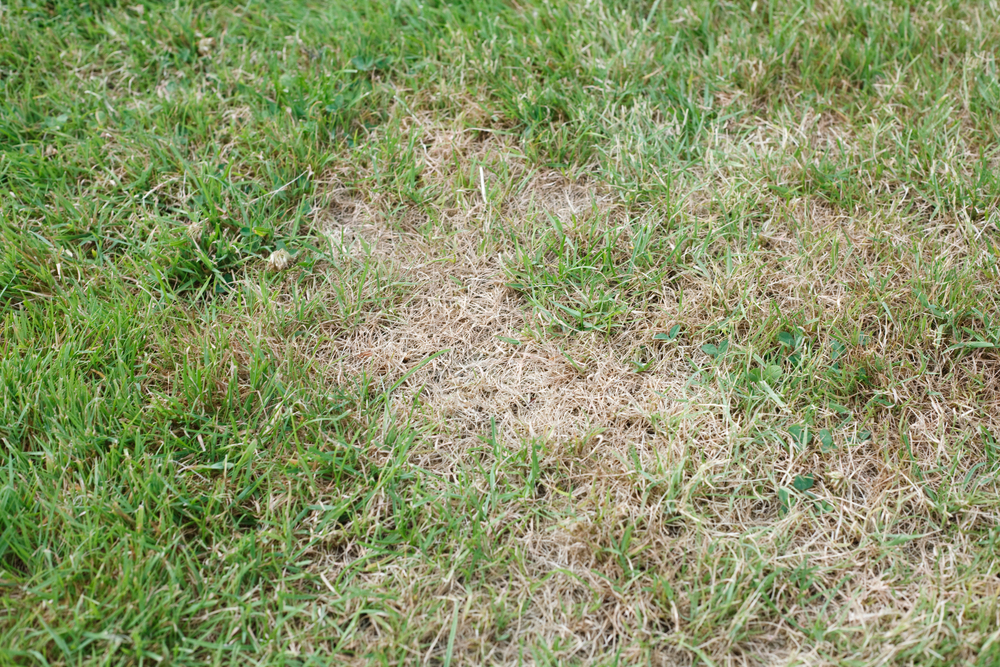
If your lawn is barely growing in May despite warm days and regular care, the problem is almost always one of three things: nitrogen has run out, the soil has stopped breathing, or your grass has started defending itself against heat. Spotting which one is happening in your garden takes ten minutes and a screwdriver, and the fix is usually cheap and fast.
May should be a peak growth month. Cool-season grasses such as ryegrass, fescue and bent break dormancy when the soil temperature at a 10cm (4 inch) depth holds above 6 to 8 degrees C (43 to 46 degrees F), and they hit maximum tillering between 12 and 18 degrees C (54 to 64 degrees F). If you cannot see fresh leaf growth between mowings during that window, the grass is telling you something specific. Walk through the diagnostic below before reaching for a feed, because the wrong fix will make a stalled lawn worse.
The Three Reasons May Lawns Stop Growing
Cool-season grasses run on nitrogen. Each blade is roughly 4 to 5 percent nitrogen by dry weight, and every clipping you remove is taking that out of the system. If you applied a spring feed in March or early April, the nitrogen window from that single dose is around 6 to 10 weeks for a quick-release granular product. By mid-May, a March feed is empty. The classic sign is uniform pale green or yellow-green across the whole lawn, slowest growth where you mow most often, and a noticeable green flush wherever the dog has urinated (because dog urine is concentrated urea, a nitrogen compound).
The second cause is compaction. Soil that has been walked on, played on or mowed when wet through April collapses the pore structure that grass roots use to breathe. Roots need oxygen as much as leaves do. When pores close, root respiration slows, water moves sideways instead of down, and the plant cannot pull up the nitrogen that is already in the soil. The test is a £3/$4 screwdriver: stand on the lawn, push the shaft straight down, and if it does not slide in to at least 12cm (5 inches) with hand pressure, you have compaction. Footprints that stay visible for more than two hours after walking and water that puddles instead of draining within ten minutes are the same signal.
The third cause appears later in May, especially in a warm spring. Cool-season grasses begin to slow voluntarily once soil temperature climbs above about 24 degrees C (75 degrees F) at a 5cm (2 inch) depth. They divert energy from leaf production into deeper root growth and reduce water loss through the blade. This is not damage, it is heat acclimation. Pushing more nitrogen at a heat-stressed lawn forces soft leaf growth that cannot keep up with water loss, and you end up with brown tips and disease pressure within two weeks.
How to Tell Which One Is Happening
Pick up a handful of soil from a stalled patch. If it is moist, dark and crumbly, nitrogen is the likely problem. If it is hard, lighter in colour and breaks into chunks, suspect compaction. If you cannot see any new leaf at the base of the plants when you part the sward with your fingers but the leaf tips are still green, the grass is in heat acclimation mode.
A quicker check is to put a square of clear plastic over a stalled patch overnight, weighted at the corners. Lift it in the morning. Heavy condensation underneath means the plant is transpiring normally and the slow growth is nutritional. Almost no condensation means the roots are not pulling water up, which points to compaction or root damage.
For a more precise answer, an inexpensive soil thermometer (around £8/$10 from Amazon or any garden centre) pushed 10cm (4 inches) into the lawn at 9am will give you the morning soil temperature. Anything between 12 and 20 degrees C (54 to 68 degrees F) and the lawn should be growing fast. Anything above 24 degrees C (75 degrees F) sustained in the morning and the slowdown is heat-driven.
The Right Fix for a Nitrogen-Starved Lawn
If the diagnosis is nitrogen, the fastest correction is a liquid feed because the plant absorbs it through both root and leaf within hours. Miracle-Gro EverGreen Fast Green Liquid Lawn Food concentrate (around £10/$13 for a 1 litre bottle treating 200m2) is a 7-0-2 NPK solution with added iron, and you will see a visible darkening of the blade within 3 to 5 days. Mix at 25ml per 4.5 litre watering can and water in evenly, or use a hose-end applicator on larger lawns. Westland Liquid Lawn Feed (around £11/$14 for 1 litre) works on the same principle at 30ml per 5 litres.
For a longer correction, a slow-release granular feed gives 8 to 12 weeks of supply. Miracle-Gro EverGreen Water Soluble Lawn Food (around £18/$23 for 2kg treating 400m2) at 35g per square metre is a 22-1-7 high-nitrogen blend that maintains colour without forcing the soft leaf growth that pure quick-release products produce. Spread with a wheeled spreader for even coverage. The reason granular feed at this rate works is that you are delivering roughly 7g of actual nitrogen per square metre, which sits within the 7 to 10g range that turf science papers cite as the sweet spot before luxury consumption (the plant absorbing more than it needs, with the excess leached into groundwater).
The mistake that kills stalled lawns is doubling the rate. Excess nitrogen in May leads to burning when the granules sit on damp leaf, and even spread correctly, an overdose pushes leaf growth so fast that the root system cannot keep up. By July you end up with a soft, shallow-rooted lawn that browns at the first dry spell.
The Right Fix for Compacted Soil
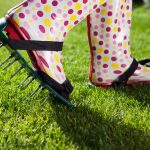
Spike aeration with a garden fork is the practical home fix for a typical 50 to 200m2 garden. Push a sturdy four-tine fork in to a depth of 10cm (4 inches), then rock the handle backwards by about 5cm to crack the soil sideways. Repeat every 10cm (4 inches) across the lawn. The Royal Horticultural Society recommends this every 2 to 3 years on average gardens and annually on heavy clay or high-traffic areas.
Solid spiking does have a known weakness. Pushing a solid tine into compacted ground forces soil sideways and can increase compaction next to the hole if the soil is too dry. The trick is to aerate when the lawn is moist but not soggy, ideally 24 hours after rain or a deep watering. The fork should come out cleanly with intact tine shape, not glazed sides.
For serious compaction across a larger lawn, a hollow-tine aerator removes plugs of soil rather than displacing them, which avoids the side-compaction problem. A petrol hollow-tine machine from a hire company costs around £45 to £90/$60 to $120 for a day, and an entire average garden takes 60 to 90 minutes to do thoroughly. Top-dress afterwards with a 50/50 mix of horticultural sharp sand and sieved topsoil, brushed into the holes to keep them open. The plugs left on the surface break down naturally within 7 to 10 days.
What to Do If It Is Heat Stress
If your morning soil temperature is already above 24 degrees C (75 degrees F), do not feed and do not aerate. Both stress the plant further. Raise the mower height to 4 to 5cm (1.5 to 2 inches), water deeply once or twice a week (15 to 20mm or 0.6 to 0.8 inches per session, enough to soak the top 15cm of soil), and accept slower growth as the correct response.
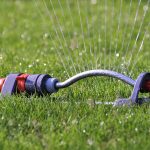
The reason the deeper, less frequent watering rule works is that grass roots follow moisture. Shallow daily watering keeps roots in the top 2 to 3cm of soil where they cook in a heatwave. A single deep soak pulls roots down to 10 to 15cm where soil temperature is 4 to 6 degrees C cooler than the surface, and the plant rides out the heat far better.
An iron-only feed such as Westland Lawn Sand (around £9/$11 for 2.5kg treating 75m2) at 30g per square metre will deepen the green colour without pushing leaf growth, which is the right move for a heat-acclimated lawn that looks pale but is otherwise fine. Iron sulphate darkens chlorophyll without the nitrogen surge that would force vulnerable new growth.
The Mistake Most Gardeners Make in May
The most common error is reaching for the highest-nitrogen feed in the shed the moment growth stalls. If the cause is compaction or heat, that feed makes the problem worse: nitrogen pushed into a lawn whose roots cannot pull up water leads to scorched leaf tips and a lawn that opens up to disease and weeds.
The second most common mistake is mowing more aggressively to “wake the lawn up.” Removing more than a third of the leaf at any one cut weakens the photosynthesis the plant uses to recover. If the lawn has stalled, drop your mowing frequency from twice weekly to once weekly until growth resumes, and raise the cut height by 5 to 10mm. Less leaf removed equals more energy for repair.
Spend the ten minutes on the screwdriver test, the soil temperature check and the soil-feel test before you spend any money on product. The right fix is usually obvious once you know which of the three things is happening underneath the green, and most stalled May lawns are growing well again within 10 to 14 days of the correct intervention.