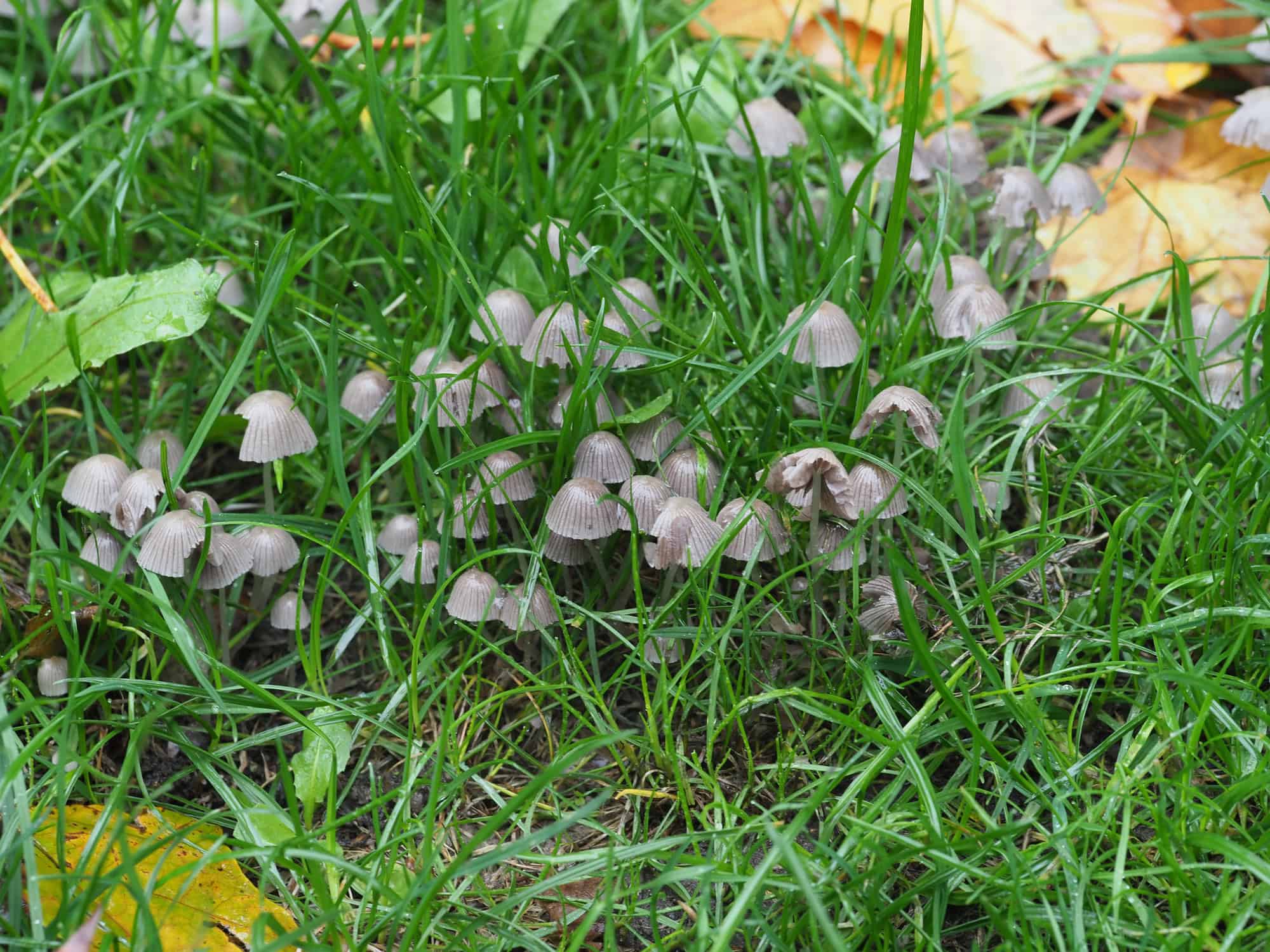
You go to bed with a flat lawn and wake up to a perfect circle of pale beige toadstools 40cm (16 inches) across, sitting in your front garden. Three days later they are gone. A week after that, a curving stripe of grass inside the ring is the deepest green you have ever seen, and a few feet outside it the grass is yellow and stressed. This is a fairy ring, and the mushrooms appearing overnight are not the problem. They are the only visible part of a fungal organism that has been living in your soil for months, possibly years, and is telling you something specific about what is happening underneath.
What Is Actually Happening When Mushrooms Appear
Mushrooms are the fruiting bodies of soil fungi. Think of them as the apples and the underground network of fungal threads (called mycelium) as the tree. The mycelium is what does the work, breaking down dead organic material in the soil and converting it into nutrients. The mushrooms only push up to the surface when the fungus has enough stored energy and the conditions are right, which usually means a sustained period of moisture combined with soil temperatures between 13 and 20 degrees Celsius (55 to 68 degrees Fahrenheit). That is why you see them in May after spring rain, in autumn after the first cold snap, and almost never in midsummer drought or midwinter freeze.
Researchers have catalogued more than 50 different species that cause visible fairy rings in domestic lawns. The most common in temperate gardens are Marasmius oreades (the Scotch bonnet or fairy ring champignon, small tan caps around 2 to 5cm wide), Agaricus campestris (the field mushroom, broader white caps with pink gills turning brown), and various puffball species. None of them are attacking your grass. They are decomposers, not pathogens.
What the Pattern Tells You About Your Soil
The shape of the ring or cluster reveals what the fungus is feeding on. A perfect circle that grows outward year on year almost always means there is a buried source of organic material at the centre: a stump from a tree removed five or ten years ago, a forgotten pet burial, deep mulch layers from a former flower bed, or builder’s rubble mixed with sawdust and timber offcuts. The fungus starts at that food source and spreads outward in all directions at roughly equal speed, eating its way through the buried material. By the time mushrooms are visible, the colony at the centre has already exhausted that area and moved to the perimeter.
Random scattered clumps that appear in different places each year usually mean general high organic content in the topsoil, often from heavy mulching with bark or from leaf litter that has been left to break down. This is benign and disappears as the easy food sources are decomposed.
A dark green inner ring with healthy grass is the most useful sign of all. As the fungus digests dead roots and woody material, it releases nitrogen, phosphorus and potassium in plant-available forms. The grass directly above this nutrient flush turns dark green and grows faster than the surrounding sward. If you are seeing this, your soil is biologically active and decomposing organic matter at a healthy rate. Most gardeners would pay for the result if they could buy it in a bag.
The Yellow Ring Just Outside, and Why It Looks Stressed
The frustrating part of fairy rings is the yellow or brown stripe of stressed grass that sits a few centimetres outside the green ring. This is the genuine problem and it is caused by hydrophobic soil. The mycelium grows so densely in the upper soil layer that it forms a thick mat, and as it digests organic matter it releases waxy compounds. Water lands on this mat and runs sideways instead of soaking in. The grass roots directly under the mat are unable to draw moisture even when you water, so the blades wilt and yellow in a curving arc that mirrors the underground colony.
You can confirm this is what you are seeing by pouring half a litre (one pint) of water from a watering can directly onto a yellow patch. If the water beads up and runs off rather than soaking in within 30 seconds, the soil is hydrophobic. On a healthy section of lawn the same amount of water will disappear into the soil in 10 to 15 seconds.
What Actually Works to Fix the Yellow Patches
Killing the fungus is almost impossible without destroying the lawn. Fairy ring fungi can live up to 30cm (12 inches) below the surface and across an area several metres wide, far beyond what any domestic fungicide can reach. Even commercial groundsmen on golf courses do not eradicate fairy rings; they manage the symptoms. The realistic approach for a home garden is to break the hydrophobic layer so water can reach the roots again.
The most effective treatment is a wetting agent. The SipcamSeven Aquatrols Revolution (the same product used on professional golf greens, around £35/$45 for a 1 litre concentrate that treats around 500 square metres) is the gold-standard wetting agent. A cheaper but still effective garden-scale option is to mix a tablespoon of unscented washing-up liquid into 5 litres (1.3 gallons) of water in a watering can and apply it generously over the affected ring. The surfactants break the surface tension of water and allow it to penetrate the waxy fungal mat.
Twenty-four hours later, deep-water the area. By deep-water I mean apply enough water that a soil sample taken 15cm (6 inches) down feels visibly moist. For most lawns this is the equivalent of 20 to 25mm (about an inch) of rainfall, which translates to roughly 25 litres per square metre. A standard garden sprinkler running for 60 to 90 minutes will deliver that. Repeat the wetting agent and deep water once a week for three weeks. The grass directly above the fungal mat will not recover until water is reliably reaching the roots.
For severe rings where the grass has already died back, hollow-tine aeration through the affected zone helps enormously. A garden fork pushed in to a depth of 10cm (4 inches) at 15cm (6 inch) spacings will physically break up the dense mycelium mat and let air, water and topdressing material penetrate. Brush a topdressing of equal parts sieved topsoil, compost and horticultural sand into the holes (a 50/50/50 mix at 5kg per square metre is the standard rate), then overseed with a ryegrass and fescue mix at 35g per square metre.
Why You Should Never Pick the Mushrooms by Hand and Compost Them
The temptation when mushrooms appear is to pick them, throw them on the compost heap, and feel you have dealt with the problem. This actually spreads the fungus. Each mature mushroom releases millions of microscopic spores into the air. Disturbing the cap shakes those spores out faster than the natural process would. Composted mushroom material then carries the spores back out across other parts of the garden when you mulch the borders.
The correct approach is to mow over them with a rotary mower set to its normal height, with the collection box on. The blades chop the mushrooms into fragments that decompose within hours, the box captures the spores, and the bag goes into general waste rather than the compost. If you do not have a mower or the mushrooms are too clustered, snip them off at ground level with secateurs, drop them into a plastic bag, and put the bag in your household waste bin.
Children and pets are the one real risk. While most lawn mushrooms in temperate gardens are non-toxic or only mildly irritating, a small number (including some Inocybe and Galerina species) are dangerously poisonous and easy to confuse with edible look-alikes. If you have toddlers who explore with their mouths or dogs who eat anything green, remove the mushrooms within 24 hours of seeing them and do not let anyone forage. The Royal Horticultural Society guidance is unambiguous on this: assume any wild mushroom in a domestic garden is toxic unless identified with absolute certainty by an expert.
The Mushrooms Are a Forecast, Not a Failure
Most gardens that produce fairy rings or scattered mushrooms in May are biologically healthy. A lawn with no fungal activity at all is usually a lawn growing on dead soil, drenched in fungicide, or built over compacted clay where nothing can break down. The mushrooms are an inconvenient symptom of an ecosystem that is working. Treat the hydrophobic patches with wetting agent, aerate the dense zones, water deeply, and the rings will eventually disappear as the fungus runs out of buried material to feed on. That can take three to five years in extreme cases, but the lawn will be steadily improving the whole time as decomposing roots and stumps are turned into plant-available nutrients in the soil underneath.