If your lawn has suddenly grown a pale, wispy haze of stalks that defy your mower and bounce back up an hour after cutting, you are looking at seed heads. From mid to late May, almost every lawn made of cool-season grasses (ryegrass, fescue, smooth-stalked meadow grass, bent) goes through the same brief reproductive surge. The grass is not dying, weedy, or starving. It is doing exactly what nature programmed it to do. The point of this article is to explain why it is happening right now, what the seed heads are telling you about how you have been treating your lawn, and the three small adjustments to mowing, feeding and watering that will pull your grass back into thick leaf growth within a fortnight.
What a seed head actually is and why it shows up in May
A seed head is a flowering stem called an inflorescence. Each green blade in a healthy sward is one tiller, and tillers normally spend their energy producing more leaf tissue and side shoots to thicken the lawn. When day length passes about 13 hours and soil temperatures sit in a moderate band (roughly 12 to 18 degrees C, or 54 to 64 degrees F), the plant receives a hormonal signal called vernalisation that flips it from vegetative growth into reproduction. Iowa State University Extension turf scientists describe this as a built-in survival mechanism: the grass wants to set seed before the heat and drought of midsummer arrive, in case conditions get too harsh for the plant to survive. Long days and moderate cool temperatures are the trigger.
That is why you see it now and not in March or August. Late May in temperate regions hits the exact combination of photoperiod and soil warmth that cool-season grasses are wired to respond to. Warm-season grasses such as bermuda, zoysia and St Augustine flower at different times because they are tuned to different climate cues.
Why your lawn looks worse for a fortnight afterwards
Seed head production is metabolically expensive. The plant pulls sugars and stored nitrogen out of its roots and lower stems and funnels them into the seed stalk. According to Michigan State University Extension, this redirection of energy means the turf often looks thin, stemmy and uneven for two to three weeks while reproduction is underway. You may also notice that the lawn looks paler than it did in early May, because chlorophyll-rich young leaves are being produced in smaller numbers while the energy budget is dominated by reproduction.
Three conditions make the seed head flush worse, and you can see them on any lawn that has been a bit neglected this spring:
- Low soil nitrogen. Lawns that received no spring feed produce more visible seed heads because the plant is in survival mode. With plenty of nitrogen available, grass stays in leaf growth longer before reproducing.
- Dry weather. A dry spring accelerates flowering. The grass senses environmental stress and rushes to set seed.
- Infrequent mowing. If you only mow once every 10 days, you leave enough time between cuts for the inflorescence to fully elongate and visibly flower above the canopy.
How to mow during the seed head flush
Set a rotary mower to 25 to 30mm (1 to 1.2 inches) for a utility lawn, or 12 to 15mm (0.5 to 0.6 inches) for a fine ornamental lawn. From late May onwards, switch to mowing twice a week if growth allows. Each pass should remove no more than one-third of the total blade length, and that becomes especially important during seed head season because every cut also lops off the developing inflorescence.
Frequency beats height. A lawn cut twice in seven days will look noticeably thicker and more uniform by the second week of June than one cut every 10 days, because each pass shaves off the seed stalks before they can bend out of the canopy. The reason this works is botanical. Once the inflorescence is removed mechanically, the tiller cannot fund a second seed stalk in the same growth cycle, and the plant reverts to leaf production. A sharp cylinder mower gives the cleanest result because it shears each stalk rather than tearing it, which reduces the brown stubble that a blunt rotary blade leaves behind.
Resist the urge to scalp the lawn in frustration. Cutting below 20mm (0.8 inches) in late May removes too much chlorophyll-bearing leaf tissue, weakens the root system, and forces the grass to use even more reserves to recover, which can paradoxically extend the seed head period and invite weeds into thinned patches.
The feed and water moves that shorten the flowering period
A late-spring feed pulled the grass back into leaf growth faster than anything else you can do. Look for a balanced product around 12-2-4 NPK or similar. Miracle-Gro EverGreen Complete 4-in-1 (around £19/$24 for 360m²) is 14-2-5 and includes mosskiller and weed treatment. If you only want feed, Westland SafeLawn (around £12/$15 for 150m²) is a gentler 6-1-3 product safe for children and pets 15 minutes after watering in. Available at B&Q, Home Depot, Amazon or most garden centres. Apply at the rate printed on the box, typically 35g per square metre, which is 1.75kg for a 50m² front lawn. Water in after 48 hours if no rain falls, because granular feed left dry on the surface can scorch in warm weather.
The reason a late-May feed works is that nitrogen drives tillering. Tillering is the production of new side shoots from each existing grass plant, and it is the primary mechanism by which a thin sward becomes a thick one. Add nitrogen to a stressed lawn at the tail end of its reproductive flush and the plants respond by switching from seed production back to leaf and tiller production within about 10 days. Without that nutrient prompt, the flowering phase drags on and the lawn stays stemmy.
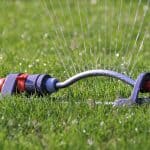
Watering follows the same logic. One deep soak per week of about 25mm (1 inch) is far better than five short daily sprinkles. A deep soak encourages roots to grow downward in search of moisture, which improves drought tolerance later in summer. Light, frequent watering trains roots to stay shallow and makes the grass more vulnerable to heat stress in July and August. Use an empty tuna tin or rain gauge to measure how long your sprinkler takes to deliver 25mm: most domestic oscillating sprinklers take 60 to 90 minutes on a single setting.
Should you ever leave the seed heads alone?
There is a niche case for letting a lawn go to seed: if you have bare patches and want a free overseed, leaving the inflorescences for 10 to 14 days lets the seeds mature, drop and germinate naturally. The Royal Horticultural Society notes that this only works reliably with bent and meadow-grass varieties that produce viable seed at a young age, and Iowa State Extension warns that most cultivated turfgrass cultivars are bred for vegetative vigour rather than seed production, so the resulting seedlings can be patchy and slow to establish. For most domestic lawns, mowing the seed heads off is the better choice, and overseeding bare patches with a proper seed mix gives a far more uniform result.
If you do choose to let it set seed, the trade-off is two to three weeks of an unkempt look followed by a flush of seedlings that take another six weeks to thicken. For a typical 50m² lawn, a 500g bag of Johnsons Quick Lawn (around £9/$11) will give better coverage in the same time and lets you go back to mowing in five days.
Common mistakes during seed head season
The biggest error is panicking and treating the seed heads as a sign of disease or weed invasion. They are neither. The second mistake is reaching for selective weed killer, which will not affect grass seed heads at all but will stress the lawn further during a delicate growth phase. The third is cutting too short, which strips photosynthetic tissue at the precise moment the plant needs maximum photosynthesis to recover from reproduction.
The correct response is the opposite of panic: mow more often, feed lightly, water deeply once a week, and the flush is over before the end of the first week of June. By mid-June the lawn looks denser and greener than it did at the start of May, because the same nitrogen and water that ended the seed head period also drove a wave of fresh tillering. The seed heads were never the problem. They were the signal that May had arrived and the grass had done its annual housekeeping.