For a small lawn, the mower that makes the most sense is often the one the gardening world has quietly moved on from: the corded electric. While attention has shifted to cordless batteries and robot mowers, a plug-in mower still cuts a small garden better, cheaper and with less fuss than anything else on the shelf. There is no battery to charge or replace, no petrol to mix or stale, no engine to service, and it starts every time at the squeeze of a switch. If your lawn is small enough to reach on a cable, the case for spending more is weaker than the marketing suggests.
Why Corded Still Wins on a Small Lawn
The biggest advantage is constant, unlimited power. A corded mower draws steady mains electricity, so it never fades the way a battery does as its charge drops, and it never stops mid-lawn because the pack ran flat. For a lawn you can cover in fifteen or twenty minutes, the trailing cable is a minor inconvenience rather than a dealbreaker, and you sidestep the single biggest hidden cost of cordless ownership: the battery. Lithium batteries lose capacity over time and typically need replacing after a few years, often at a cost of £50 to £120 ($65 to $150) each, which can approach the price of a whole new corded mower.
Corded mowers are also lighter and simpler. With no heavy battery on board and no petrol engine, they are easy to push, easy to lift in and out of a shed, and quiet enough to use early on a Sunday without annoying the neighbours. There is no oil to change, no air filter to clean, no spark plug, no winter fuel draining. The maintenance is limited to keeping the blade sharp and the deck clean. For the second number of households, easy handling and simplicity beat raw capability, and a plug-in mower delivers both at a price no petrol or cordless machine can match.
How to Read the Power and Cutting Width
Corded mowers are rated either in watts or in amps, and the two describe the same thing: how much electrical power the motor can draw, which roughly indicates how hard it can cut through thick or damp grass. In watt terms, a motor of around 1000 to 1400W suits a small to medium lawn, while 1500 to 1800W handles longer or coarser grass without bogging down. In amp terms, common in some ranges, a 10-amp motor is fine for a small lawn up to roughly an eighth of an acre, while 12 to 13 amps gives more cutting force. Higher numbers are not always better; a bigger motor on a tiny lawn is power you pay for and never use.
Cutting width decides how many passes you make. A 32 to 34cm (13 inch) deck suits a small lawn and is easy to steer around borders and obstacles. A 36 to 40cm (14 to 16 inch) deck cuts a medium lawn in fewer passes but is heavier and less nimble. Check the range of cutting heights too: a good mower will adjust from around 20mm up to 60mm (0.8 to 2.4 inches) so you can cut fine in spring and leave the grass longer through summer to protect it from drought. A single-lever height adjuster is far quicker than unbolting each wheel separately. Look as well for a folding handle, which turns a mower into something that hangs flat on a shed wall in a small garden where space is tight.
What to Buy and How to Use the Cable Safely
Among small corded mowers, a few models cover most needs. The Bosch Rotak range is a long-standing favourite for small to medium lawns and is widely available at B&Q, Argos, Amazon and garden centres, with entry models around £80 to £130 ($100 to $165). The Ryobi RLM13E-33S pairs a 1300W motor with a 33cm cut, five cutting heights from 20 to 60mm and a folding handle, ideal for a compact lawn. For the smallest spaces, a light model such as a Black and Decker plug-in with a 10-amp motor handles lawns up to about an eighth of an acre and costs less than most cordless machines. Across the board, expect to pay roughly £70 to £150 ($90 to $190) for a capable corded mower, well below the cost of a comparable battery model once you count the battery.
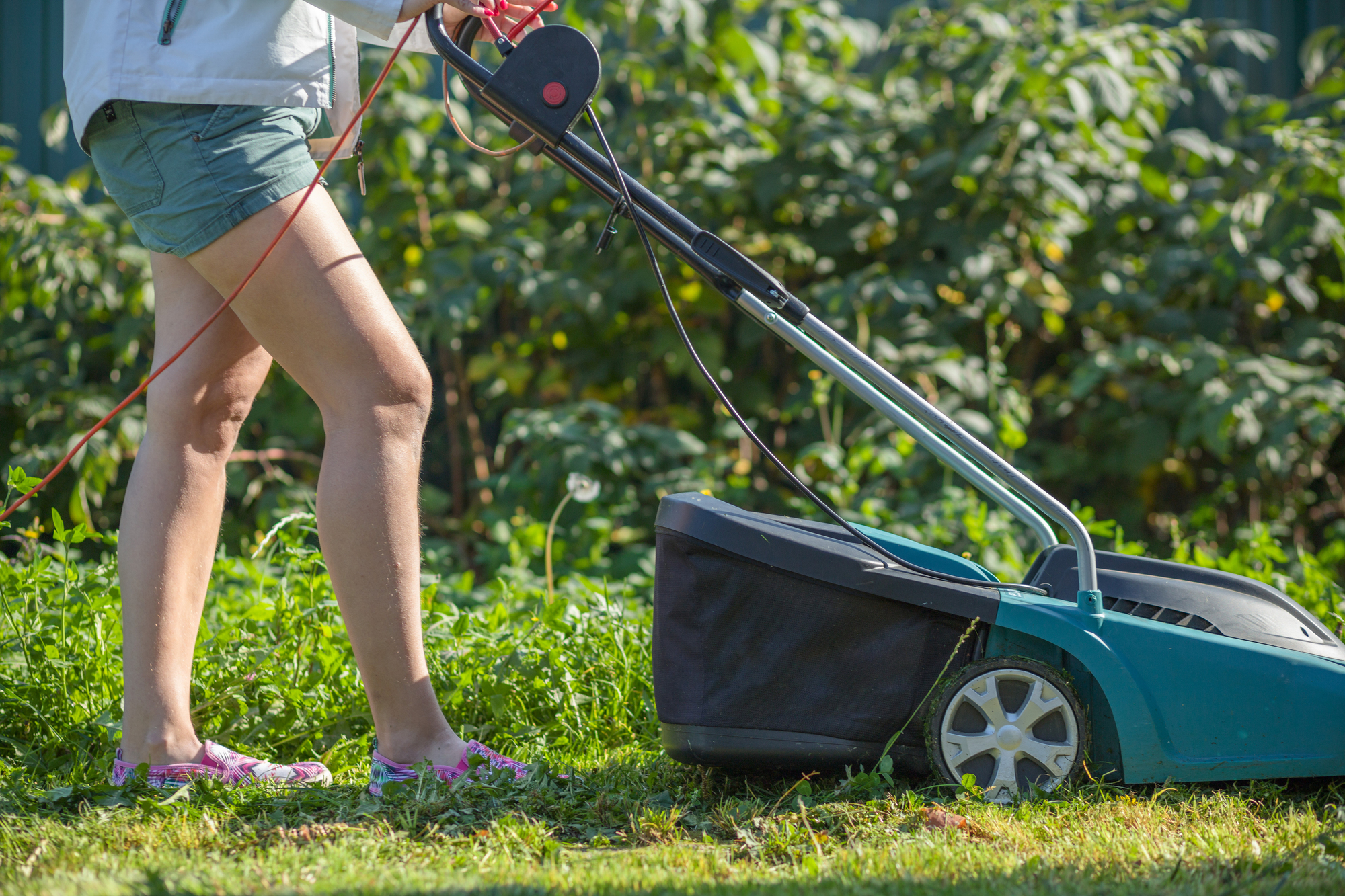
The one thing you must get right is the cable. Use an extension lead rated for outdoor use and matched to the mower, and always run it through a residual current device, an RCD plug or socket adapter, which cuts the power in a fraction of a second if the cable is cut or a fault develops. This is the safety part nobody should skip, because the commonest accident with a corded mower is running over its own lead. The simple technique that prevents it is to start at the socket end and mow away from the cable, draping the lead over your shoulder and working in stripes so the cable always trails behind you onto the cut grass, never ahead into the grass you are about to mow.
Getting the Best Cut and the Longest Life From a Plug-In Mower
A corded mower rewards the same good habits as any other machine, and a few of them matter more on a small electric model. Keep the blade sharp, because a smaller motor has less torque in reserve than a petrol engine and a blunt blade makes it work far harder. A sharp blade shears the grass cleanly, while a dull one tears and bruises the leaf tips, leaving a ragged, whitish finish that browns within a day and loses more moisture through the damaged ends. Sharpening a corded mower blade once or twice a season with a file or a bench grinder, and keeping it balanced so it does not vibrate, keeps the cut clean and stops the motor straining.
Never mow wet grass with a corded mower if you can avoid it, and not only for safety. Wet clippings clump, clog the deck and the grass box, and force the motor to push through a heavier, denser load, which on a plug-in machine means more heat in the windings and a shorter motor life. Damp grass is also where the real danger lies with electricity, so if the lawn is soaked, wait. When you do mow, take a little off often rather than letting the grass get long and then cutting it all at once, because a small motor bogs down in long growth and a deep single cut breaks the one-third rule and stresses the lawn. Cutting twice a week in the growing season, removing only a third of the blade each time, gives a better finish and an easier life for the motor.
Storage is the last piece. A corded mower has no fuel to stale and no battery to degrade, so it stores far more easily than its rivals, but it still pays to brush the clippings off the deck and out from under it before it goes away, because packed wet grass holds moisture against the metal and the blade and encourages rust. Coil the cable loosely rather than kinking it tightly, since repeated sharp bends fatigue the copper inside and are a common cause of a lead that eventually fails or trips the RCD. Hang the mower and the lead on a wall and the whole machine takes up almost no room, which in a small garden with a small shed is a real practical gain.
The honest limit of a corded mower is reach and lawn size. Most extension leads give a working radius of around 20 to 30 metres from the socket, so a large or distant lawn, or one split into sections by paths and beds, is where cordless or petrol earns its keep. A lawn full of trees, beds and obstacles can also make a trailing cable tedious to manage. But for a simple, open small lawn near the house, paying hundreds more for a battery you will replace in a few years, or a petrol engine you will service every season, buys you very little. The plug-in mower remains the quiet, sensible choice that does the job and then disappears onto a hook on the wall.