If you laid turf in the last few weeks and the joints have started to open into finger-width gaps, do not assume the turf has failed. Those gaps are almost always a sign that the turves are drying out and physically shrinking, and the cure is more water, faster, before the edges die back for good. New turf in hot weather can go from green and thick to crisp in as little as two to three days without enough moisture, so the moment you see gaps appearing is the moment to step up watering rather than wait and see. Turves that are still alive will swell back and knit together once the soil beneath them is properly wet again.
The gaps open for one reason: a turf is mostly water. The roots and soil in a fresh turf are roughly four-fifths water, and as that water evaporates in the heat the whole slab contracts, exactly the way a sponge stiffens and curls as it dries. Each turf pulls away from its neighbours, and the shrinkage shows up worst along the outer edges of the lawn and at every joint, where two dry edges sit side by side with air between them.
Why Summer Turf Shrinks Faster Than You Expect
Freshly laid turf has no anchoring roots yet. For the first two to three weeks it sits on the soil like a rug rather than a lawn, held down only by its own mass, and it draws every drop of water from the thin layer of earth it was grown on plus whatever has soaked into the ground below. In a heatwave that thin root layer dries out in hours, not days. The grass keeps transpiring water out through its blades to stay cool, the soil under it cannot replace what is lost fast enough, and the turf shrinks to match its falling water content.
Soil type makes the shrinkage sharper. Turf grown on a clay loam, or on a soil rich in organic matter, contracts more than turf on a sandy base, as clay and organic particles swell when wet and collapse when dry. The edges suffer first for a simple reason: an edge turf loses water from its cut side and from its top, so it dries from two directions at once. That is why a new lawn often looks fine in the middle while the perimeter turves have curled and pulled back a centimetre or more from the border.
There is a hard deadline built into all of this. Turf that is allowed to dry out completely can be dead within 48 to 72 hours in strong summer heat, and dead turf does not recover no matter how much you water it afterwards. Gaps are the early warning that the clock has started. Read them as a signal to act that day, not as a cosmetic fault to tidy up later.
How to Water New Turf Through a Heatwave
New turf needs far more water than an established lawn, and it needs it often. For the first two to four weeks after laying, water every day, and in genuine heat water two or even three times a day rather than once. The aim is to keep the soil moist to a depth of at least 10 to 15cm (4 to 6 inches), well below the turf, so the new roots have a reason to grow downward into damp ground. A quick surface sprinkle that wets only the grass evaporates within the hour and trains the roots to stay at the surface where they cook.
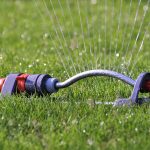
Check that you are getting water deep enough by lifting a corner of one turf and feeling the soil underneath. If it is dark and moist a finger-depth down, you have watered enough for now; if it is dry under a green surface, you have not. Water in the early morning and again in the evening when it is cooler, so less is lost to evaporation and the turf has hours to take it up before the next peak of heat. A cheap oscillating sprinkler on a timer (around £20/$25 from B&Q, Home Depot, Amazon or Argos) takes the daily grind out of it and puts the water on evenly while you are at work. Stand a straight-sided tin on the lawn and run the sprinkler until it collects about 25mm (1 inch) at each session in hot spells.
Keep off the turf while you are doing all this. Walking on soft, freshly laid turf presses the roots away from the soil and leaves dents that turn into thin patches, so water from the edges or lay a plank to stand on if you must cross it. As the gaps close and the turf stops lifting when you tug a corner, usually after two to three weeks, you can start easing back to a deep soak every few days rather than a daily flood.
Closing the Gaps That Have Already Opened
Once the turf is well watered again, many hairline gaps close on their own as the turves rehydrate and swell. For gaps that stay open, the fix is to fill them rather than force the turves back together. Brush a light, free-draining topsoil or a sandy lawn dressing into each joint with a stiff broom, working it right down into the gap until it is nearly level with the surface. The damp soil in the joint gives the grass roots on both edges something to grow across, and within a couple of weeks new shoots creep over the fill and knit the seam shut.
For wider gaps, mix a little grass seed into the dressing before you brush it in, choosing a seed that matches the turf, usually a hard-wearing rye and fescue blend for a general family lawn. Keep the filled joints damp along with the rest of the lawn and the seed germinates into the gap to speed up the join. Never try to shuffle whole turves back into place once they have rooted, as you tear the new roots and set the lawn back further than the gap ever would.
The mistakes that cost people a new lawn are all versions of doing too little too late. Watering once a day in a heatwave and calling it done leaves the turf short; assuming a rain shower counts as watering, when a summer shower rarely wets more than the top few millimetres; and letting the edges dry to a crisp while focusing on the green middle. A dead edge turf has to be lifted and replaced, at the cost of new turf and the labour to lay it, whereas a living but shrunken one costs nothing but a few extra soaks. When you are unsure whether an edge is dormant or dead, water it hard for a week; living turf greens up from the base, dead turf stays brown and lifts away in a dry mat.
Get It Through the First Month and It Is Set
The first four weeks decide whether new turf becomes a lawn or a bill. Gaps in that window are normal in hot weather and rarely fatal, provided you treat them as a call to water harder and deeper straight away, then close whatever stays open with a brushed-in dressing. Keep the soil under the turf reliably moist, stay off it while the roots take hold, and by the end of the month the turves will have rooted down, stopped shrinking and grown together into a single surface that shrugs off the heat the way an established lawn does. Mark the date you laid it, count four weeks forward, and treat everything up to that point as watering season whatever the forecast promises. The effort is front-loaded into those first few weeks, and it is the best-value work you will ever do on the lawn.