The price on the box is only the start of what a mower costs you. Run three machines of the same cutting width side by side for ten years, a corded electric, a cordless battery and a petrol, and the gap in running costs runs into hundreds of pounds, almost always with petrol at the expensive end and corded electric at the cheap end. A corded mower costs roughly 15p/20 cents to run per cut, a cordless one a little under 20p/25 cents, and a petrol mower several times that once you add fuel, oil, spark plugs and servicing. If you are choosing between two mowers with similar tickets, the running cost is the number that decides which one is actually cheaper.
None of this means the cheapest to run is the right mower for every garden. A long extension lead is no use on a paddock, and a battery that dies halfway round a large plot will drive you back to petrol regardless of the pennies. The point is to see the whole cost, buy with your eyes open, and stop paying a premium to run a machine you did not need.
What Each Type Actually Costs to Run
Start with corded electric, the cheapest to feed. A typical 1,000 to 1,400 watt corded mower cutting an average lawn in about half an hour draws a fraction of a unit of electricity. At a rate of around 29p/kWh, a single cut works out at roughly 15p/20 cents, and a full mowing season of thirty cuts costs you around £4 to £5/$5 to $7 in electricity. There is no oil, no fuel, no spark plug and almost nothing to service beyond keeping the blade sharp and the deck clean. The running cost is close to trivial; the catch is the cable, which ties you to a socket and a garden small enough to reach on a lead.
Cordless battery mowers cost a touch more per cut and carry one big hidden cost. Charging a battery pack to mow an average lawn uses a little mains electricity, usually under 20p/25 cents a cut and often far less, so day to day they are nearly as cheap as corded. The cost people forget is the battery itself. A lithium pack holds up to somewhere between 500 and 1,000 full charges, roughly three to five years of normal use, and a replacement runs from around £60 to £150/$75 to $190 depending on its voltage and capacity. Fold that into the maths and a cordless mower still comes out cheap to run, but not free, and buying a machine that shares one battery platform with your trimmer and blower spreads that replacement cost across several tools.
Why Petrol Costs the Most Over Time
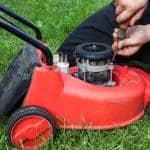
Petrol mowers are where the running costs stack up, as almost every part of keeping one going carries a price. There is the fuel, and a walk-behind petrol mower gets through roughly a litre an hour, so a season of cutting an average lawn burns a few pounds of unleaded, more on a large plot. There is engine oil, changed once a season at a couple of pounds a time. There is a spark plug every year or two, an air filter, and the servicing a four-stroke engine needs to keep starting cleanly, whether you pay a shop or do it yourself. None of these is large on its own, and together they add up to far more than a battery charge ever will.
One long-run cost comparison shows the shape of it clearly. Over ten years, a petrol push mower worked out at roughly $725 all in, counting purchase, fuel, engine maintenance and blade care, while an equivalent cordless electric came in around $506 counting purchase, electricity, a battery replacement and blade care. That is a difference of a couple of hundred dollars or pounds, and it grows the more often you mow, as fuel and servicing scale with use while a battery charge barely registers. The blade sharpening in that comparison is the one cost every type shares, so it is really fuel and engine upkeep that separate them.
Petrol carries a couple of quieter costs too. Modern pump petrol contains ethanol, which turns acidic in storage and can rot a carburettor over a winter, so a bottle of fuel stabiliser (around £8/$10) or ethanol-free fuel becomes part of the yearly bill for anyone who wants the engine to survive. And a petrol engine that is neglected, run on stale fuel and never serviced, tends to need repairs a sealed electric motor never will. The sticker savings on a cheap petrol mower can vanish into a single carburettor rebuild.
Matching the Mower to the Garden
The running costs only help once you set them against the size and shape of your lawn. For a small, flat garden within reach of an outdoor socket, a corded electric mower is the clear value winner: cheapest to buy, cheapest to run, lightest to push and almost nothing to maintain. The trailing cable is the only real drawback, and on a lawn you can cross in a couple of passes it is barely a nuisance. Spending more on petrol or battery power here is money handed over for capability you will never use.
For a medium garden, or any lawn where a cable would be a trip hazard or will not stretch, a cordless mower is usually the sweet spot. Running costs stay low, there is no fuel to store or engine to service, and a single charge covers most domestic lawns. Buy enough battery capacity to finish your lawn on one charge, or a second pack to swap in, and check the voltage and amp-hour rating rather than the headline price. A higher amp-hour figure means more minutes of cutting per charge, so a 5Ah pack covers a bigger lawn than a 2Ah one on the same machine, and it is the single number worth paying more for on a medium plot. For a large plot, a steep slope, or long wet grass that bogs a battery down, petrol still earns its place through raw stamina, and the higher running cost is the price of a machine that will not run flat with a third of the lawn left. Ride-on and larger self-propelled work often leaves no realistic alternative to a petrol engine at all.
The mistake that costs the most is buying more mower than the garden needs. A petrol machine bought for a small town lawn burns fuel, needs servicing and stores a can of volatile fuel in the shed, all to cut a patch a corded electric would handle for pennies. The opposite mistake, a cheap battery mower with too small a pack for a big lawn, ends in a half-cut garden and a machine worked so hard its battery wears out early. Size the mower to the lawn first, then let the running costs settle any close call between two machines that both fit.
Add Up the Whole Cost, Not the Ticket
Before you buy, do a rough sum over the years you expect to keep the machine. Take the purchase price, add the fuel or electricity for your number of cuts a year, add oil, plugs and servicing for petrol or a battery replacement for cordless, and add blade sharpening for all of them. The answer that emerges is usually the reverse of the shop shelf: the petrol mower that looked like good value on price often costs the most to own, while the plain corded electric that looked basic turns out cheapest by a distance on a small lawn. Work out the true cost over its whole life, set it against the size of your garden, and buy on that number rather than the one on the shelf edge. Do that and the mower will look after your money and your grass in equal measure.