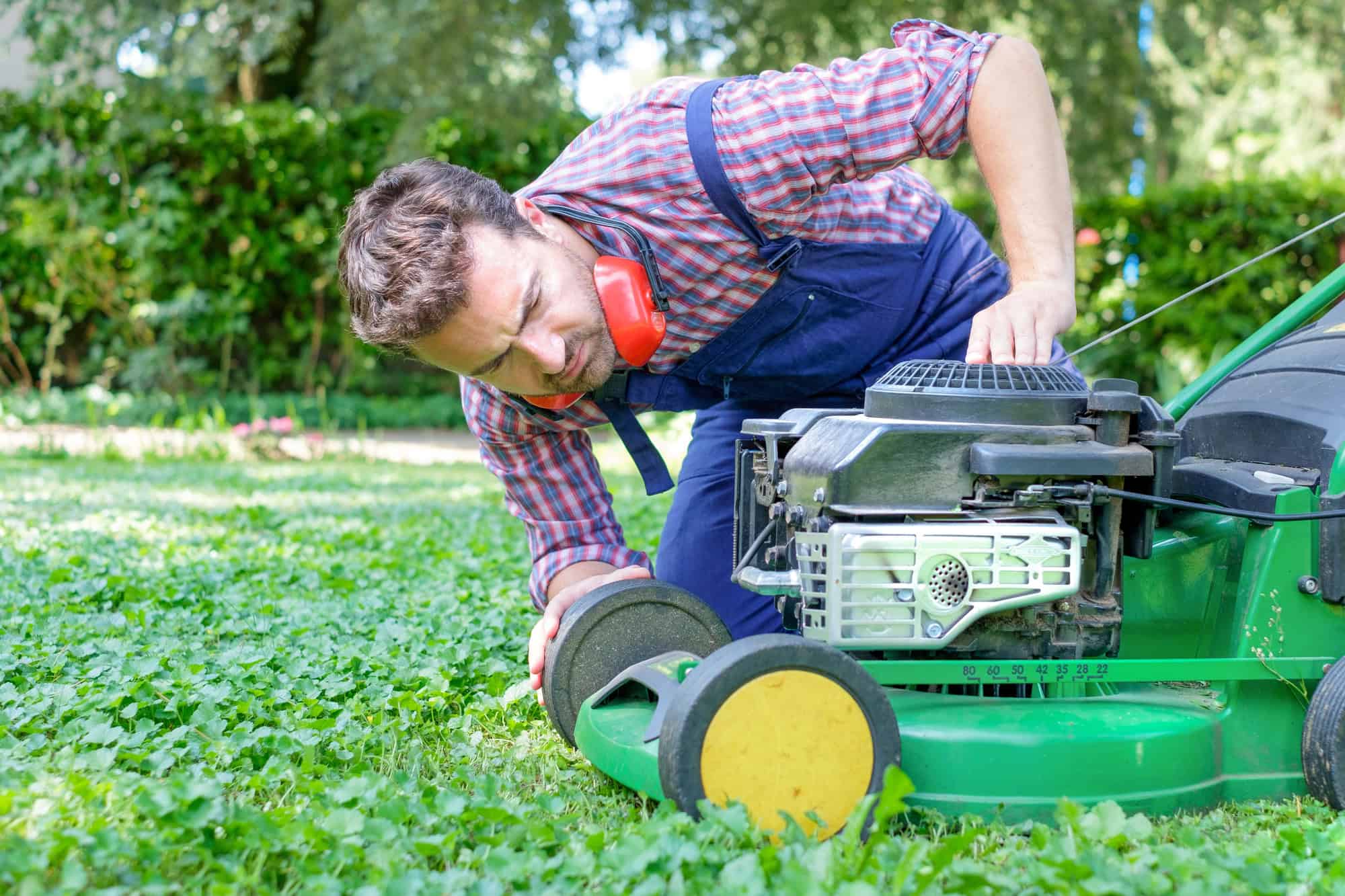
A self-propelled mower that has stopped pulling itself is one of the most common late-season complaints, and it almost always strikes now, when thick, damp growth puts the drive under the heaviest load of the year. Most people reach straight for a new drive belt. In practice the belt is often fine, and the real fault is a control cable that has stretched over a season of use, a fix that costs nothing and takes a few minutes with a screwdriver. Here is how to find which part has actually failed and put the drive right, whichever it turns out to be.
Before you touch anything, pull the spark plug wire off the plug and let the engine go cold. A walk-behind mower cannot start with the lead disconnected, and that one step keeps your hands safe while you work near the blade and the drive.
First, work out which part has failed
The drive on a self-propelled walk-behind runs in a chain. The engine turns a drive belt, the belt turns a small gearbox or transmission, and the transmission turns the drive wheels. A thin steel cable links the drive bar on the handle to that transmission, so squeezing the bar engages the drive and releasing it lets the wheels roll free. A fault anywhere along that chain shows up the same way at the handle: you squeeze the bar and the mower will not pull.
Run through the chain in order. Squeeze the drive bar slowly and watch how far it travels before the wheels start to grip. If the drive only bites when the bar is almost shut against the handle, or not at all, the cable has most likely stretched. If the drive engages normally but the mower crawls and the belt squeals or smells hot when you push into long grass or up a slope, the belt is slipping. If the drive engages and the wheels spin freely on damp grass without moving the mower, the fault is traction rather than the drive. Tip the mower up with the air filter and carburettor side pointing up, so oil and fuel cannot run into the carburettor, and look underneath for grass packed around the drive pulleys, which can jam the whole system.
The low-cost fix most people miss: adjusting the drive cable
Roughly four out of five drives that “lose the belt” have actually lost cable tension. Here is why. The control cable has an inner steel wire running through an outer housing. Over a season the inner wire stretches a fraction and the outer housing beds down at its end stops, and those two small changes add up to slack. That slack means squeezing the drive bar no longer pulls the transmission fully into engagement, so the drive slips or does not catch until the bar is right at the end of its travel. The belt and the gearbox can be in perfect health while the mower still refuses to pull.
The cure is the barrel adjuster. Almost every self-propelled mower has a small threaded barrel where the cable meets the handle, or lower down where it meets the transmission. It looks like a short metal or plastic sleeve with a lock nut. Loosen the lock nut, then turn the barrel to lengthen the outer housing by a few turns. Lengthening the housing takes up the slack in the inner wire, so the drive engages earlier in the bar’s travel. Turn it a little, test by squeezing the bar, and repeat until the drive bites cleanly when the bar is about halfway closed. You want the drive fully engaged with the bar held shut and fully released when you let go. Do not overtighten, as a cable pulled too tight keeps the drive partly engaged even at rest, which drags the mower and wears the transmission. Once it feels right, hold the barrel and nip the lock nut back up.
If the cable is stiff, kinked or frayed rather than simply slack, adjustment will not save it. Drip a little light machine oil or a spray lubricant such as 3-IN-ONE or WD-40 down the housing to free a stiff cable, and work the bar to draw it through. A cable that is kinked or has broken strands needs replacing, and a new drive cable runs about £8 to £14 ($10 to $18) at Amazon, Screwfix or the parts counter at Home Depot and Lowe’s. Match the part number to your model, as cable lengths and end fittings vary from mower to mower.
When it really is the belt
Sometimes the belt is the problem. A drive belt carries power from the engine output shaft to the transmission, and like the fan belt on a car it dries out and stretches with age and heat. A stretched or glazed belt grips well enough on flat, dry grass but slips the moment you ask it to work, which is why belt faults show up first on slopes and in the thick growth of late summer. A slipping belt often squeals and gives off a hot rubber smell, and if you leave it slipping it glazes to a hard shine and burns out faster, so it pays to sort it early.
Tip the mower up, air filter side up, and look at the belt where it runs around the pulleys. Cracks, a shiny glazed surface, fraying edges or obvious stretch all mean it is time for a change. Clear any packed grass from the pulleys while you are there, as a wad of dried clippings around a pulley mimics a worn belt by stopping it seating properly. When you fit a replacement, buy a belt of the same length and part number as the one you take off. A too-long belt slips and a too-short one will not fit over the pulleys or will wear out in weeks. A new drive belt costs about £8 to £20 ($10 to $25) depending on the model, and swapping it is usually a matter of freeing the belt from the engine pulley, then the transmission pulley, and reversing the process with the new one.
When the drive works but the wheels still spin
If the drive engages properly and the belt is sound, but the wheels spin on the spot on damp grass, the fault has moved to the tyres. The moulded lugs on plastic mower wheels wear smooth over a few seasons, and smooth wheels cannot bite into wet turf, so the drive turns them and they slide. This is most obvious on a slope or first thing in the morning while dew is still down.
There is a neat and long-standing trick for worn wheels. Drive a few self-tapping sheet metal screws with hex-shaped heads into the tread of each drive wheel so the heads stand a couple of millimetres proud, and they act like the studs on an off-road tyre, cutting through the wet film to grip. A small box of hex-head self-tappers costs about £4 to £7 ($5 to $9). If the wheels are badly worn or the teeth are stripped inside the wheel where the drive gear meets them, new wheels are the better answer.
Balance can rob a front-wheel-drive mower of grip too. When the grass bag fills, the mower’s centre of balance shifts back and lifts the front drive wheels slightly, so they lose contact and spin, and the same happens going uphill or over uneven ground. Emptying the bag more often restores the grip on a front-drive machine, and if you mow a lot of slopes, a rear-wheel-drive mower keeps its traction far better as the mass stays over the driven wheels.
Keep the drive healthy through the season
A drive that gets a little attention rarely leaves you stranded mid-mow. A few drops of machine oil on the wheel axles and the cable ends keep everything moving freely, and a quick spray down the cable housing once or twice a season stops the inner wire seizing. Clear the packed grass from around the drive pulleys whenever you clean the deck, as that debris is the quiet killer of belts and pulleys. Check the drive-bar travel every few weeks and take up any new slack at the barrel adjuster before it turns into a no-drive fault.
Late summer is the right moment for this check. The drive is working its hardest in heavy, damp growth, and a marginal belt or a stretched cable that coped all spring will finally give up now, right before the leaf-mulching weeks of autumn pile on more load. Fifteen minutes spent with the barrel adjuster and an oil can keeps the mower pulling through to the last cut of the year.
So work the chain in order. Disconnect the plug lead, squeeze the bar and watch where the drive bites, and start at the cable adjuster, as that is the cheapest and most likely fix. Move on to the belt if the drive engages but slips, and check the tyres and the bag balance if the wheels spin. In most cases the mower is pulling again before you have even opened the parts catalogue.