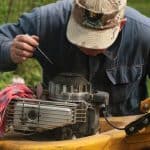
Few things kill the momentum of a Saturday mow faster than a cloud of smoke rising off the engine. It looks alarming, and it is easy to fear the worst. The good news is that a smoking mower is usually simple to diagnose, and the colour of the smoke tells you almost everything you need to know before you pick up a spanner.
One rule comes before all the others. “First and foremost, if your mower begins smoking after starting, turn it off immediately,” says Shawn Carothers, a manager at Toro. “While seeing smoke can be alarming, taking immediate action to diagnose the issue will help you avoid any serious problems.” Shut the engine down, let it cool, then work through the colours below.
White smoke: oil burning off the outside of the engine
White smoke almost always means oil has reached somewhere hot that it should not have. On a four-stroke walk-behind mower, the oil lives in a sealed sump beneath the engine, kept apart from the fuel and the combustion chamber. Tip the machine the wrong way to clean the deck or swap the blade, and oil sloshes out of the sump and onto the muffler, cylinder head or air filter. The next time the engine runs and heats up, that stray oil burns off as pale white smoke.
Overfilling the sump does the same thing. Pour in more oil than the dipstick calls for and the excess is forced up past seals and out onto hot metal. As the Family Handyman guide explains, white or blue smoke usually means oil “has gotten into somewhere it’s not supposed to be.” A recent tip to swap the blade, or an overfilled sump, are the two everyday triggers.
The fix is reassuringly easy. Let the engine idle for a few minutes and the smoke often clears on its own as the spilt oil burns away. If it keeps going, pull the dipstick and check the level against the full mark. Too high, and you drain a little back out through the drain plug or siphon it from the fill tube until the reading is correct. Wipe any oil residue off the muffler and shroud so it stops smoking on the next start.
Which way to tip a mower. This one detail prevents most white-smoke scares. Always tilt the machine with the spark plug and carburettor facing up, air filter side high. That keeps oil in the sump and away from the intake. Tip it the other way and you flood the filter and cylinder with oil.
Blue smoke: oil burning inside the engine
Blue-tinged smoke is a more serious relative of white. It points to oil getting past the engine’s internal seals and burning in the combustion chamber alongside the fuel. In a healthy engine, piston rings and valve stem seals keep oil in the sump and out of the cylinder. Once those parts wear, oil seeps through on every stroke and burns with the fuel, and the exhaust turns a faint blue.
Start with the same checks as white smoke, as an overfill or a recent tip can also read blue at first: confirm the oil level, and make sure you used the correct grade for the engine, typically an SAE 30 or a 10W-30 (a bottle runs about £8 to £14 / $10 to $18). If the level is right, the oil is correct and the blue smoke persists after a good warm-up, worn rings or valve seals are the likely cause. That is a bigger job, and on an older or cheaper mower the repair can cost more than the machine is worth, so balance the cost of the repair against a new machine before you commit.
Blue smoke paired with the engine running hot deserves a second look at cooling and airflow too. Our guide to a mower that cuts out in late-summer heat covers the clogged parts that push engine temperatures up.
Black smoke: too much fuel, not enough air
Black smoke is a different problem altogether. It signals a rich mixture, meaning the engine is getting too much fuel and not enough air, so the surplus fuel leaves as sooty, unburnt carbon. “You’ll know that this is the cause if your mower is smoking black, which means that it has too much fuel and not enough air is getting in,” explains Ionel Giuran, a lawn care expert with Fantastic Gardeners.
The usual offenders, in the order worth checking:
- A clogged air filter. This is the single most common cause. A filter choked with grass dust and oil throttles the airflow, so the mixture runs rich. Pull it out, and either clean a foam filter in warm soapy water and dry it fully, or drop in a new paper element (£5 to £12 / $6 to $15). This alone clears most black smoke.
- A stuck choke. A choke lever that has not returned to the run position keeps the mixture deliberately rich. Check it has moved fully off.
- A maladjusted or dirty carburettor. If the filter and choke are fine, the carburettor can be metering too much fuel. A clean or an adjustment sorts it.
- Poor-quality or stale fuel. Old petrol that has gone off over the winter burns badly and can smoke. Drain it and refill with fresh.
Black smoke is the one to respect most. “Black is the worst of the smokes,” warns Kody Ketterling, a lawn expert and founder of K-IT Products. “A lot of times, the black smoke means you need to take it to a mechanic to be corrected or fixed.” At that level, the damage he describes runs to a blown head gasket or a failed cylinder or rod. So if the filter, choke and fuel all check out and the black smoke keeps pouring, stop and get it looked at rather than running the engine on.
Smoke from an electric or cordless mower
Everything above assumes a petrol engine. An electric or battery mower has no oil to burn, so smoke from one is a different, urgent matter. It points to the motor burning out or a belt or other part overheating. Giuran’s advice is to stop straight away: “If you’re not exactly sure which one’s the reason for the smoke after careful examination, it’ll be safest to call and consult with a repair specialist.” Do not keep running it. An overheating electric motor or a swelling battery is a fire risk, so disconnect the power or pull the battery pack and let it cool well away from anything flammable.
How to stop your mower smoking in the first place
Most smoking traces back to a handful of habits, and fixing them keeps the engine clean for years:
- Never overfill the oil. Check the dipstick and stop at the full mark. More is not better; it is the fast route to white smoke.
- Use the oil grade the manual specifies, usually SAE 30 or 10W-30, and change it on schedule. Fresh, correct oil burns clean.
- Tip the mower the right way, spark plug up, whenever you clean the deck or change the blade.
- Service the air filter and spark plug. A clean filter and a good plug (£3 to £7 / $4 to $9) keep the fuel-to-air mixture where it should be. Clean or replace the filter at least once a season.
- Keep the blade sharp. As Ketterling notes, sharp blades stop the mower “working harder than it needs to,” which keeps the engine load and running temperature down. A labouring engine is more likely to smoke.
One last note on what is normal. A brief puff of smoke as you start the engine, or a wisp while mowing across a slope, is nothing to worry about, as a little oil shifts and burns off. Carothers draws the line clearly: a large plume, or smoke that keeps pouring out, points to a real problem that needs fixing. Read the colour, work through the checks in order, and most smoking mowers are back cutting cleanly the same afternoon. A mower that also rattles and shakes has a separate issue worth chasing down in our guide to why a mower vibrates more at the end of summer.