- The black-green jelly and green film appearing on wet lawns are algae and a jelly-like organism called Nostoc, and they take hold only where the grass has already thinned and the ground stays wet.
- Skimming the growth off with a spade clears it in minutes as it has no real roots, but it comes straight back unless the shade, compaction and poor drainage that invited it are dealt with.
- Spiking the soil, easing off the wet lawn with your feet and letting more light reach the grass turn the conditions back in the lawn’s favour, with no chemicals needed.
If There Is Black-Green Jelly on Your Lawn, the Slime Is Not the Real Problem
You walk across the lawn after a wet week and the grass is slick underfoot, with patches of what looks like dark green or almost black jelly spread over the thin, bare areas. Scrape at it and it peels off in cold, rubbery sheets. It is unpleasant, it is slippery, and the instinct is to reach for something to kill it. Hold off. The slime is a symptom, not the disease. Clear it the wrong way and it is back within a fortnight. Deal with what let it grow and it has nowhere to return to.
The quick fix and the lasting fix are two different jobs. Lifting the growth off takes a few minutes. Stopping it coming back is the part that protects the lawn, and it is the part most people skip. Both are below, and neither needs a chemical.
What the Slimy Green Jelly Actually Is
Most of what appears on a wet lawn in autumn falls into one of a few groups, and telling them apart helps you judge how worried to be. The dark, rubbery jelly is usually Nostoc, which the RHS describes as a jelly-like bacteria. Wet, it swells into greenish-brown gelatinous blobs across the surface. Dry, it shrinks to a dark, crusty flake you could lift with a fingernail. It has been on the planet far longer than grass has and it asks for very little: bare ground, light and water.
Alongside it you might see a plain green film or a fine powdery green deposit over the thin, sparse patches. That is algae, simple plant-like growth that spreads fastest in shade with still, damp air. Flattish grey, brown or green scales lying over the turf, crusty and paler when dry, are lichens, most often the dog lichens of the Peltigera group. A flat green sheet with no proper leaves is a liverwort, which settles on damp, compacted, shaded soil. One more to know by sight so you do not panic over it: a sudden white, yellow or orange frothy mass, sometimes called dog vomit fungus, is a slime mould. It looks far worse than it is, sits on top of the grass without attacking it and fades on its own once the weather dries.
None of these is a lawn disease in the ordinary sense and none is poisoning the grass. The real harm is twofold. On any path, step or slope that gets walked on, a film of wet Nostoc or algae is properly slippery and worth clearing for safety alone. And across the lawn, a spreading mat of slime shades and smothers the thin grass that is left, so the few healthy plants clinging on lose ground to it.
Why It Has Appeared on Your Lawn and Not Your Neighbour’s
Algae, Nostoc and the rest are opportunists. They cannot muscle into a thick, healthy sward. A dense lawn shades its own soil surface, drinks the rain and dries quickly after it, which leaves no bare, bright, permanently wet ground for slime to colonise. When the green jelly turns up, it is reading you the exact conditions it found: the grass cover has thinned, light is reaching the soil, and that soil stays wet for days. The RHS makes the point plainly, noting that the presence of these growths shows the growing conditions are not right and the grass is likely struggling already.
Three conditions do most of the damage, and they usually work together. The first is shade. A lawn under trees, beside a north-facing fence or in the lee of the house gets less light and less moving air, so the surface never properly dries. The second is compaction. Soil that has been walked over all through a wet autumn, or heavy clay that packs down on its own, loses the air gaps that roots and drainage depend on. The third is poor drainage and waterlogging, which the RHS links directly to algae, moss and fungal trouble. Water that cannot sink away sits on a hard, airless surface, and that standing film is exactly what Nostoc and algae need. Put a shaded, compacted, badly drained corner together and you have built the perfect home for green slime without meaning to.
How to Clear What Is There Now
The good news is that the clearing itself is easy, as none of these growths has a true root system anchoring it down. Slide the edge of a spade or a flat shovel just under the growth and skim it off the surface. It lifts away in sheets with almost no effort and takes none of the soil structure with it. Where the Nostoc has dried to dark crusts, a stiff brush will lift most of it. Drop whatever you remove into a home compost bin or the green waste collection rather than leaving it heaped at the lawn’s edge to wash back.
That leaves the bare patches the slime was sitting on. In autumn there is still time to sow into them before the cold sets in. Loosen the top of the soil with a fork, work in a little sandy top dressing to lift the surface clear of the wet, and sow a shade-tolerant grass seed mix at the rate on the bag. A mix blended for shade and damp, around £10 to £18 per kilogram ($13 to $23) at B&Q, Wickes or Amazon, has a far better chance in these corners than a standard sun-and-hardwearing blend. One honest caveat from the RHS: reseed without fixing the drainage and the slime, and before long the bare patch, will be back. The seed buys you time; the next section buys you the lawn.
How to Stop It Coming Back
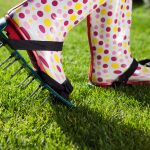
Every lasting fix comes down to the same aim: get air and light into the ground and get the water out, so the grass can thicken and crowd the slime out itself. Start with aeration. Drive a garden fork straight down to about 10cm (4in) and rock it gently to open the holes, working across the worst areas at roughly a boot’s width apart. On heavy, badly compacted ground a hollow-tine aerator, which pulls out small cores of soil rather than just slitting it, does far more and costs about £20 to £40 ($26 to $52) at Screwfix or Amazon. The spiked strap-on aerator shoes sold cheaply online barely reach the surface and are not worth the money for this job.
Follow the aeration with a light top dressing of sandy loam brushed into the holes, roughly a bag of 20 to 25kg (£8 to £12 / $10 to $16) spread thinly over a few square metres. This keeps the channels open, lifts the surface a little further above the wet and improves how fast the top layer drains over the seasons that follow. Worms do the same work for free, pulling organic matter down and leaving air behind them, which is one reason a lawn full of worm activity rarely grows slime.
Then take the pressure off. Staying off the lawn while it is wet, heavy clay above all, stops you grinding the air back out of the soil you have just opened. Let more light and moving air reach the problem corners by lifting the lower branches of nearby trees or thinning out a dense shrub, which dries the surface and tips the balance back to the grass. Where a part of the lawn sits under water after every downpour, proper drainage is the real answer, though the RHS is honest that this is a major job and finding somewhere for the surplus water to go is rarely simple. If one dank, shaded strip defeats every attempt, the sensible move is to stop fighting it and plant it with shade-and-damp ground cover that wants those conditions, leaving the grass to the parts of the garden that can actually grow it. Fix the air, the light and the water, and the green jelly loses the only lawn it could ever have taken.