
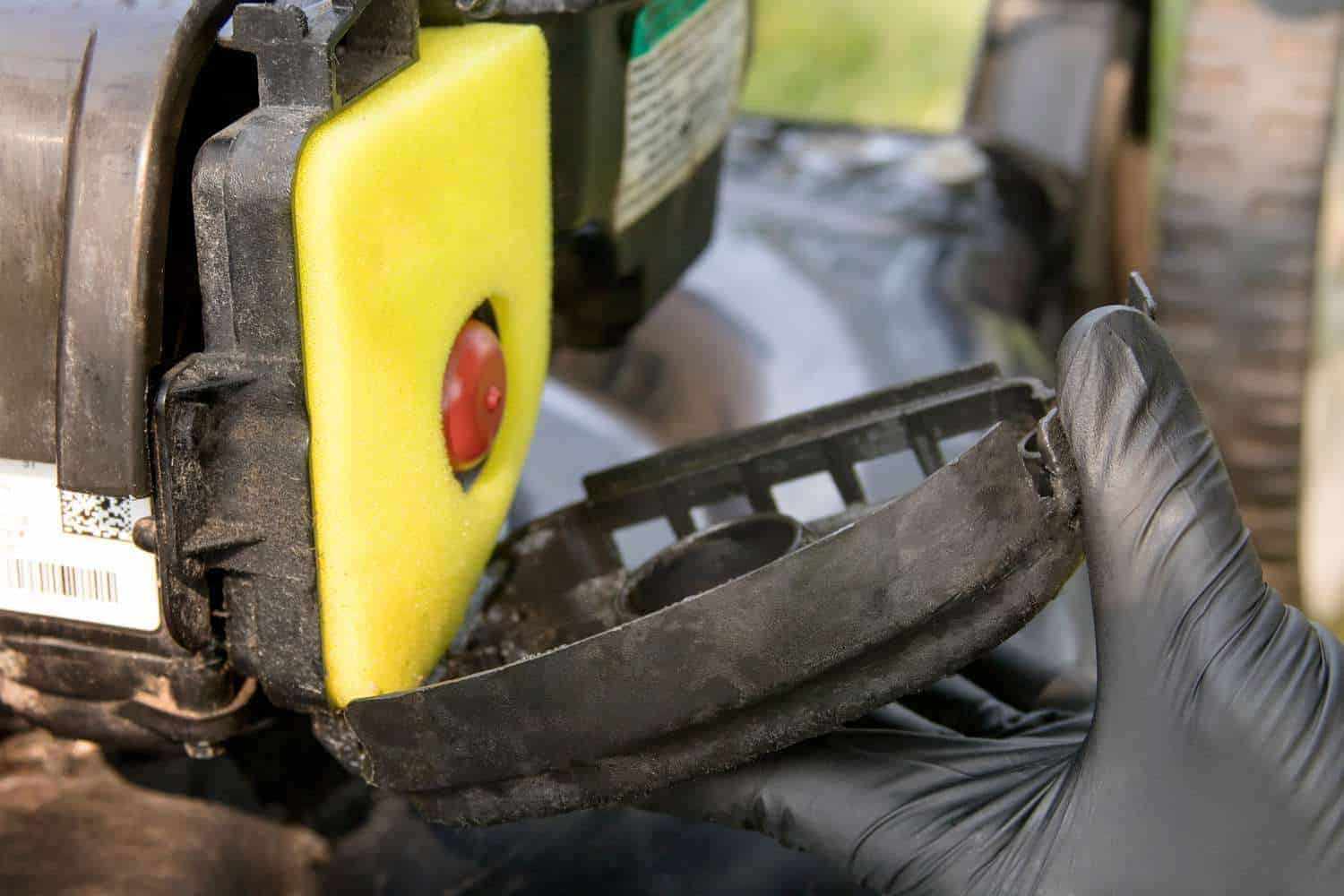
- A mower that drags on the pull cord, fires on the fifth or sixth go and then drinks petrol has usually been choked by a clogged air filter, and a new one costs only a few pounds.
- Pull the pleated paper filter out of the housing on the side of the engine; if it has gone grey-brown or sheds dirt when you tap it, clean or swap it before you touch anything else.
- If a clean filter, a fresh spark plug and fresh petrol still leave it hard to start, the carburettor or the oil is the next thing to check, and only then is it worth a repair bill.
Why a Starved Engine Burns More Petrol, Not Less
A small petrol engine runs on a fixed recipe of air and fuel. Choke off the air with a blocked filter and the mix turns rich, meaning too much petrol for the trickle of air getting through. That is the reason a mower with a clogged filter is hard to pull over, coughs black sooty smoke and empties the tank faster than it should. The fix most owners walk past is the cheapest, and it is the first one a mechanic reaches for. “The engine has to breathe,” is how one small-engine repair expert, Lee, puts it to This Old House. Pull the filter and look at it before you spend a penny on anything else.
What the hard starting is telling you
Read the symptoms before you reach for a spanner. A mower starved of air is hard to start, needs many pulls, runs rough and stalls when it hits thicker grass, and the exhaust shows black, sooty smoke. The spark plug fouls with soot, and the fuel level drops faster than usual. All of that points one way: too much fuel, too little air.
One thing is worth separating out, as it sends people to the wrong part. Black, sooty smoke means a rich mix and an airflow or fuel problem. Blue or white smoke is a different fault, caused by engine oil burning in the cylinder, and no amount of air-filter work will cure that. Getting the colour of the smoke right at the start saves you stripping down the wrong thing.
Check the air filter first
Start by pulling the spark plug wire off the plug so the engine cannot fire while your hands are near it. Then find the air filter housing, a rectangular plastic box on the side of the engine, often on the left. Unclip or unscrew the cover, usually held by one or two screws, and lift out the element inside.
Now read the filter. A new pleated paper element is white or light blue, and a little discolouration is normal. If the colour has darkened all the way through, or the paper sheds dirt when you tap it against a hard surface, it needs cleaning or replacing. A filter that is clogged solid is better replaced, as it is cheap: a paper filter to fit a common engine such as a Briggs and Stratton runs about £7 to £10, or $9 to $13, at Screwfix, Amazon or Home Depot. Filters are not interchangeable between mowers, so match it to your machine by its model number, searching along the lines of “Toro push mower 21445 air filter” and checking the listing names your mower.
To clean a paper filter rather than replace it, tap it on a hard surface to knock the loose dirt out, then blow it through with an airline or a compressor, working over both faces and down between the pleats. “Just blow it out, you could, if you want it, or you could just get a new one,” as Lee tells This Old House. Refit a paper filter with the pleated edges facing outward. If your mower uses a foam filter instead, wash it in warm soapy water, let it dry fully, then work a little clean engine oil through it and squeeze out the excess; that thin film of oil is what traps the dust. While the housing is open, clear any clippings from the cooling fins with a screwdriver or a lolly stick so the engine can shed heat.
Check the filter at least once a year and replace it at least once a season, which is what most engine makers ask for. A filter kept clean often lasts two seasons. Skip it, and the cost is not just wasted petrol: a rich-running engine fouls its plug, runs hot, and over time washes the oil film off the cylinder bore, which wears the engine out early. A part that costs the price of a sandwich protects one that costs hundreds.
If a clean filter does not fix it
Move to the spark plug next. A worn or soot-fouled plug makes an engine hard to start and rough to run. Replace it every 25 to 50 hours of use, at the start of each season, or whenever it is more than three years old, whichever comes first. Pull the wire, undo the old plug with a deep socket, set the gap on the new one to the figure in your handbook, thread it in by hand so you do not cross the threads, then nip it up with the socket without heaving on it. A mower plug costs about £4 to £6, or $5 to $8.
Then the fuel. Petrol left standing goes stale and, where it contains ethanol, draws in water, and both gum up the carburettor and make an engine run rough. Equipment shop owner Craig Murray, talking to This Old House, warns against leaving cans of petrol standing, as the fuel draws in water over time and that is what makes an engine run rough. Buy about a month’s worth of petrol at a time, add a stabiliser such as Briggs and Stratton Fuel Fit or STA-BIL (about £10, or $12, at Amazon or B&Q) if the mower will stand for 30 days or more, and run the tank dry before the machine goes away for winter. One quick test: lift the filter out, trickle about a teaspoon (5ml) of fresh petrol straight into the carburettor throat, refit the filter, switch on and pull. If it fires and then dies, fuel is not reaching the engine and the carburettor is the culprit.
Check the oil while you are there, not as a starting cure but to save the engine. Read it cold, on level ground. “When the engine’s cold, all the oil is drained down. You’re getting a proper reading,” landscaper Roger Cook tells This Old House. Run it too low and the damage is not small. “You could actually seize the engine, blow it up,” Cook warns. If the oil on the dipstick looks dark and dirty, change it: tip the mower with the air filter facing up, drain the old oil into a sealable container, top up slowly with the grade your handbook lists, and take the old oil to a recycling point.
When to stop and call someone
Work through the cheap fixes in order and most hard-starting mowers come good. A clean or new air filter, a fresh plug, fresh fuel and a quick carburettor check add up to about £15 to £30, or $20 to $40, in parts, and an hour or two of your time. That is the whole job for most machines.
Stop when the teaspoon test shows the engine fires and dies. That points at a carburettor that needs stripping and cleaning, or a deeper fault with compression or a valve, and those are the jobs worth handing over. A workshop carburettor clean or valve repair runs several times the cost of the parts above, so weigh it against the mower. On a machine more than about eight to ten years old that needs a carburettor rebuild, the money is often better put toward a replacement than a repair.
