

Perennial ryegrass (Lolium perenne) is the single most prevalent grass species in British lawns. Found in an estimated 70 to 80 per cent of domestic seed mixes sold in the UK, it accounts for the bulk of what grows underfoot in gardens from Cornwall to Aberdeen. Rapid germination, hard-wearing resilience, and tolerance of the British climate make it the default species for any lawn that handles foot traffic, children, dogs, or regular mowing. It is also the grass used on the courts at Wimbledon, where the All England Club switched to 100 per cent perennial ryegrass in 2001.
Botanical Profile and Identification
Perennial ryegrass belongs to the Poaceae family and is native to Europe, temperate Asia, and North Africa. In the UK, it has been cultivated for agricultural and amenity use for over 300 years. The species grows in dense tufts and spreads by tillering, meaning it produces new shoots from the base of the plant rather than sending out stolons or rhizomes. Each plant stays roughly where it was sown and does not creep laterally the way bent grasses or meadow grasses do.
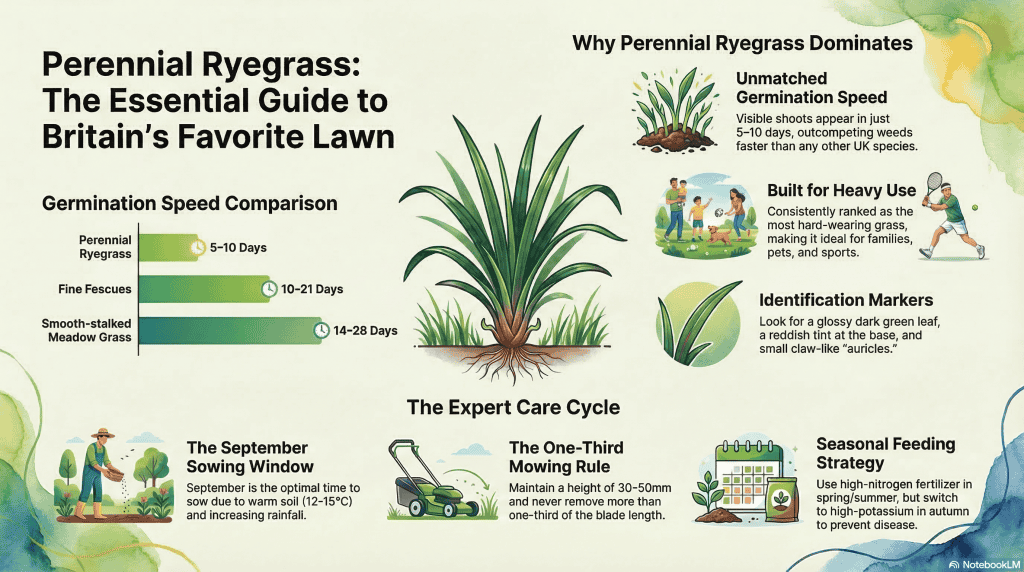
A mature ryegrass blade is 2 to 4mm wide with a glossy, dark green upper surface and a prominent central vein (keel) on the underside. The leaf is folded in the shoot, and the base of the plant often shows a reddish tint at soil level. The auricles, small claw-like projections where the blade meets the sheath, are a reliable identification feature. They are present on ryegrass but absent on most fescues and bents. Left unmown, perennial ryegrass grows to a natural height of 30 to 90cm and produces a distinctive spike-like seed head from June onwards.
Individual perennial ryegrass plants have a lifespan of roughly three to five years, after which they die back naturally and need replacing. The species does not die from cold British winters or moderate drought; it goes dormant and recovers. What kills perennial ryegrass permanently is prolonged waterlogging, severe shade, repeated scalping, or heavy fungal infection left untreated. The lawn sustains itself through continuous tillering and, to a lesser extent, self-seeding if the grass is allowed to flower. In mown lawns, flowering is rare, so a maintenance programme that includes periodic overseeding is the best long-term strategy for keeping the sward dense.
Why It Dominates UK Lawn Seed Mixes
The answer comes down to speed and resilience. Perennial ryegrass germinates faster than any other common UK lawn grass. At soil temperatures above 7 to 8 degrees Celsius, expect visible shoots within 5 to 10 days. BBC Gardeners’ World reports germination in as few as five days under ideal conditions. By comparison, fine fescues take 10 to 21 days and smooth-stalked meadow grass (Poa pratensis) can take 14 to 28 days.
That germination speed serves a practical purpose. A new lawn establishes ground cover before weeds get a foothold. An overseeded patch fills in while the surrounding grass is still active. In both cases, ryegrass outcompetes slower species for light and space in those first critical weeks.
Wear tolerance is the other factor. The Sports Turf Research Institute (STRI) has consistently ranked perennial ryegrass cultivars among the most hard-wearing amenity grasses available. This is why it forms the backbone of utility lawn mixes, typically 40 to 80 per cent of the blend, and sports pitch mixes across the UK. For a family lawn that handles regular foot traffic, no other species matches it for recovery and durability.
Modern breeding has reshaped the species from a coarse agricultural grass into a genuine amenity performer. The Institute of Biological, Environmental and Rural Sciences (IBERS) at Aberystwyth University has led this work for over a century, with grass breeding trials at the site dating back to 1919. The first notable cultivar, S23, was developed by the Welsh Plant Breeding Station and remained on the UK Recommended List until 1993. Today’s Aber varieties, including AberMagic and AberDart, are widely regarded as the best perennial ryegrass cultivars for UK lawns, delivering finer leaf texture, denser growth, and improved disease resistance. Dwarf perennial ryegrass cultivars, bred for a more compact growth habit and finer leaf, now appear in premium lawn seed mixes and are suited to homeowners who want the toughness of ryegrass with a closer visual finish. These modern varieties bear little resemblance to the agricultural ryegrasses of 50 years ago.
When and How to Sow Perennial Ryegrass
Sow perennial ryegrass during spring (April) or autumn (September) when soil temperatures are warm, and moisture is adequate, ideally between 8 degrees Celsius and 15 degrees Celsius. Prepare the soil, then sow at 25-30 grams per square metre, cover lightly (10–15mm), and keep moist. Perennial ryegrass germinates quickly, often in 5–10 days.
Best Sowing Windows
The best time to sow perennial ryegrass in the UK is September. Soil temperatures are still warm from summer, typically 12 to 15 degrees Celsius in early September, rainfall is increasing, and weed competition is declining. These conditions give ryegrass every advantage for rapid establishment.
Spring sowing, from late March through May, is the second-best option. Soil temperatures in April typically reach the 8 to 10 degree minimum needed for germination. The risk in spring is competition from germinating weeds, which are active at the same time. If you sow in spring, plan to apply a selective herbicide once the new grass has been mown at least three times.
Avoid sowing in summer. High temperatures and irregular rainfall make establishment unreliable, and new seedlings are vulnerable to heat stress. Winter sowing is equally unproductive. Soil temperatures below 5 degrees Celsius stall germination completely.
Soil Preparation and Sowing Rates
For a new lawn from scratch, the soil needs to be prepared to a fine tilth. Rotovate or dig over the top 15 to 20cm, remove stones and debris, and rake the surface level. Apply a pre-seeding fertiliser with an NPK ratio around 10-15-10 at the rate specified on the packaging, and lightly rake it into the top 2 to 3cm of soil.
Sow at a rate of 35 to 40 grams per square metre for a new lawn. For overseeding into an existing lawn, 20 to 25 grams per square metre is sufficient. These rates are consistent with guidance from the Royal Horticultural Society and most UK seed suppliers. To get an even spread, divide the total seed quantity in half and apply in two passes, walking perpendicular paths across the area.
Scatter the seed evenly by hand or with a broadcast spreader, then lightly rake the surface to bring the seed into contact with the soil. A light rolling with a garden roller, or walking over the area with flat-soled shoes, improves seed-to-soil contact. That contact is the single most influential factor in germination success.
Germination and Early Establishment
At soil temperatures above 8 degrees Celsius, expect the first shoots within 5 to 10 days. Full germination of the sown area should be visible within 14 to 21 days. Keep the soil consistently moist, not waterlogged, for the first four to six weeks. In dry spells, water lightly once or twice a day. A single heavy soaking is less effective than frequent light irrigation at this stage.
The first mow should happen when the grass reaches approximately 50mm. Set the mower to its highest setting and remove no more than one-third of the blade length. This first cut encourages tillering, which is how ryegrass thickens and fills in. Without it, the plants grow tall and thin rather than bushy and dense.
Do not walk on the new lawn any more than necessary for the first 8 to 12 weeks. Ryegrass is wear-tolerant once established, but young seedlings with shallow root systems are easily pulled out or crushed. Patience at this stage pays off for years.
How to Mow a Perennial Ryegrass Lawn
Mow perennial ryegrass at a height of 1.5 to 2.5 inches (38–64 mm), ideally with sharp blades to avoid tearing the grass. Maintain a regular 7–10 day mowing schedule, never removing more than one-third of the blade length at once. In shaded areas, increase height to 40–50mm to ensure enough leaf surface.
Recommended Cutting Heights
For a standard utility lawn, the recommended mowing height is 30 to 50mm. UK sources, including guidance from George Browns and industry consensus, suggest 35 to 40mm as a solid baseline in the growing season, rising to 50mm at the height of summer when heat and low rainfall increase stress on the plant.
Some modern fine-leaved ryegrass cultivars can be mown lower, down to 15 to 20mm. This demands more frequent mowing, every 2 to 3 days, and a higher-input maintenance programme with regular feeding and watering. For most domestic lawns, 30 to 40mm delivers the best balance of appearance and plant health.
Never remove more than one-third of the blade length in a single mow. Cutting too short, known as scalping, removes the photosynthetic tissue the plant needs to produce energy. A scalped ryegrass lawn turns yellow-brown within days and can take two to four weeks to recover fully. If the grass has grown too tall between mows, bring it back to the target height over two or three cuts rather than one aggressive pass.
Mowing Frequency Through the Growing Season
In the UK, the growing season for perennial ryegrass runs from roughly March through October, with peak growth in May and June. At peak growth, a well-fed ryegrass lawn can add 25 to 30mm of height per week. That means mowing every four to five days to stay within the one-third rule.
In March and April, as growth resumes, once a week is usually sufficient. The same applies in September and October as growth slows. From November through February, mowing is rarely needed. If the grass does grow in a mild winter spell, a light top with the mower set high at 50mm or above will not cause harm, but only mow on dry days when the soil is firm underfoot.
Keep the mower blades sharp. Dull blades tear rather than cut, leaving ragged tips that turn white and increase the lawn’s susceptibility to disease. A clean cut with a sharp blade produces less stress and a better visual finish.
How to Feed a Perennial Ryegrass Lawn
Perennial ryegrass is a hungry, fast-growing cool-season grass that thrives on regular feeding, particularly with nitrogen, during autumn, winter, and spring. Apply a high-nitrogen, slow-release granular fertiliser every 4–6 weeks for steady growth, or use a liquid lawn feed every 3-4 weeks for quick green-up.
Spring and Summer Fertiliser Programmes
Perennial ryegrass is a hungry grass. It responds well to nitrogen and, compared to fine fescues, needs more feeding to look its best. A typical domestic ryegrass lawn benefits from three to four fertiliser applications per year.
Start in early spring, March or April, depending on when growth resumes, with a high-nitrogen fertiliser. Products with an NPK ratio around 12-4-4 or similar work well. Apply at the manufacturer’s recommended rate, usually 30 to 35 grams per square metre for granular products.
A second application in late May or early June sustains growth through the peak season. In summer, a lighter application or a slow-release formulation helps maintain colour without pushing excessive growth in hot weather. Excessive nitrogen in July and August increases the risk of fusarium patch later in the year, which is why restraint in summer feeding is worth the discipline.
Autumn Feed and Pre-Winter Care
Switch to an autumn fertiliser in September or October. Autumn feeds are high in potassium and low in nitrogen, typically with an NPK ratio around 3-0-8 or 4-0-14. Potassium strengthens cell walls and improves the grass’s tolerance to frost, disease, and winter stress.
Do not apply high-nitrogen fertiliser after September. Soft, lush growth going into winter is an open invitation for fusarium patch and other fungal diseases. The RHS advises that excess autumn nitrogen is one of the most common causes of fungal outbreaks on domestic lawns.
A light application of iron sulphate in late autumn, either standalone or as part of a moss-control product, can help harden the grass and suppress moss ahead of winter. Apply according to the product label and water in if no rain is forecast within 24 hours.
Watering Perennial Ryegrass
Watering perennial ryegrass requires keeping soil consistently moist (not soaked) during the first 30 days, watering 3-4 times daily for germination. Once established, transition to deep, infrequent watering (2-3 times per week, early morning) to encourage deep roots, especially during hot summers.
How Much Water Ryegrass Needs
In a typical British summer, rainfall alone is often sufficient to keep a ryegrass lawn alive. The species is moderately drought-tolerant and will go dormant, turning brown, in extended dry spells, then recover when rain returns.
For a lawn you want to keep green through dry periods, apply approximately 25mm of water per week. The simplest way to measure this is to place a straight-sided container, a tuna tin or coffee cup, on the lawn while the sprinkler runs and stop when 25mm of water has collected.
Water early in the morning, before 10am. Evening watering leaves the grass wet overnight, which raises the risk of fungal infection, including fusarium patch and red thread. Morning watering allows the leaf surface to dry before nightfall.
Signs of Drought Stress and Recovery
The first sign of drought stress in perennial ryegrass is a colour shift from bright green to a dull blue-green. If you walk across the lawn and your footprints remain visible for more than a few seconds, the grass is losing turgor pressure and needs water.
If the lawn goes fully dormant and turns brown, it is not dead. Perennial ryegrass can survive four to six weeks of dormancy in a typical UK summer. When consistent rainfall returns, recovery takes two to three weeks in most cases.
Where possible, avoid heavy foot traffic on a dormant lawn. The grass is alive but not growing, and wear damage sustained at this stage will not repair until active growth resumes. A brown lawn that is left alone will bounce back far faster than one that continues to take punishment while dormant.
Common Diseases of Perennial Ryegrass
Common diseases affecting perennial ryegrass include Fusarium Patch (Microdochium nivale), Red Thread, and Rusts (Crown Rust). These fungal pathogens thrive in cool, humid conditions and can cause significant turf thinning and discolouration. Key control methods include optimising nutrient management, removing excess thatch, and selecting resistant cultivars.
Fusarium Patch
Fusarium patch (Microdochium nivale) is the most common lawn disease in the UK and has been identified as the most economically damaging disease on winter sports turf in Britain. Perennial ryegrass ranks among the most susceptible species. The disease appears as small orange-brown patches, 2 to 5cm in diameter, that can merge into larger areas. In damp conditions, a white or pinkish mycelium is visible at the edges of the patch in the early morning.
The pathogen thrives in cool, damp conditions with ambient temperatures between 12 and 19 degrees Celsius and poor air circulation. Outbreaks are most frequent from October through March. High nitrogen levels in autumn and alkaline soils make the disease worse, which is why autumn fertiliser programmes should be low in nitrogen and high in potassium.
Prevention includes removing fallen leaves and debris to improve air circulation, avoiding late-season nitrogen, and watering only in the morning. For active outbreaks, a systemic fungicide containing trifloxystrobin is the standard chemical treatment. Research published in the Journal of Turfgrass Management supports a combined approach using cultural controls alongside targeted chemical application where necessary.
Red Thread
Red thread (Laetisaria fuciformis) is the second most common disease in UK lawns. It produces distinctive pink or reddish thread-like structures on the grass blades, visible to the naked eye. Affected patches turn pale brown and appear dead, but the grass almost always recovers with the correct response.
The primary trigger is nitrogen deficiency. A hungry ryegrass lawn under stress from insufficient feeding is far more likely to develop red thread than a well-fed one. In most cases, an application of nitrogen-rich fertiliser resolves the problem within two to three weeks without any need for fungicide.
Red thread rarely kills grass permanently. It looks alarming, and the visual impact can be dramatic, but it is one of the more benign lawn diseases. If outbreaks are recurrent, review your annual fertiliser programme. The lawn is likely not receiving enough nitrogen across the growing season.
Ryegrass Crown Rust
Crown rust (Puccinia coronata) produces orange-yellow pustules on the grass blades, and your shoes will pick up visible orange dust after walking across an affected area. The disease is most active in late summer and early autumn when temperatures are warm and humidity is high.
Like red thread, crown rust is strongly linked to nitrogen deficiency. A well-fed lawn with adequate nitrogen levels is far less likely to develop it. If the outbreak is severe, mowing and collecting the clippings rather than mulching them helps reduce the spore load.
Crown rust is self-limiting in most cases. As temperatures drop in autumn and the grass receives its autumn feed, the disease fades. It does not typically require fungicide treatment on domestic lawns.
Overseeding with Perennial Ryegrass
Overseeding lawns with perennial ryegrass is ideal for repairing wear, improving density, and rapid establishment, especially in spring or autumn. For best results, scalp the existing lawn, scarify to remove thatch, apply seed at 35-40g per square metre, and ensure consistent moisture for 10–14 days.
When and Why to Overseed
Perennial ryegrass plants live for three to five years. Without periodic overseeding, a ryegrass lawn gradually thins as older plants die and are not replaced. Natural tillering cannot fully compensate for this attrition, and bare patches become colonised by weeds and moss. Annual or biannual overseeding keeps the sward dense and competitive.
The best time to overseed is September, using the same sowing window logic as for new lawns. Soil is warm, rain is returning, and weed pressure is declining. Spring overseeding in April or May is the alternative if autumn is missed.
Overseeding is also the correct response to isolated damage, whether from dog urine, heavy wear, or disease scarring. Patch-repair mixes sold at garden centres are typically dominated by perennial ryegrass for exactly this reason: it fills in faster than anything else.
Step-by-Step Overseeding Method
Mow the existing lawn short, to about 20 to 25mm, and remove all clippings. If there is a significant thatch layer, scarify first to open up the surface and allow seed-to-soil contact. Scatter seed at 35 to 40 grams per square metre, then lightly rake the area to work the seed into the surface.
Keep the overseeded area consistently moist for three to four weeks. Avoid heavy foot traffic on the new seedlings for at least six to eight weeks. Once the new grass has been mown three or four times, it is established enough for normal use.
If overseeding a large area, a slit seeder or mechanical overseeder gives better results than hand broadcasting. These machines cut narrow grooves in the soil surface and deposit seed directly into them, which dramatically improves germination rates compared to surface scattering alone.
Perennial Ryegrass Strengths and Limitations
Where Perennial Ryegrass Excels
Speed of establishment is the defining quality. No other UK lawn grass goes from seed to visible turf as quickly, and for a new lawn or a renovation project, that speed makes all the difference. A patch sown in early September can look respectable within four to six weeks.
Wear tolerance is the second major strength. Perennial ryegrass handles foot traffic, children, dogs, and regular mowing better than fescues or bents. It is the default species for sports pitches, school playing fields, and high-use domestic lawns for exactly this reason.
Recovery from damage is the third selling point. While ryegrass does not spread laterally, its aggressive tillering means existing plants bulk up quickly to fill small gaps. Combined with overseeding for larger bare areas, this makes a ryegrass lawn one of the easiest to repair and maintain over the long term.
Where It Struggles
Shade tolerance is poor. In areas receiving fewer than four hours of direct sunlight per day, perennial ryegrass thins and weakens progressively. For shaded areas of the garden, fine fescues, and creeping red fescue in particular, are a better choice. A mixed seed blend with a higher proportion of fescue is the standard approach for partially shaded lawns.
Drought resistance, while reasonable for a cool-season grass, is not as strong as that of fine fescues or smooth-stalked meadow grass. In extended dry spells, ryegrass will enter dormancy before these species do.
Close mowing is the other limitation. Standard ryegrass cultivars do not perform well below 20mm. If you want a bowling-green-quality finish mown at 5 to 15mm, browntop bent (Agrostis capillaris) is the correct grass, not ryegrass. Pushing ryegrass below its comfort zone leads to thinning, stress, and increased susceptibility to disease.
Removing Unwanted Perennial Ryegrass
Removing perennial ryegrass, often unwanted because it forms thick, coarse clumps that ruin the uniform appearance of fine-leaf lawns, requires a combination of physical removal, cultural changes, and sometimes selective, high-skill chemical application. As a hardy, fast-growing grass, it is difficult to remove without harming surrounding turf, often requiring patchy removal and re-seeding.
When Ryegrass Becomes a Problem
Perennial ryegrass is not always welcome. In a fine fescue or bent grass lawn managed for ornamental quality, ryegrass plants stand out as coarse, fast-growing invaders that disrupt the uniform texture. It can also colonise flower beds and borders adjacent to a ryegrass lawn, particularly where seed has scattered during mowing.
Because ryegrass spreads by tillering rather than runners, it does not creep aggressively into new areas the way couch grass does. Unwanted plants tend to appear in clumps, making targeted removal feasible rather than requiring a whole-lawn approach.
How to Get Rid of Perennial Ryegrass
For small infestations in a fine lawn, hand removal is the most precise method. Dig out individual ryegrass clumps with a daisy grubber or narrow trowel, removing the entire root crown. Fill the resulting hole with soil and overseed with your preferred fine grass species.
For larger areas where ryegrass has taken over, a glyphosate-based herbicide is the standard chemical approach. Glyphosate is non-selective and kills all vegetation it contacts, so it is only suitable for areas you intend to re-sow from scratch. Apply on a dry, still day when growth is active, typically between April and September, and allow two to three weeks for the grass to die back fully before cultivating the soil and re-seeding.
There is no selective herbicide that kills perennial ryegrass while leaving other lawn grasses unharmed. This is the core difficulty in removing it from a mixed sward. Where ryegrass has become dominant in a lawn that was intended to be fine fescue or bent, the practical options are spot-treatment of individual clumps, or a full renovation using glyphosate followed by re-seeding with the desired species.
Perennial Ryegrass FAQs
What is the downside of ryegrass?
The main downside of ryegrass is poor shade tolerance. Perennial ryegrass thins and weakens in areas receiving fewer than four hours of direct sunlight per day, making it unsuitable for heavily shaded gardens. It also struggles when mown below 20mm, ruling it out for bowling-green or ornamental finishes. Drought resistance is moderate rather than strong; in prolonged dry spells, ryegrass enters dormancy and turns brown before fine fescues or smooth-stalked meadow grass would. The species is also more susceptible to fusarium patch than most other UK lawn grasses, particularly when autumn nitrogen levels are too high. Individual plants live for only three to five years, so without regular overseeding the sward gradually thins.
Is ryegrass good for lawns in the UK?
Ryegrass is the most widely used lawn grass in the UK. Perennial ryegrass appears in an estimated 70 to 80 per cent of domestic seed mixes sold in Britain because it germinates in as few as five to ten days, tolerates heavy foot traffic, and recovers from wear faster than any other cool-season species. It thrives in the British maritime climate across every region from the south coast to Scotland. For family gardens, utility lawns, and any area that handles children, dogs, or regular use, perennial ryegrass is the strongest performer available. It is less suited to deep shade or very close mowing below 20mm, where fine fescues or bent grasses are the better choice.
Is perennial ryegrass a good grass?
Perennial ryegrass is a strong performer for most UK lawn situations. It germinates faster than any other common British lawn species, establishes ground cover within weeks, and handles foot traffic, play, and regular mowing better than fescues or bents. Modern cultivars bred at Aberystwyth University, including AberMagic and AberDart, deliver a finer leaf texture and denser growth than older agricultural varieties. Perennial ryegrass is the grass of choice for Wimbledon, Premier League football pitches, and the majority of domestic lawns in Britain. It performs best in open, sunny positions with a mowing height of 30 to 50mm and a regular feeding programme.
How fast does perennial ryegrass grow?
Perennial ryegrass is the fastest-germinating lawn grass in the UK. At soil temperatures above 8 degrees Celsius, the first shoots appear within 5 to 10 days of sowing. Full germination across the sown area is typically visible within 14 to 21 days. Once established, perennial ryegrass grows at a rate of 25 to 30mm per week during peak season in May and June, slowing to around 10 to 15mm per week in early spring and autumn. Growth stops almost entirely from November through February when soil temperatures drop below 5 degrees Celsius.
Sources
- Royal Horticultural Society. “Lolium perenne.” rhs.org.uk
- Royal Horticultural Society. “Fusarium Patch and Snow Mould.” rhs.org.uk
- Aberystwyth University. “Welsh Grass Breeders Deliver Leading Varieties with Significant Global Impact.” aber.ac.uk
- Aberystwyth University. “Amenity Grass Breeding at IBERS.” aber.ac.uk
- Farming Connect / Business Wales. “Centenary of Welsh Plant Breeding Boosts Grass Yields for Welsh Farmers.” businesswales.gov.wales
- Journal of Turfgrass Management. “Fusarium Patch Disease on Winter Sports Turf in the UK.” tandfonline.com
- AHDB (Agriculture and Horticulture Development Board). “Grassland Reseeding: Sowing Depth, Seed Rates and Rolling.” ahdb.org.uk
- BBC Gardeners’ World. “Complete Guide to Perennial Ryegrass.” gardenersworld.com
