
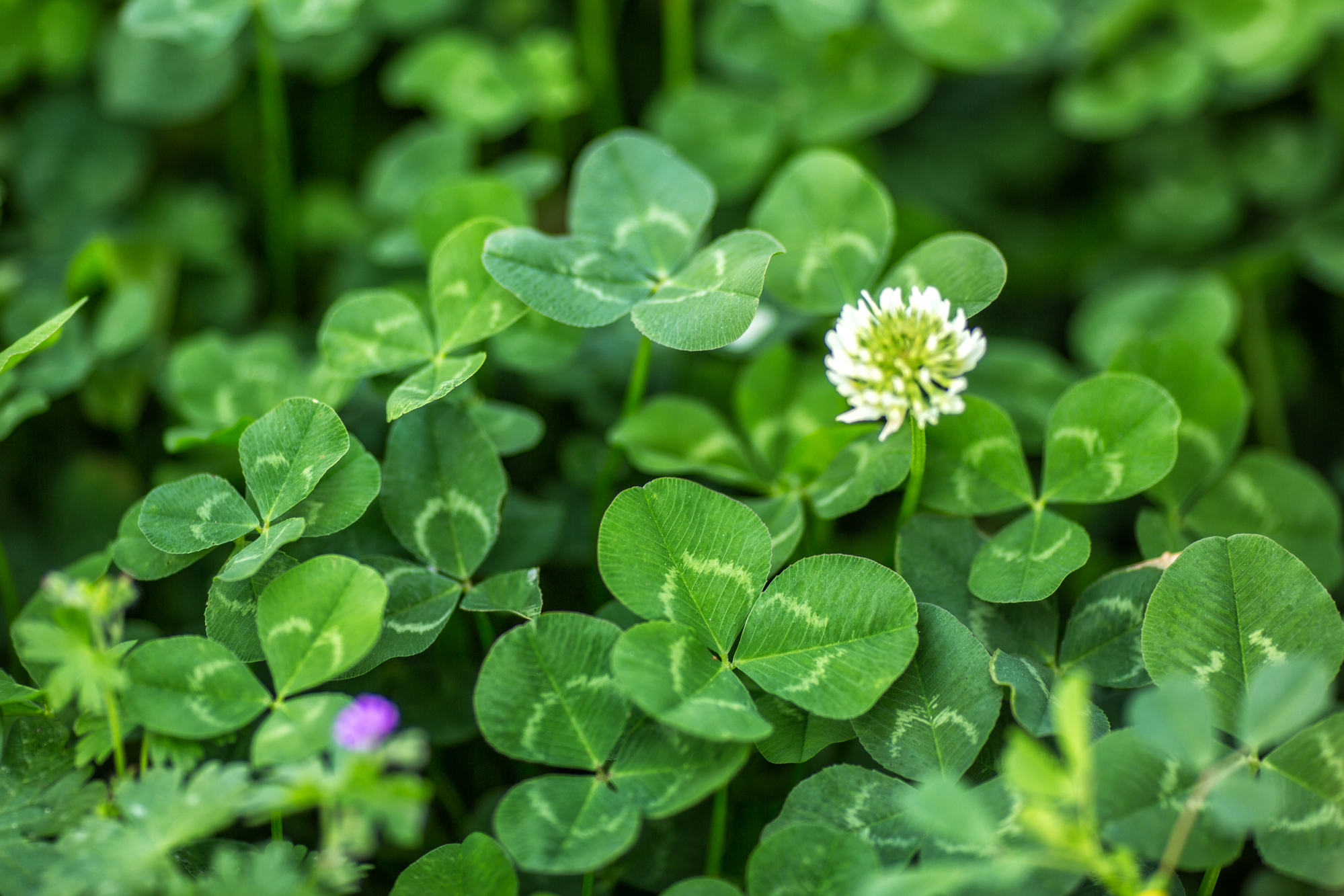
Clover in grass is one of the most common sights in British lawns, and one of the most misunderstood. For some lawn owners it is a weed to be eliminated, for others it is a welcome addition that feeds bees and fixes nitrogen into the soil. The reality is that clover is neither strictly good nor bad. It is a legume, a flowering plant in the pea family, and several different species can show up in a lawn depending on soil conditions, mowing habits, and how the lawn has been managed over the years.
Knowing exactly which type of clover in grass you are dealing with is the first step to deciding what to do about it. The control method that works for white clover does not necessarily work for the smaller trefoils, and the approach you take will depend on whether you want to remove it, tolerate it, or even encourage it. This guide walks through the main clover species you are likely to encounter in a UK lawn, how to identify each one, why it has appeared, and what your options are for managing it.
Why Clover Appears in Lawns
Before getting into species identification, it is worth knowing why clover shows up in the first place. Clover is not a sign of a neglected lawn. In fact, it often thrives in lawns that are otherwise in reasonable condition. It appears because the lawn’s growing environment happens to suit it, and in many cases because the grass has been weakened just enough to give clover a foothold.
The three most common reasons for clover spreading through a lawn are low soil fertility, particularly a shortage of nitrogen, compacted or poorly drained soil, and mowing too short. Clover is a legume, which means it can fix atmospheric nitrogen through nodules on its roots and effectively feed itself. Grasses cannot do this and rely entirely on nitrogen from the soil. When nitrogen is scarce, grasses slow down and thin out, and clover moves into the gaps. This is why lawns that have not been fed for a year or two often show a sudden flush of clover in late spring.
Compaction is another factor. Clover has a shallower root system than most lawn grasses but tolerates poor soil structure better, so it holds its ground in areas where the grass is struggling. Close mowing makes things worse by reducing the grass leaf area available for photosynthesis, which further weakens the sward and allows low-growing clover to outcompete it. If your lawn is mown below 25 millimetres and has not been fed for some time, clover will almost certainly appear sooner or later.
There is a positive side to this. Clover improves soil fertility, stays green in dry weather when grass has gone dormant, and supports pollinators when it flowers. The question of whether to remove it comes down to personal preference and what you want the lawn to look like.
The Main Clover Species Found in UK Lawns
There are around a dozen clover and trefoil species that can appear in British lawns, but five account for the vast majority of sightings. Each has distinct leaves, growth habits, and flowers, and correctly identifying what you have will help you choose the right response.
White Clover (Trifolium repens)
White clover is by far the most common clover in grass across the UK. If you see clover in your lawn, it is almost certainly this species. White clover is a low-growing perennial with creeping stems called stolons that spread horizontally across the soil surface, rooting at intervals to form new plants. This is why a single patch can expand into a large colony within a year or two.
The leaves are trifoliate, meaning they have three leaflets. Each leaflet is broadly oval, usually about 10 to 20 millimetres long, and marked with a pale crescent or chevron in the middle. The flowers are white or very pale pink, rounded, and about 15 to 20 millimetres across. They appear from late May through to September and are a favourite food source for honeybees and bumblebees.
White clover is tolerant of close mowing, drought, poor soil, and heavy foot traffic, which makes it one of the toughest plants in a lawn setting. It is also one of the hardest to remove once established, as cutting off the tops simply stimulates more stolon growth from the base. For full control options, see our guide on how to get rid of clover in lawn.
Red Clover (Trifolium pratense)
Red clover is the second most common species, though it is seen less often in closely mown lawns because it does not tolerate low cutting the way white clover does. It is taller, usually growing to 30 or 40 centimetres if left alone, and has a more upright growth habit. In a lawn that is mown regularly, red clover often forms flatter rosettes at ground level without ever reaching full height.
The leaves are also trifoliate but the leaflets are narrower and more oval-shaped than white clover, typically 20 to 30 millimetres long, and marked with a pale V-shaped chevron. The flowers are reddish-pink to purple, larger than white clover flowers at around 20 to 30 millimetres across, and carried on a short stem above the foliage. They appear from June through to September.
Red clover is more often found in meadow-style lawns, recently sown areas, and gardens on heavier soils. It is not as persistent as white clover because it lacks the creeping stolons, relying instead on seed to spread. This makes it easier to control through consistent mowing and improved grass health. Control methods are covered in detail in our article on how to control clover in your lawn.
Lesser Trefoil (Trifolium dubium)
Lesser trefoil, also known as yellow suckling clover, is often mistaken for a different weed altogether because of its small size and yellow flowers. It is a true clover despite its trefoil name, and is one of the candidates for the original Irish shamrock. The plant is annual, germinating from seed each spring and completing its life cycle by late summer.
The leaves are trifoliate with very small leaflets, usually 5 to 10 millimetres long, without the pale chevron markings seen on white and red clover. The plant grows flat against the soil, forming loose mats rather than the dense patches of white clover. The flowers are tiny, only 3 to 4 millimetres across, bright yellow, and carried in small rounded clusters of 10 to 25 individual flowers. They appear from May to July and fade to pale brown as they set seed.
Because lesser trefoil is an annual, the most effective control is to prevent seed set by mowing before the flowers mature. A healthy, well-fed lawn will also crowd it out over a couple of seasons. It rarely causes the same level of visible disruption as white clover, and many lawn owners leave it alone once they realise it will not persist from year to year.
Hop Trefoil (Trifolium campestre)
Hop trefoil is similar in appearance to lesser trefoil but slightly larger and stronger. It earned its common name because the dried flower heads resemble miniature hops, and it is sometimes called large trefoil or field clover for the same reason. It is an annual or short-lived biennial, again relying on seed for reproduction.
The leaves are trifoliate with leaflets about 8 to 15 millimetres long, noticeably larger than lesser trefoil and with a slightly pointed tip. The flowers are yellow, carried in rounded heads of 20 to 40 individual flowers, and about 8 to 12 millimetres across. When the flowers fade they turn light brown and persist on the plant for several weeks, giving the characteristic hop-like appearance.
Hop trefoil is more often found in lawns on dry, sandy, or chalky soils and in areas that receive full sun. It tolerates drought well but does not compete strongly with vigorous grass. Improving grass health through feeding and correct watering is usually enough to reduce it over time.
Microclover (Trifolium repens var. Pirouette or Pipolina)
Microclover is not a distinct species but a cultivated variety of white clover that has been selectively bred for smaller leaves, reduced flowering, and better compatibility with lawn grasses. It has become increasingly popular in recent years as more lawn owners look for low-input, drought-tolerant alternatives to pure grass lawns.
The leaves are trifoliate, with leaflets typically half the size of standard white clover at 5 to 10 millimetres across. The growth habit is lower and denser, and flowering is much reduced, which means fewer bee visits but also less visible white heads breaking up the green surface of the lawn. Microclover blends well with fine grasses such as fescues and tolerates closer mowing than its parent species.
If you are seeing microclover in your lawn, it is either because it was deliberately included in a seed mix at the point of sowing, or because standard white clover has gradually produced smaller-leaved forms under regular close mowing over many years. For readers who want to introduce clover intentionally, our guide on how to plant clover in existing lawn covers the process from seed selection through to establishment.
Other Clover-like Plants That Are Easy to Confuse
A few other plants are regularly mistaken for clover because of their trifoliate leaves. Correctly distinguishing them is useful because the control methods for true clovers do not always work on these look-alikes.
Creeping wood sorrel, Oxalis corniculata, has three heart-shaped leaflets that fold up at night and in bright sun. The flowers are small and yellow, similar in colour to lesser trefoil, but the leaves are the giveaway. Sorrel leaflets are notched at the tip like an upside-down heart, whereas clover leaflets are oval or rounded. Sorrel prefers the same conditions as clover, so the two are often found growing together.
Black medick, Medicago lupulina, is part of the pea family and closely related to clovers. It has three oval leaflets, each with a small point at the tip, and yellow flowers very similar to lesser trefoil. The difference is in the seed pods, which are tightly coiled and turn black when mature. Black medick is common in poor, dry lawns on alkaline soils.
Bird’s-foot trefoil, Lotus corniculatus, is another pea-family plant that often turns up in lawns. It has five leaflets rather than three, though two of them sit at the base of the stem and can be missed at first glance. The flowers are larger than true clover, yellow with red streaks, and produce long narrow seed pods arranged like a bird’s foot. It is more often seen in lawns on chalky or sandy soils.
How to Identify Clover in Your Grass
If you are not sure which species of clover in grass you are looking at, the following quick checks will narrow it down.
Look at the flower colour first. White or pale pink flowers point to white clover or microclover. Pink or purple flowers indicate red clover. Yellow flowers mean one of the trefoils, or possibly a look-alike such as wood sorrel or black medick.
Next, measure the leaflet length. Leaflets of 15 to 25 millimetres usually mean white clover. Leaflets of 20 to 30 millimetres with narrower shapes suggest red clover. Leaflets of 5 to 10 millimetres without any chevron marking are most likely lesser trefoil or hop trefoil, or possibly microclover if they are broader and rounder.
Finally, check the growth habit. Plants spreading by visible horizontal stems that root at the nodes are white clover or microclover. Plants growing upright from a central crown without runners are red clover. Small plants forming loose mats close to the soil are lesser trefoil or hop trefoil.
A hand lens or the camera zoom on a phone will help you see the fine details. If you still are not sure, the Botanical Society of Britain and Ireland has an online identification guide with photographs of all the common species.
Should You Remove Clover from Your Lawn?
The question of whether to remove clover in grass depends on what you want from your lawn. There are good reasons to keep it and good reasons to get rid of it, and there is no single correct answer.
Reasons to keep clover in the lawn include that it fixes atmospheric nitrogen through root nodules, effectively feeding itself and the surrounding grass. This reduces or eliminates the need for nitrogen fertiliser in a mixed lawn. Clover stays green in dry weather when grass has gone brown and dormant, giving the lawn a more continuous colour through summer droughts. The flowers support honeybees, bumblebees, and other pollinators, which are under pressure from habitat loss and pesticide use. Clover is low-maintenance, drought-tolerant, and tolerant of poor soils, making it easier to grow than grass in many situations.
Reasons to remove clover include that the flower heads attract bees, which can be a concern in lawns used by bare-footed children or by people with bee allergies. The mixed texture of clover and grass is not to everyone’s taste, and many traditional lawn owners prefer a uniform green sward. Clover can dominate over time if left unchecked, eventually crowding out the grass entirely and leaving a pure clover lawn. In sports turf and show lawns, clover is considered a weed because of its different wear characteristics and appearance.
The middle ground is increasingly popular. Many lawn owners now accept a small percentage of clover as part of a healthy, low-input lawn, aiming for a roughly 90 to 10 grass-to-clover ratio rather than pure grass or pure clover. This gives most of the benefits of both without committing fully to either.
Controlling Clover in the Lawn
If you have decided to reduce or remove clover from your lawn, there are several approaches, each suited to different situations. A brief overview follows, with links to more detailed guides for readers who want the full treatment.
The first and most effective long-term approach is to improve the grass so it outcompetes the clover. This means feeding the lawn with a nitrogen-based fertiliser two to three times per year, raising the mowing height to at least 30 millimetres, and addressing any compaction or drainage problems through aeration. A strong, dense grass sward will gradually crowd out clover without the need for chemicals. Keeping to a regular feeding schedule is the foundation of this approach.
The second approach is manual removal. For small patches of clover, you can lift the plants out with a hand fork or a narrow trowel, taking care to remove the entire root system. This works best in spring or early autumn when the soil is moist and the roots come out cleanly. Overseed the bare patches with a matching grass seed mix to prevent reinfestation.
The third approach is selective herbicide treatment for larger infestations where manual removal is impractical and cultural control has not worked. A selective lawn herbicide containing clopyralid, fluroxypyr, or a combination product will kill clover without harming the grass. Apply when clover is actively growing, typically from May to September, and follow the label instructions carefully. More on this in our article on how to get clover out of lawn.
Whichever method you choose, follow up with cultural improvements to prevent the clover from returning. Without better feeding, mowing, and soil management, the clover will come back within a season or two regardless of how much you spray or pull.
When Clover Is a Good Thing
It is worth saying again that clover in grass is not always a problem. A well-maintained mixed lawn with 10 to 20 percent clover by area is one of the easiest lawn types to keep looking green through a British summer. It needs less water, less fertiliser, and less frequent mowing than a pure grass lawn, and it supports more wildlife. Many golf courses, public parks, and large estate lawns now include clover deliberately as part of their low-input turf management programmes.
If you are starting from scratch or renovating a tired lawn, adding microclover to your seed mix at around 2 to 5 percent by weight gives you the benefits of clover without the aggressive spread of standard white clover. The result is a lawn that stays green in drought, feeds itself, and needs minimal intervention once established. This approach fits well with broader eco-friendly lawn care principles that prioritise soil health and biodiversity over chemical inputs.
Clover Frequently Asked Questions
What type of clover in grass is most common in UK lawns?
White clover, Trifolium repens, is by far the most common clover species in British lawns. It is a perennial that spreads by creeping stolons and tolerates close mowing, drought, and foot traffic, which makes it very persistent once established.
Is clover in grass bad for my lawn?
Not necessarily. Clover fixes atmospheric nitrogen, stays green in dry weather, and supports pollinators. It is only a problem if you want a uniform all-grass lawn or if it is crowding out the grass entirely. A small percentage of clover is beneficial in most lawn situations.
Why is there so much clover in my grass all of a sudden?
A sudden appearance of clover usually points to low soil nitrogen, compaction, or close mowing weakening the grass. Clover thrives where grass is struggling because it can fix its own nitrogen. Feeding the lawn, raising the mowing height, and aerating compacted areas will reduce clover over time.
How do I tell white clover and red clover apart?
White clover has white or pale pink flowers and spreads along the ground by creeping stolons. Red clover has pink to purple flowers and grows upright from a central crown without runners. The leaflets of red clover are also narrower and more oval-shaped than those of white clover.
Will clover take over my entire lawn?
White clover will gradually dominate a weakened, underfed lawn over several years if nothing is done to restore the grass. In a healthy, well-fed lawn, clover rarely exceeds 20 percent by area and coexists with the grass without taking over.
Can I have a lawn that is only clover?
Yes. A pure clover lawn is possible and increasingly popular as a low-input alternative to grass. It stays green in drought, feeds itself, and needs much less mowing. The trade-off is less tolerance of heavy wear and a softer, more textured appearance than a traditional grass lawn.
Does clover attract bees?
Yes. White and red clover flowers are a major food source for honeybees and bumblebees. If you have concerns about bees in the lawn, such as for young children or allergy sufferers, mowing before the clover flowers or choosing microclover varieties that flower less will reduce bee activity.
Is microclover the same as regular clover?
Microclover is a cultivated variety of white clover, Trifolium repens, selectively bred for smaller leaves and reduced flowering. It blends better with fine lawn grasses and is less visually dominant than standard white clover, but it is the same species biologically.
Sources
- Royal Horticultural Society. “Clover in Lawns.” RHS Gardening Advice. https://www.rhs.org.uk/weeds/clover
- Botanical Society of Britain and Ireland. “Trifolium Species Identification Guide.” BSBI Plant Atlas. https://plantatlas2020.org/
- The Lawn Association. “Clover Management in Domestic Lawns.” Technical Bulletins.
- Sports Turf Research Institute (STRI). “Weed Management in Amenity Turf.” Research Publications. https://strigroup.com/
- Wild Flower Society. “Native UK Clovers and Trefoils.” Field Guide Notes.