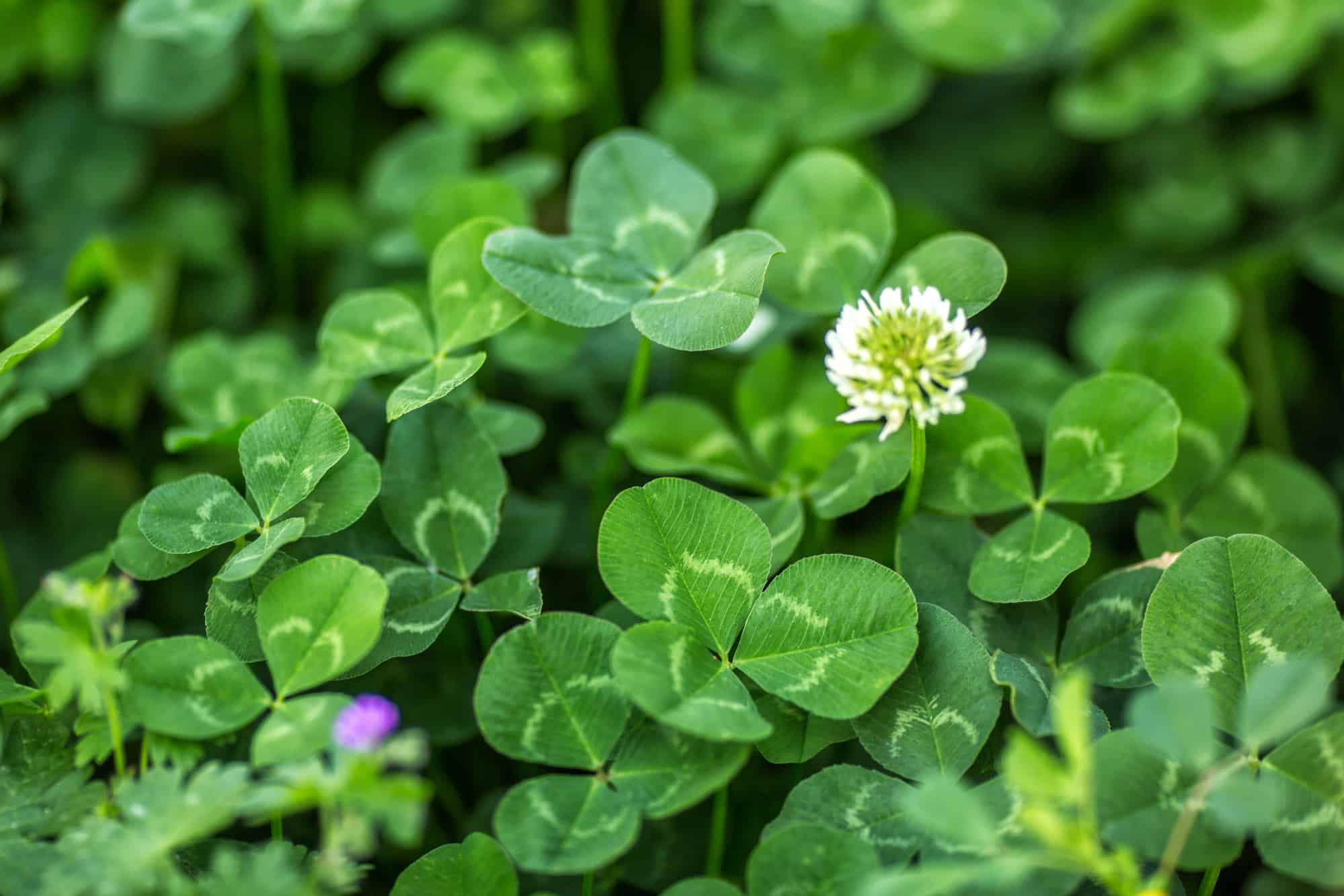
While ordinary lawns turn brown in the first dry spell, a lawn with micro-clover mixed through it tends to stay green, and it does so on roughly a quarter less water and little or no feeding. Micro-clover is a small-leaved selection of white clover bred specifically to blend into a lawn rather than form the big, sprawling patches of ordinary clover. Sown through existing grass, it pulls nitrogen out of the air to feed the lawn for free, sends a taproot deep enough to find moisture when the grass roots have run dry, and fills gaps that would otherwise become bare. For anyone tired of watering, feeding, and watching a lawn scorch every summer, it is worth understanding how it works and how to establish it.
Why Micro-Clover Stays Green When Grass Browns
The drought tolerance comes down to root shape. Grass grows a mat of fine, fibrous roots concentrated in the top few centimetres of soil, which is why a lawn browns within days once that surface layer dries out. Clover, by contrast, drives down a taproot that reaches moisture held deeper in the soil profile, moisture the shallow grass roots never touch. A micro-clover lawn needs around 25 percent less water than a pure grass lawn to stay green, and an established stand will hold its colour through a moderate dry spell that turns the grass around it straw-brown. That deep rooting strengthens year on year: from the second season onward the taproot pushes further down and reaches subsoil reserves that are simply unavailable to turf grass.
The second advantage is nitrogen, and this is where micro-clover pays for itself. Clover is a legume, and like all legumes it hosts bacteria in nodules on its roots that take nitrogen from the air and fix it into a form plants can use. That fixed nitrogen leaks into the soil and feeds the surrounding grass, so a lawn carrying 20 to 30 percent clover cover can approach the nitrogen supply of a conventional feeding programme at no cost and with no bag of fertiliser. The grass between the clover grows greener and thicker as a result. Add the deep green of the clover leaf itself, which holds colour better than grass under heat, and the whole lawn reads as healthy through weather that would leave a pure grass lawn looking dead.
How to Sow Micro-Clover Into an Existing Lawn
Micro-clover is cheap to establish because the seed is tiny and you need very little of it. Sow at around 1 to 2.5 grams per square metre when overseeding into existing turf, which means a 250g pack covers roughly 100 square metres and costs anywhere from about £4 to £20/$5 to $25 depending on the brand and quality. Compared with the running cost of feeding and watering a conventional lawn all summer, that is a small one-off outlay. The seed germinates quickly, usually within 7 to 14 days, and integrates into the lawn within a single growing season.
The method counts because the seed is so small it can easily be wasted. Start by mowing the existing lawn short and raking out moss and dead thatch so the seed can reach soil rather than lodging on top of a dense mat. Because each seed is fine, mix it with a few handfuls of dry sand or sieved soil before scattering; this bulks it up so you can spread it evenly by hand and see where it has gone. Scatter it across the raked lawn, water it in with a fine spray, and keep the surface damp for the first two weeks while it germinates. Spring, once the soil has warmed to around 8 to 10 degrees C (46 to 50 degrees F), and early autumn are the best windows, for the same reason they suit grass seed: warm soil and reliable moisture. Do not bury the seed; clover needs light at the surface to germinate, so raking it in lightly and firming is enough.
Once it is in, change how you treat the lawn. Stop using selective lawn weedkillers, because the broadleaf herbicides that kill daisies and dandelions will kill clover just as readily and undo the whole project. Cut back hard on nitrogen feed, since the clover is now supplying it and excess nitrogen makes the grass outcompete the clover. Raise the mowing height a little, to around 40mm (about 1.6 inches), which suits the clover and helps both components shade the soil and hold moisture.
The first season sets up everything that follows, so manage it deliberately. In the weeks after sowing, mow with the blade set high and the mower on its lightest pass, because young clover seedlings sit close to the surface and a low cut will tear them out before they have anchored. Keep foot traffic light until the clover has knitted into the grass, which usually takes a couple of months from germination. By the end of the first growing season the clover should read as a scattering of small dark leaves through the sward rather than distinct patches, and that even distribution is the sign it has integrated well. If it comes up in clumps, it was sown too thickly in those spots, and a light raking and a thin oversow of grass seed the following spring will even it out.
What to Weigh Up Before You Commit
Micro-clover is not the right choice for every garden, and it is fair to know the trade-offs before sowing. Clover flowers, and even small-leaved selections will push up white flowers if left unmown, which attract bees. For a wildlife-friendly garden that is a benefit, but for a lawn where children play barefoot it means keeping on top of the mowing to remove the flowers, or accepting that bees will visit. Clover also wears differently from grass: it is softer underfoot and can stain clothing more readily than grass, and on a heavily-used sports-style lawn it is less hard-wearing than a pure ryegrass sward. It is best thought of as a low-input, drought-tolerant lawn for ordinary family and ornamental use, not a substitute for a hard-wearing pitch.
There is also a maintenance shift to accept rather than a maintenance saving in every direction. You will water far less and feed far less, which is the whole appeal, but you do give up the option of blanket-spraying broadleaf weeds, so weeding becomes a matter of pulling the occasional intruder by hand or spot-treating with care. Get the balance wrong in the other direction and the clover can spread more vigorously than you wanted, especially in a thin or poor lawn where it faces little competition; keeping the grass reasonably dense is what holds clover to a tidy 20 to 30 percent of the sward. Weighed against summers of watering a lawn that browns anyway, a great many gardeners find that trade worth making. For related low-water approaches, see our guides on drought-proofing your lawn and managing clover and daisies.