
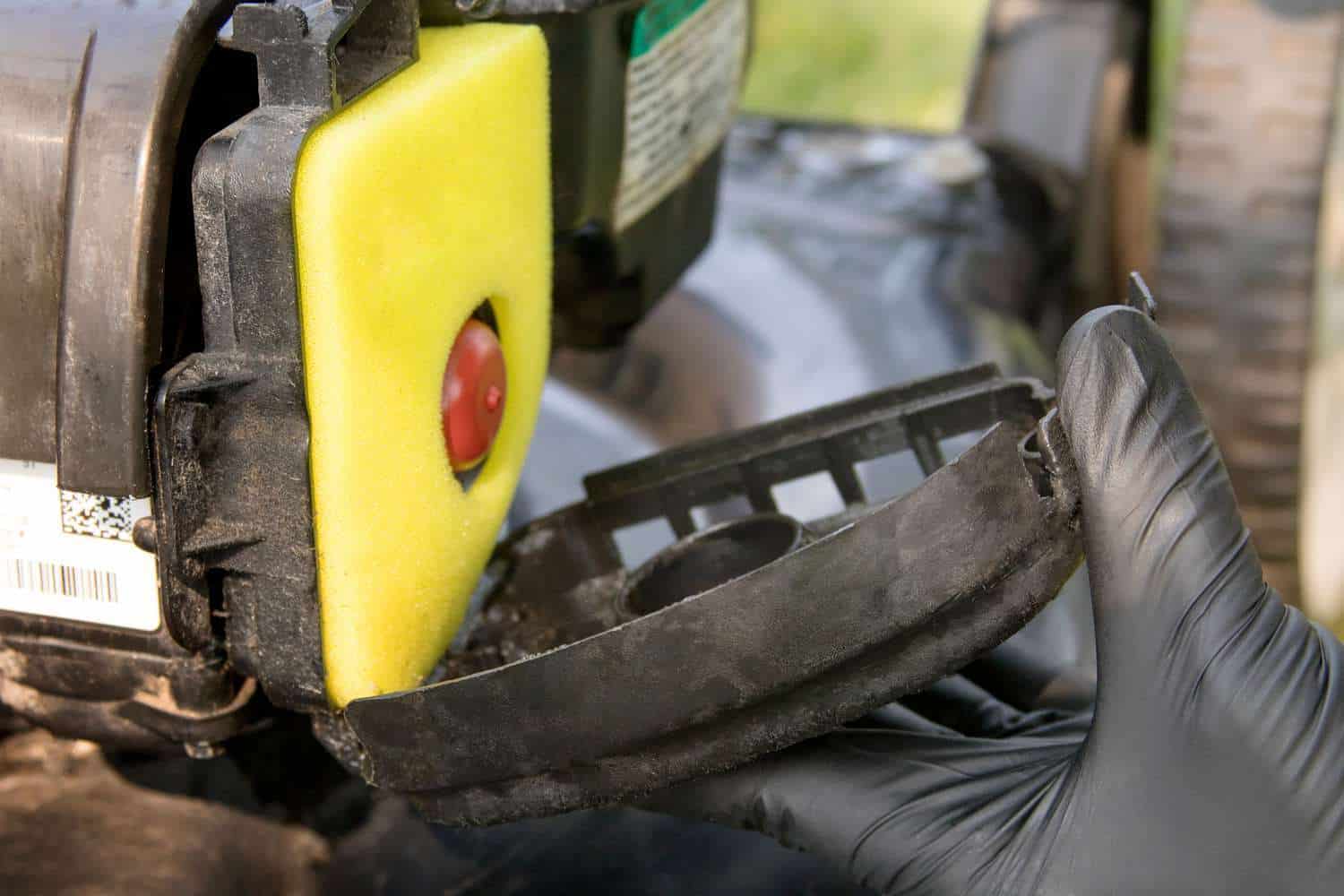
Take the cover off your petrol mower’s air filter before the next cut and hold the element up against a bright sky. If almost no light comes through the pleats, the engine has been running rich for hours and you have already lost power you paid for. On a crisp, dusty July lawn, a paper cartridge that went in clean at the start of spring can be choked grey by mid-summer. A new one costs around £4.40/$6.39. The engine it protects costs around £250/$300 to replace.
Briggs & Stratton’s own maintenance guidance sets the baseline: if your engine has a paper cartridge with no foam pre-cleaner, “replace cartridge every 25 hours or every season, more often under dusty conditions.” That last clause is the one everybody skips. Twenty-five hours is a figure written for spring grass and damp soil. In a drought summer, pull the cover and look at the element every 5 hours of running, which for most gardens means every third or fourth cut.
Why a Dry Lawn Feeds Dust Straight Into the Intake
A 160cc four-stroke turning 2,900rpm swallows somewhere near 200 litres (about 7 cubic feet) of air every minute. Over a 40 minute cut, that is roughly 8,000 litres pulled through a piece of pleated paper the size of a postcard. Every particle suspended in that air arrives at the filter face. The question is only what the air is carrying.
In April the answer is: not much. Moist soil holds its fine particles together, spring clippings are heavy with water and drop out of the airstream quickly, and the sward is dense enough to cap the surface. By mid-July on a drought-stressed lawn, all three of those protections have gone. The top few millimetres of soil have broken down into a talc-fine powder. The thatch layer has dried and crumbled. Grass leaves that have gone brittle shatter into fines when the blade hits them, rather than shearing cleanly.
Then the mower makes it worse. A rotary deck is a centrifugal blower. The blade tip is moving at something close to 80 metres per second (roughly 180 miles per hour), and the deck is shaped to lift the grass and throw it toward the discharge. That same airflow whips up a dust cloud, and the air filter intake sits directly in it, typically only 15 to 20cm (about 6 to 8 inches) above the deck. The engine is drinking from its own plume. Mulching mowers recirculate the clipping inside the deck so it can be chopped again and again, which grinds it finer and thickens the cloud further. Cut too short on baked ground and the blade scalps high spots, flinging raw soil into the same air.
The particles that do the real harm are the ones you cannot see. Airborne silica, the mineral fraction of dust, sits at around 7 on the Mohs scale. Cast iron cylinder bores sit around 4. Grit that gets past a filter is harder than the metal it lands on.
What a Choked Element Does Inside the Engine
A small mower carburettor does not measure air. It meters fuel by pressure drop. Air rushing through the venturi drops in pressure, and that pressure difference is what lifts petrol out of the main jet. Block the inlet with a matted filter and the depression downstream of the restriction gets stronger, so the jet keeps pulling fuel while less and less air arrives to burn it. The mixture goes rich, and it goes rich progressively, which is why the decline creeps up on you.
The first symptoms are familiar to anyone who has fought a mower in August. It fights the starter cord and needs five or six pulls from cold. It coughs black smoke on start-up. It bogs down in a thick patch that it walked through in spring. Pull the spark plug and the electrode is sooty black and dry, and a fouled plug then makes the hard starting worse, so the problem compounds itself.
Underneath, unburnt fuel is doing structural damage. Rich running lays soft carbon on the valve heads and seats, and carbon on a seat stops the valve closing fully, which bleeds compression away and puts more heat into the valve. Worse, the raw petrol that never burns runs down the cylinder wall and strips the oil film off the bore. That film is all that separates the piston rings from the iron. Take it away and the rings scuff, the honing crosshatch polishes smooth, and the bore starts to lose its ability to hold oil at all. Some of that fuel also washes past the rings into the sump, thinning the oil and dropping its viscosity so the big-end bearing loses its cushion too.
Here is the tell that generic advice never mentions. Check the dipstick on a mower that has been running rich for weeks. The oil level will have crept up rather than down, and the oil will smell of petrol. That rising level is fuel dilution, and it means the bore is already being washed.
A healthy small engine cranks somewhere around 80 to 100psi. Once bore and ring wear pull that below roughly 60psi, it will not start reliably however many new plugs you fit, and no carburettor clean will bring it back. At that point the repair is a replacement engine, around £250/$300 for a 163cc unit, on a mower that might have been worth £180 secondhand. A filter costs less than a pint.
Paper Elements: Never Wash It, Never Blow It Out
A paper element works by trapping dirt on the outside face of a fibre matrix riddled with microscopic pores. The pores are sized to stop particles a few microns across. Nothing you do at home can restore them.
Never wash a paper cartridge. Water swells and then collapses the fibre structure as it dries, and the element that comes out of the bucket looking respectable is filtering nothing like it did. Never blow a paper element out with a compressed air line from the outside, either. Workshop air at 6 to 8 bar (roughly 90 to 115psi) drives the trapped grit deeper into the pleats and punches holes clean through the fibre, and those holes are invisible until you hold the element to a light and see pinpricks. From that moment, dust takes the path of least resistance straight through the wound, into the carburettor throat, and into the bore. A ruptured filter is more dangerous than a filthy one, as it gives you no warning.
The only permitted cleaning is a gentle tap of the flat edge against the palm of your hand or a bench, to knock loose surface dust off. If a tap does not bring it back to something close to its original colour, replace it. When you fit the new one, follow the Briggs & Stratton sequence: loosen the cover screw, tilt the cover down, remove the old cartridge, and install the new one with the paper pleat facing out, then close the cover and tighten the screw securely. Pleat out is not cosmetic. The pleats are the dirty side, and reversing the element halves its usable area. Nip the plastic cover screw up snug and stop, as splitting the housing lug lets unfiltered air past the seal entirely.
Foam and Dual-Stage Filters: Oil It or Lose It
Foam is a different mechanism. It traps dirt in a film of oil spread through an open cell sponge. Briggs & Stratton is blunt on the point: “A dry or non-oiled oil foam filter will trap only the largest particles. If the air filter element is foam only, it MUST be oiled and serviced regularly.” A foam filter run dry is barely a filter at all, and thousands of them are running dry right now on mowers whose owners washed them once and put them straight back.
Service one properly. Wash it in warm water with washing-up liquid, squeezing rather than wringing, so the cell walls do not tear. Rinse until the water runs clear. Then let it dry completely, several hours at minimum, as oil will not spread evenly through damp foam. Saturate the dry sponge with clean engine oil, SAE 30 straight out of the same bottle you use for the sump, then wrap it in a clean cloth and squeeze the surplus out until no oil drips. You want the foam tacky, not wet. Roughly a tablespoon (about 15ml) does a typical pre-cleaner wrap. Over-oil it and the sponge behaves exactly like a clogged paper element, choking the airflow and driving the mixture rich, with the added insult that surplus oil gets drawn into the carburettor and fouls the plug directly.
One more mistake to avoid: never clean foam with petrol, paraffin or brake cleaner. Those solvents attack the polyurethane binder, and the sponge will feel fine for a week before it starts crumbling into the intake. Soapy water only.
Dual-stage setups put a foam wrap over the paper cartridge, and the foam is a sacrificial pre-cleaner that catches the coarse fraction before it can blind the expensive element underneath. Briggs & Stratton’s interval for that arrangement is: replace the pre-cleaner every 25 hours or every season, and replace the cartridge every 100 hours. Running the paper element without its foam wrap fitted, which people do after tearing the sponge and shrugging, guts the whole design and puts the cartridge under four times its intended dust load.
Parts, Prices and the Pre-Season Check That Saves an Engine
The parts themselves are trivially cheap, which is what makes the neglect so expensive.
- Briggs & Stratton 491588S flat pleated-paper cartridge, the common element on Quantum and 625 to 725 Series engines: around £4.40/$6.39.
- Briggs & Stratton 273356S foam pre-cleaner wrap, which fits over the 697029 cartridge on Intek OHV engines: around £4.70/$4.51.
- Honda 17211-ZL8-023 paper element for GC160 and GCV160: around £17.99 delivered by post, or about $6.51 over a dealer parts counter, which is the single strongest argument for buying it while you are already at the dealer.
- Honda 17211-Z8B-901 for the newer GCV145, GCV170 and GCV200 engines: around £10.54/$16. This is a different element to the ZL8-023, and fitting the wrong one is a common and costly error, as a cartridge that does not seal against its housing face lets dust bypass the media completely.
- Mountfield and Stiga 118550147/0 paper element, fitting RM45, SV150M, SV40, RV40, M150 and V35 machines: £6.32, measuring 120mm x 100mm x 20mm (about 4.7 x 3.9 x 0.8 inches).
All of these turn up at B&Q, Home Depot, Amazon, Screwfix, Lowe’s, a mower specialist, or a dealer parts counter. Buy two. The one you fit today, and one that lives in a sandwich bag on the shelf above the mower, so the next time you find a grey element in the middle of a heatwave you have no excuse to shrug and refit it.
The pre-season check is the habit that actually saves engines. Before the first cut of the year, take the cover off and inspect the housing, not just the element. Look for a rodent nest, which is common on machines stored in a shed over winter, and for a cracked or warped cover that no longer clamps the element flat. Check that the rubber or foam sealing face on the element is unbroken all the way round, and that the cartridge sits square in its recess. Then run a finger along the inside of the intake tube on the carburettor side of the filter. If it comes out gritty, dust has already been bypassing the element, and you have a sealing fault to fix before another season’s worth of silica goes down the bore.
Write the hours on the element with a marker when you fit it. Mowers do not have hour meters, and nobody remembers. A date and a running tally on the paper edge turns a vague intention into a service interval you can actually keep, and in a summer like this one, keeping it is the difference between a £5 filter and a £250 engine.