If irregular yellow-bronze patches have spread through your lawn this month, the fix is almost certainly a bag of nitrogen and a higher mower setting, not a hosepipe and not a fungicide. Anthracnose, caused by the fungus Colletotrichum cereale, is the disease that turns a heat-stressed summer lawn from tired to badly damaged, and it feeds on the exact things most gardeners do to a struggling lawn in July: scalp it, starve it, and walk on it while it is dry. Get a hand lens on a dead leaf before you do anything else. The diagnosis takes thirty seconds and it changes the entire treatment plan.
The hand-lens test that settles the diagnosis in seconds
Anthracnose has one diagnostic feature that no other common lawn disease shows, and almost nobody looks for it. The fungus produces its spores inside saucer-shaped fruiting bodies called acervuli, and out of those acervuli push black, stiff, hair-like bristles called setae. Pull a handful of dead and dying leaves from the edge of a patch, hold them up under a 10x hand lens or a jeweller’s loupe in good light, and look along the surface of the blade and the leaf sheath. Setae look like coarse black stubble, or like a scattering of tiny black whiskers standing proud of the tissue. Dollar spot does not produce them. Red thread does not produce them. Drought does not produce them. If you can see black bristles, you have anthracnose and you can stop guessing.
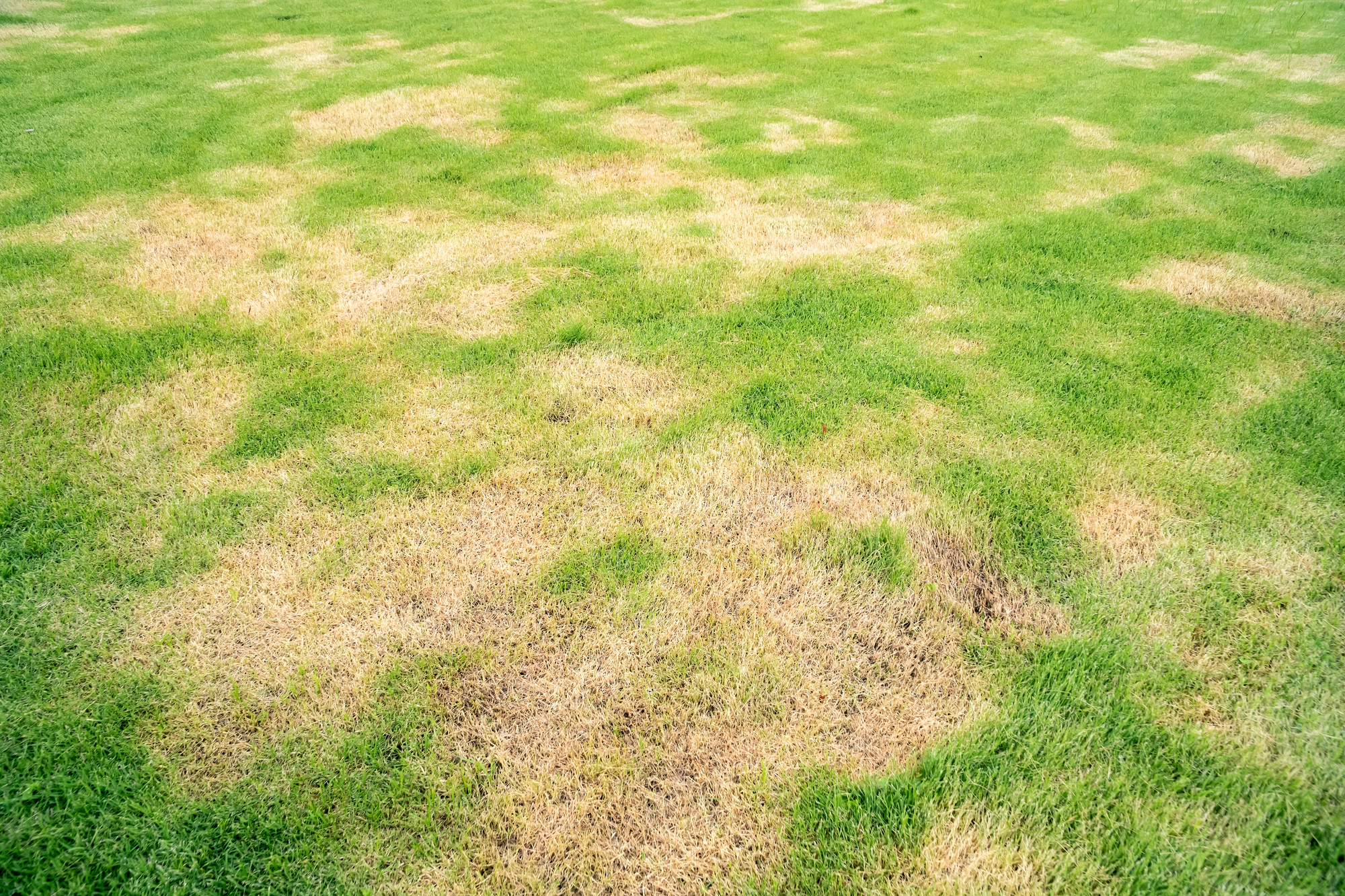
The two things people confuse it with are worth separating properly. Drought stress moves through a lawn in a pattern dictated by the soil: the thin, sandy, sun-baked strips go first, footprints stay pressed into the sward for minutes after you walk across, and the grass takes on a blue-grey cast before it browns. Anthracnose ignores that logic. It appears as irregular yellow to bronze patches from a few centimetres (an inch) across up to a metre (3 feet) or more, with no relationship to where the soil dries fastest, and the individual leaves yellow from the tip downwards rather than folding and greying along their length. Dollar spot is the other suspect, and its signature is on the blade: bleached straw-white lesions pinched in the middle like an hourglass, often with a reddish-brown margin, in patches about the size of a coin. Anthracnose lesions are yellow to reddish-brown and never form that hourglass pinch.
The grasses in the patch tell you something too. Annual meadow-grass (Poa annua) and the bentgrasses are the highly susceptible ones, so if your lawn carries a heavy population of that pale, seed-heading annual meadow-grass, the yellow patches will often map almost exactly onto where it grows. Perennial ryegrass and the fescues are far less susceptible. A lawn that is 70 per cent ryegrass and fescue with 30 per cent annual meadow-grass can look mottled and blotchy through July for precisely this reason: one species is collapsing while the others carry on.
Two forms, and only one of them is survivable
The same fungus causes two different diseases and the distinction decides whether your lawn recovers in September or has to be reseeded. Foliar blight is the milder form. The fungus colonises the leaf tissue, the older leaves yellow from the tip and die back, and the turf thins and goes off colour. The crown, the growing point sitting at the base of the plant, stays alive. Once the heat breaks and the rain returns, the plant pushes new leaves and the patch closes over.
Basal rot is the form that kills. Here the fungus attacks the leaf sheaths, the crown, and the stolons at the very base of the plant. Pull an affected plant out of the ground, strip back the outer sheaths, and the tissue at the base is blackened and water-soaked, dark and soft where it should be firm and white. That crown is the plant’s entire regenerative capacity. Lose it and the plant is dead, permanently, and no amount of autumn rain brings it back. This is the difference between a lawn that greens up when the weather turns and a lawn that stays bare, then fills with the seedlings of annual meadow-grass and broadleaf weeds through September and October, when soil temperatures are still warm and the bare ground is wide open. The autumn weed invasion that follows a bad anthracnose summer is not bad luck. It is the direct consequence of dead crowns leaving unoccupied soil.
Basal rot also explains why a lawn can look worse three weeks after the heat breaks than it did at the peak of it. The crowns were killed in the heat; the collapse only becomes visible when the surviving plants green up around them and throw the dead ground into relief.
Why it is a stress disease, and why cutting low is the trigger
Colletotrichum cereale is a weak pathogen. It rarely takes down a plant that is growing well. What it does, with real efficiency, is finish off plants that are already exhausted, and turf pathology programmes at Rutgers, Penn State, Purdue and Michigan State all describe it in the same terms: a stress-induced disease driven by low nitrogen, close mowing, compaction, drought, traffic and heat. The fungus becomes aggressive when day temperatures sit around 25 to 30 degrees C (77 to 86 degrees F), nights stay above 20 degrees C (68 degrees F), and leaf surfaces stay damp from dew while the soil underneath is dry. That combination is exactly what a midsummer high-pressure spell delivers.
Mowing height is the single biggest lever you control, and the numbers from the Rutgers work on annual meadow-grass are startling in their scale. Mowing at 2.8 mm (0.110 in) increased anthracnose severity by 3 to 21 per cent compared with mowing at 3.6 mm (0.142 in), with 3.2 mm sitting between the two. A difference of eight tenths of a millimetre in cutting height changed how much disease the turf carried. Scale that principle up to a garden lawn cut at 20 mm instead of 40 mm and the mechanism is the same, only larger.
The mechanism is carbohydrate. A grass plant funds everything it does, including its defence responses, out of sugars made in the leaf. Cut the leaf shorter and you remove photosynthetic area, so the plant draws down its stored reserves to rebuild what you took. Cut it shorter again a week later and the reserves never rebuild. A plant running on empty cannot mount a defence at the infection site, cannot repair damaged tissue, and cannot push roots deep enough to reach moisture at 150 mm (6 in) when the top 50 mm (2 in) has baked dry. Short mowing also raises soil temperature at the crown, which suits the fungus and punishes the grass. Every close cut in a July heatwave is a direct transfer of resources from the plant to the pathogen.
Mowing a wilted lawn compounds it. When the leaf is flaccid and the plant has lost turgor, the blades tear rather than cut cleanly, and every torn edge is an open wound the fungus can colonise. Mow in the evening after the lawn has recovered, or wait for a cooler day. Blunt blades do the same damage on a good day, so sharpen them.
The programme that actually works, with what it costs
Feeding is the treatment. This runs against every instinct, as gardeners are told not to feed a lawn in a drought, but the research is consistent and it is the strongest single finding in the field. Rutgers trials found that greater nitrogen fertilisation produced a bigger reduction in anthracnose severity and a bigger improvement in turf quality than either raising the mowing height or increasing sand topdressing, and that weekly summer applications of roughly 0.1 lb of nitrogen per 1,000 square feet cut disease significantly compared with lower rates. Combining higher nitrogen with a higher cut and topdressing suppressed the disease to an acceptable level with no fungicide at all through moderate outbreaks. Nitrogen works here for a simple reason: it funds new leaf growth, and new leaf outruns the infection. A starved lawn hands the fungus a stationary target.
On a garden lawn cut far higher than a putting green, aim for around 5 g of actual nitrogen per square metre per month through the summer, roughly 1 lb per 1,000 square feet, and split it into two lighter doses two or three weeks apart rather than one heavy hit. Little and often is the whole point. A single large dose of soluble nitrogen on a heat-stressed lawn forces a flush of soft growth the plant cannot support and burns the leaf if the soil is dry.
- Miracle-Gro EverGreen Fast Green Lawn Food, the 400 m2 pack, £29.99 at Coolings garden centres, with smaller 80 m2 and 200 m2 packs for a modest lawn. Also stocked through B&Q and Amazon. It carries an iron supplement alongside the nitrogen, which greens the leaf without pushing soft top growth.
- Scotts Turf Builder Lawn Food (32-0-4), a 12.5 lb bag covering 5,000 sq ft, $27.24 at Home Depot, and stocked at Lowe’s. That bag delivers 4 lb of actual nitrogen across 5,000 sq ft, which lands at 0.8 lb per 1,000 sq ft, close to the monthly figure above.
- Vitax Clay Breaker, a 2.5 kg tub, £7.99 at Polhill Garden Centre and widely stocked through independent garden centres. A calcium-based conditioner that flocculates clay particles and opens up the pore structure so water and air reach the root zone.
- Simple Lawn Solutions Liquid Soil Loosener, a 32 oz bottle, $34.99 direct and also sold through Amazon, treating up to 32,000 sq ft. It works alongside mechanical aeration rather than replacing it, moving water vertically through compacted ground instead of letting it run off.
Raise the cut and leave it raised. Set the mower to at least 35 mm (1.4 in) and preferably 40 mm (1.6 in) for the rest of the summer, and never take off more than a third of the leaf in one pass. If the lawn has run long and you want it back to 40 mm from 80 mm, do it over two cuts a week apart.
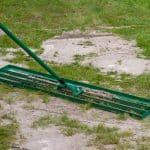
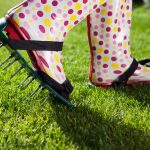
Relieve compaction where the patches are worst, which is usually the routes people walk. Hollow-tine or solid-tine those areas now with a garden fork driven 100 mm (4 in) deep at 100 mm spacings, then work a light sandy topdressing into the holes at around 2 to 3 kg per square metre. Rutgers found sand topdressing suppressed anthracnose independently of the other practices, and the reason is mechanical: it protects the crown from the mower and from foot traffic, and it keeps the crown zone drier while the root zone stays moist. Lightweight rolling helped in the same trials, smoothing the surface so the mower does not scalp the high spots.
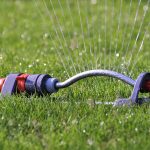
Water deeply and infrequently. One or two applications a week totalling around 25 mm (1 inch), applied early in the morning, keeps the root zone alive without leaving the leaf wet overnight. Frequent light sprinkling does the worst of both: it keeps the canopy humid, which the fungus wants, and it never wets the soil deeply enough to grow roots, which the grass needs. Rutgers work also found that soils deficient in potassium carried worse anthracnose, so a summer feed with a potassium component earns its place.
The mistakes that turn a bad patch into bare ground
The first mistake is reaching for a weed and feed. Those products pair fertiliser with a selective herbicide, and applying a herbicide to a lawn already under heat and drought stress adds a second injury to plants that are barely holding on. Feed now, and deal with weeds in autumn when the grass is growing again.
The second is scarifying or raking hard in the belief that the patches are thatch. Dragging a scarifier through a lawn full of anthracnose tears crowns out of the ground, spreads infected debris across clean turf, and turns a recoverable foliar blight into bare soil. Leave the scarifier in the shed until September.
The third is a fungicide bought in a panic. Domestic products for turf disease are limited, and the Rutgers work found that nitrogen rate and mowing height changed how well fungicides performed in the first place. A starved, scalped lawn undermines the chemistry you paid for. Fix the agronomy and the disease pressure falls on its own.
The cost of getting this wrong is measured in seed and time. A lawn that loses its crowns to basal rot does not thicken back up in autumn on its own. You are looking at overseeding at 25 to 35 g per square metre, a bag of seed and a fortnight of watering through September, and a spring spent watching annual meadow-grass and broadleaf weeds compete with the seedlings you paid for. A lawn that keeps its crowns through a hot July needs nothing more than a feed and the rain.