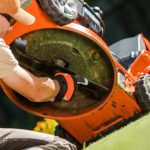

- If the mower drops clumps, leaves an uneven, ragged finish and the bag fills slowly, the underside of the deck is probably caked with a hard crust of old clippings.
- Scraping it back to bare metal takes about half an hour with the blade off, a putty knife or scraper and a wire brush, then a spray of lubricant so grass stops sticking.
- Left alone, the packed grass traps moisture against the steel and chokes the airflow the deck needs for a clean cut, so a free half-hour now saves a rusted deck and a ragged lawn later.
The Clumps on the Lawn Are Coming From Under the Deck
The cut has gone scruffy. The mower drops clots of grass in little piles, the finish looks uneven and ragged a day later, and the collection bag fills half as fast as it used to. Before you blame the blade or the engine, tip the mower up and look underneath. Nine times out of ten the deck, the metal housing over the blade, is lined with a hard grey-green crust of old clippings packed into every corner.
The fix costs nothing but half an hour. With the blade off and a scraper in hand, you take that crust back to bare metal, finish with a wire brush and a spray of lubricant, and the mower cuts cleanly again. Family Handyman puts the problem plainly: “All lawnmowers develop layers of caked grass under the mower deck, which can cause poor cutting performance.” The end of the mowing season is the right moment to do it, so the machine goes into winter clean and dry instead of sealing a season of wet grass against the steel for months.
Why a Caked Deck Ruins the Cut
A mower does not just chop grass, it stands it up and lifts it. The spinning blade and the shaped deck above it create a draught that pulls each blade of grass upright so the cutting edge slices it, then carries the clippings out to the bag or the side chute. That airflow is the whole trick behind a clean, even finish. Pack the deck with a thick rind of old grass and the space the air moves through shrinks, the draught weakens, and the blade starts to batter the grass flat rather than slicing it. The result is the ragged, clumping cut you noticed, and a bag that no longer fills. The same draught feeds the collection bag, which is why a choked deck and a slow-filling bag tend to turn up together; This Old House lists cleaning the grass bag alongside the deck so the air keeps a clear run.
There is a slower cost, too. Packed clippings hold water like a sponge and press it against the steel deck for days, and wet grass against bare metal is how rust starts. A deck scraped and dried at the end of each season outlasts one left to rot from the inside, which is the difference between a mower that lasts fifteen years and one that corrodes through in six. A dull finish also leaves the lawn open to trouble. As This Old House landscaper Roger Cook puts it, a ragged cut “invites disease and gives your lawn a brown cast two or three days after mowing.” A clean deck and a sharp blade are two halves of the same clean cut.
How to Scrape the Deck Clean, Step by Step
Start with safety, every time. Pull the spark plug cap off the plug before you go anywhere near the blade, so the engine cannot fire while your hands are under the deck. On a petrol mower, run the tank down low or empty first, and note which way you tip the machine: keep the air filter and carburettor side up, so oil and fuel do not run into them. Family Handyman is firm on that point, telling you to “keep the air filter and carburetor up so oil and fuel don’t leak into the carburetor.” A cordless mower is simpler: take the battery out and set it aside.
Next, take the blade off. It gives you a clear run at the deck and keeps your knuckles away from the cutting edge. Hold the blade still with a block of wood wedged against the housing, undo the central bolt with a socket and ratchet, then set the blade aside to sharpen while the deck is open. Roger Cook keeps it short: “Take the blade off, take a putty knife and scrape the deck clean.”
Now scrape. Work a putty knife, a stout paint scraper or a small pry bar (£3 to £8, or $4 to $10) under the crust and lever it off in sheets. Family Handyman sets a sensible target: “The underside of the deck does not have to be super-clean, just remove material down to the metal.” If the grass has baked on too hard to shift, do what the same guide suggests and soak it first: “soak the underside of the mower with a garden hose, let the grass soften for an hour, then scrape it clean.” Follow the scraper with a wire brush (£3 to £6, or $4 to $8) to take off the last residue, then let the deck dry fully before you go further. Keep a pressure washer away from the job: forcing water into the blade spindle, the bearings or the engine does more harm than the caked grass ever did, and a plain garden hose shifts everything the scraper leaves behind.
Finish with a coat that stops it happening again. A light spray of silicone or dry PTFE lubricant (£5 to £9, or $6 to $12) over the clean, dry metal gives grass nothing to grip. Roger Cook explains why it works: “That’s gonna make it slick so that no grass is gonna stick in there anymore.” Refit the sharpened blade, tighten the bolt back up, and only then push the spark plug cap back on. While the mower is stripped, it is the natural moment to change the oil and clean the air filter; our guides to cleaning the air filter and sharpening and balancing the blade cover both.
How Often to Do It, and When to Give Up on the Deck
A full scrape once a year, at the end of the season, keeps most mowers healthy, and a quick look under the deck every few cuts in peak growth catches a crust before it bakes on hard. Cutting wet grass packs the deck fastest, so a mower used on damp lawns wants checking more often. Once the metal is slick with lubricant, a quick hose and a wipe is usually enough between full cleans. Mowers run in mulching mode, with the discharge blocked so the clippings are chopped small and dropped back into the lawn, cake the deck faster than bagging or side discharge, so look under those more often.
There is a point where cleaning is not the answer. If the scraper goes through the deck, or you find it thin and flaking with rust holes, the housing has had its day and no cleaning brings it back, as a holed deck throws clippings everywhere and cannot hold the airflow for a clean cut. If the blade is bent or cracked rather than just blunt, fit a new one rather than refit the old. And if the mower still cuts unevenly or shakes hard once the deck is clean and the blade is sharp and balanced, the fault has moved up into the crankshaft or the deck mounts, and that is the stage to hand it to a service engineer. Short of that, the deck is a half-hour job with a scraper, and it is the cheapest cut-quality upgrade your mower will ever get. With the clean done, store the mower somewhere dry for winter so it starts first time in spring; our guide to putting a mower away for winter takes it from there.