
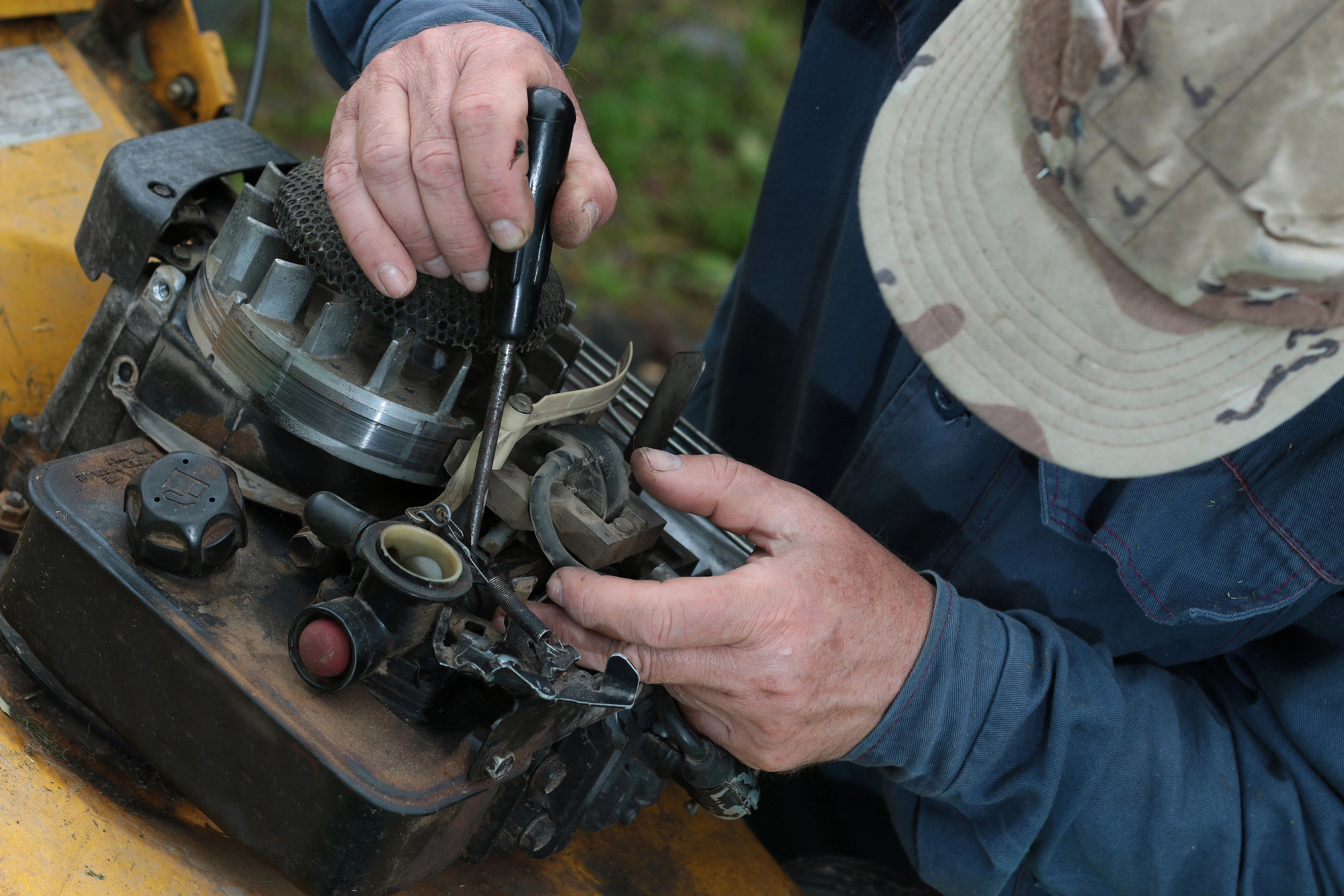
- A mower that catches for a second then dies, or needs pull after pull to stay running, almost always has a carburettor clogged by the fuel left sitting in it over summer.
- Stripping the carburettor and soaking its parts in cleaner for an hour clears the gum from jets finer than a human hair, and a rebuild kit or a replacement carburettor costs a fraction of a workshop bill.
- Running the tank dry or adding a fuel stabiliser before the mower goes away stops the gum forming in the first place.
Why a Mower That Ran Fine in June Will Not Fire in Autumn
The fault is almost never the engine itself. It is the fuel you left in it. Pump petrol starts to break down in about a month, and the ethanol blended into most of it pulls water out of the air and holds it. Over a summer standing in a warm shed, the lighter parts of the petrol evaporate and what stays behind thickens into a sticky gum and a hard varnish. That residue settles in the worst possible spot: the narrow jets and drillings inside the carburettor, several of them finer than a human hair.
A small engine runs on a fine mist of fuel and air. The jets meter that mist down to a precise amount, and when gum narrows or blocks them the engine can pull in air but not enough fuel. So it catches on the thimble of neat fuel the choke or primer delivers, burns through it, and dies a second or two later. Pull after pull gives the same short cough. The engine is healthy. Its fuel supply is throttled to a trickle.
Family Handyman’s small-engine guide puts the scale of it plainly: repair shops earn around half their income from cleaning or replacing carburettors knocked out by old fuel. A workshop minimum charge sits at about £65 ($80) plus parts, and the carburettor work itself is roughly an hour of labour you can keep in your own pocket. The parts are cheap. What you are really paying a shop for is the knowledge of which part to clean, and that is what this walks through.
Check the Cheap Faults First
Before you unbolt anything, rule out the five-minute faults. Make sure the fuel tap is open, there is fresh petrol in the tank and the spark plug is clean and throwing a spark. A fouled plug and an empty tank account for a surprising share of mowers dragged to the bench.
Then test whether the trouble really is fuel. Spray a one-second burst of carburettor cleaner (a 400ml to 500ml can runs about £5 to £8, or $7 to $11) straight into the carburettor throat and pull the cord. If the engine fires and then dies, the ignition side is doing its job and the fuel side is the problem, which points at the carburettor. If there is no life at all after a few pulls, the fault is deeper than a dirty carburettor and the machine belongs at a garage.
One more test saves a wasted strip-down. Clamp the fuel line, slide back the spring clamp, work the tube off the carburettor nipple and catch the petrol in a bowl. If fuel runs out freely, the supply is fine and the carburettor is the suspect. If nothing comes, the line or the fuel filter is blocked, not the carburettor, and a new length of fuel hose or a filter is a far cheaper fix than a strip-down.
How to Strip and Soak the Carburettor
Work in a ventilated spot, wear gloves and an organic-vapour respirator, and gather a 4-in-1 screwdriver, a nut driver or socket set, an adjustable wrench, needle-nose pliers and a couple of clamps before you start. Carburettor cleaner is strong stuff and the fumes are not pleasant in a closed garage.
Take out the two mounting bolts, unhook the throttle cable from the linkage and lift the carburettor clear, standing it in a container to catch the fuel that drains. Open the float bowl on the bottom and look inside. White or green crust is corrosion, and a corroded carburettor body should be replaced rather than cleaned, as the pitting never seals properly again and the leaks come straight back.
If the inside is just gummed and varnished, strip it from the bottom up in order: bowl, float, needle and seat. Photograph each stage on your phone so putting it back together is a matter of running the pictures in reverse. Lay the new gaskets and O-rings from a rebuild kit (about £10 to £20, or $13 to $26) next to the old ones as you remove them, so each worn seal is matched to its replacement. Wire the larger metal parts together, wrap the small parts in a scrap of fine aluminium mesh so nothing escapes down the drain, and soak the lot in a bucket of carburettor cleaner for one hour. New kit parts go in dry and need no soak. Rinse everything in clean water, blow it dry with compressed air rather than a cloth that sheds fibres, rebuild it, bolt it back on and set the idle speed and mixture to the kit’s figures before you fire it up.
Short on time or nerve? You can often skip the full removal. Take off the float bowl on its own and work cleaner up into the exposed fuel passages and the main jet. It will not rescue a badly gummed carburettor, but on a mildly dirty one it clears enough to get the engine running again. Keep in mind that a brand-new carburettor often costs about the same as a rebuild kit plus the chemicals, which is why many repairers fit a new one by default rather than gamble an afternoon on a clean. When you order either, quote the machine’s make, model and serial number along with the engine’s make and serial number, usually stamped on a metal plate above the spark plug or on the carburettor’s mounting flange.
When to Stop and Call Someone
Hand it over when the carburettor body is corroded and a replacement will not drop straight in, when fresh fuel still will not reach a cleaned carburettor after you have cleared the line and the filter, or when the engine will not catch at all with a clean plug and a known spark. At that point you are into valves, the ignition module or lost compression, and those want a workshop with the right gauges. Set against a full day over the bench as a first-timer, a £65 ($80) minimum charge can be money well spent on the jobs that run deeper than fuel. For the rest of the autumn service you can keep in-house, our guide to putting your mower away for winter so it starts first time in spring and the one on sharpening a blade that tears the grass instead of cutting it cover the other faults that build up over a cutting year.
Stop It Gumming Up Again
The whole repair is avoidable, and the cure costs a few pounds. Never let petrol stand in a mower over the off-season. Either run the tank and the carburettor dry at the end of the cutting year, turning the fuel tap off and letting the engine idle until it stops on its own, or add a fuel stabiliser (£6 to £10, or $8 to $13 a bottle) to a full tank and run the engine for a few minutes so the treated fuel reaches the carburettor and sits in the jets over winter.
Buy petrol in small amounts so none of it ages in the can, and keep the mower somewhere dry rather than a damp shed where condensation adds to the water the ethanol already draws in. For a machine that sits for months, ethanol-free alkylate petrol (around £22, or $29, for 5 litres, about 1.1 gallons) keeps for years rather than weeks and leaves almost no gum behind. Do that one thing and the carburettor you cleaned this autumn will still be clean next spring, and the mower starts on the first or second pull instead of going back on the bench.