
- RHS advisers say clover is a wildflower, not a weed, and that it makes its own nitrogen and stays green when the grass around it struggles.
- Patches of clover often point to thin, hungry or compacted grass, and many lawn weedkillers do not touch clover anyway.
- If you want it gone, thicken the grass, rake before you mow and lift the stems out by hand; if you want a green lawn that needs no feeding, leave it alone.
Clover Is Not the Sign of a Failing Lawn Most People Think It Is
You walk out, see white flowers and a mat of small three-leaf plants creeping through the grass, and decide the lawn has lost the fight. It has not. Clover is a wildflower and a member of the pea family, and it does well where grass struggles. It can do something grass cannot: with help from soil bacteria, it turns nitrogen gas from the air into food for itself.
That changes the first job. Before you reach for a sprayer, decide whether the patch is a problem at all. If it is green, soft underfoot and takes the mower, you can leave it, and it asks for no feeding or watering. If you want fine turf with nothing in it but grass, the fix is to thicken the grass and lift the clover by hand. Clover loses to dense, healthy lawn grasses, and it shrugs off many selective lawn weedkillers.
Autumn is the season for deciding and preparing. Hand pulling and raking work now, and the autumn jobs that take away clover’s advantage, scarifying and aerating, are best done in September or October.
What Clover Actually Does in Your Lawn
The plant most people call clover is usually white clover, a creeping perennial that roots along its stems. It can grow to 45 cm (18 in) tall but is often much shorter in a lawn. Creamy-white flowers appear from late spring until October, and the leaves usually come in threes.
Relatives share the patch. Lesser trefoil forms a flat, roughly circular mat of thin, wiry stems with yellow flowers and can reach 25 cm (10 in), though it is usually shorter. Black medick, about 20 cm (8 in) tall, drops black seedpods. You do not need to tell them apart, as one set of methods deals with all of them.
Clovers form a partnership with soil bacteria. The clover gives the bacteria energy, and the bacteria convert nitrogen gas into a form the roots can use for healthy green growth. With their own nitrogen supply, clovers need no fertiliser to stay green. They also cope with drought better than lawn grasses, so they need no watering either, and in a parched lawn the clover is the part that stays green.
Clover copes with some foot traffic, which makes it a fair stand-in for grass on poor, dry soil. Its flowers are a good source of nectar for bees. Its leaves cast shade over the soil, which makes life hard for other weeds trying to take root. It also deposits nitrogen in the soil, and some gardeners mix white clover seed into grass seed on purpose.
A weed is a plant growing where you do not want it, and the call is yours.
What Clover Is Telling You About Your Soil
Clover turns up for reasons that mostly come down to the soil. Three problems give it an opening.
Low nitrogen. Grass needs nitrogen to grow well, so clover wins wherever the soil runs short. Purdue University’s turf programme lists white clover as a possible sign of low nitrogen fertility.
Compaction. Hard, packed soil stops grass roots reaching the nutrients, air and water they need. Clover tolerates compaction, drought and cold better than turfgrass does, so it fills the gaps.
Thatch. A thin layer of dead grass and organic material between the soil and the green blades does good. A thick layer blocks water and nutrients from reaching the soil, so the grass thins and clover moves into the gaps.
Mowing height belongs on that list. White clover tolerates close mowing, and cutting grass too short stresses it. Mowing very short in summer weakens grass and leaves bare patches for weeds to settle in. Clover spreads by seed, and seed germinates when it lands on bare soil. White clover and bird’s foot trefoil also creep along by stems or underground stems called rhizomes, so in the right conditions they build large patches.
Paul Tukey, an organic lawn-care advocate featured in This Old House Magazine, sums up the lesson: “You can kill the messenger all day long, but it doesn’t change the message that something is wrong with your soil.” Kill the clover and leave the low nitrogen, the compaction and the thin grass in place, and the next batch of seed lands on a lawn that still favours it.
When to Leave Clover Alone and When to Take It Out
Leave it if you want a lawn that stays green with the least work. Clover needs no feeding, no extra watering and little attention, and it holds its colour on poor, dry soil when the grass fades. There is no need to feed a lawn where you want more wild plants to grow. If your priority is bees and butterflies, the flowers are the reward.
Take it out if you want a perfectly manicured fine lawn. You will probably want every patch gone, and the methods below work without a bottle of chemicals.
There is a middle path. If you like some clover but not a carpet of it, cut off faded flowers before they set seed, or mow regularly to deadhead the low-growing patches. That holds the numbers down.
There is also a way to keep clover on your terms. Some gardeners reseed with white clover, often dwarf types, and seed companies sell a low-growing micro clover made for mixing into grass seed. One seed supplier advises that a mix with grass seed should not exceed 3 percent clover to grass. The same supplier says clover sown in October can wait until the following spring to germinate, and that spring or early summer is the ideal time. Treat sowing as a job for spring.
How to Remove Clover Without Weedkiller
Start with small patches, where hand removal gives quick results.
Pull it. Grasp the sprawling stems together and pull, taking the roots with them. Where the soil is compacted or the plant is well established, slide a hand fork under the rooted stems and lift the whole plant out. Leave roots behind and the clover grows back.
Fill the bare soil. Bare soil is where clover seed germinates, so a gap left open invites the next generation. RHS puts autumn sowing of lawn seed at September to November and calls early autumn the better option, as the seedlings root in before the first hard frosts. If that window has passed where you live, spring is the other time to sow.
Rake before you mow. Rake over the clover to lift the stems, so the mower removes more growth. That weakens each plant and stops it seeding itself.
Clear the clippings. Rake up and remove the clippings that contain clover. Left behind, they let the plant shed seed or root again.
Re-turf a badly infested patch. Where clover grows through the grass and pulling will not shift it, cut out and lift the turf with a sharp spade, remove the roots, fork the soil over lightly, rake it level, tread it down and lay fresh turf.
Covering a patch with black plastic sheeting cuts off light and kills clover over a few weeks. It kills the grass beneath too, and for well-established plants with deep roots the process can take a year or more, with the dead roots dug out at the end. Re-seed or turf the gap once the patch is clear.
Sprays are the shortcut that does not work. Clovers, trefoils and medicks resist many selective lawn weedkillers, and the methods above work, so there is no need for one. Non-selective products kill the grass along with the clover and leave bare soil, the exact place clover seed germinates. Vinegar from the kitchen, at about 5 percent acetic acid, is unlikely to work. Horticultural vinegar, at 20 to 30 percent, can cause skin and eye damage, so it calls for protective gear. It is non-selective, so it can kill the grass beside the clover, and it can burn the clover leaves while leaving the roots intact.
How to Stop Clover Coming Back
Mow higher. Short cuts stress grass and thin the turf, which opens gaps for weeds. Taller grass grows deeper roots and shades out weeds, and sharp blades cut the grass cleanly instead of ripping it. Check the cutting height that suits your grass and set the blades toward the top of it. RHS gives up to 40 mm (1.5 in) in spring and autumn for an ordinary domestic lawn, while a university extension guide recommends 5 to 8.9 cm (2 to 3.5 in) for bluegrass and 6.4 to 8.9 cm (2.5 to 3.5 in) for tall fescue. Mow once a fortnight or once a week in autumn, depending on growth, and never take off more than a third of the height in one cut.
Clear the thatch. Scarify in autumn with a spring-tined rake, raking vigorously in one direction and then the other, without uprooting the grass. If you cannot see the soil between the blades, the lawn needs it. Remove all the raked-out thatch. Water then reaches the soil more easily, which helps the lawn cope with drought.
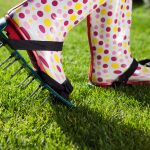
Relieve the compaction. Spike the lawn with a garden fork, with each set of holes 10 to 15 cm (4 to 6 in) apart and as deep as you can push, then rock the fork to widen them. For most lawns, aerating every two to three years is enough. On clay or waterlogged soil, a hollow-tined aerator makes wider holes, best done every three to four years, followed by top dressing raked into the holes.
Feed only a thin lawn. Most lawns recover from summer wear without feeding. If yours needs a boost, use a feed made for autumn, as it encourages root growth through winter instead of leafy growth. Apply it just before rain at the rate on the pack, and water it in if rain has not come within a day or so.
Do these jobs through the year and the grass thickens until clover has little room to start. If a patch still returns after a season of good care, keep fixing the soil or accept it. The plant that feeds your lawn is a weed only if you call it one.