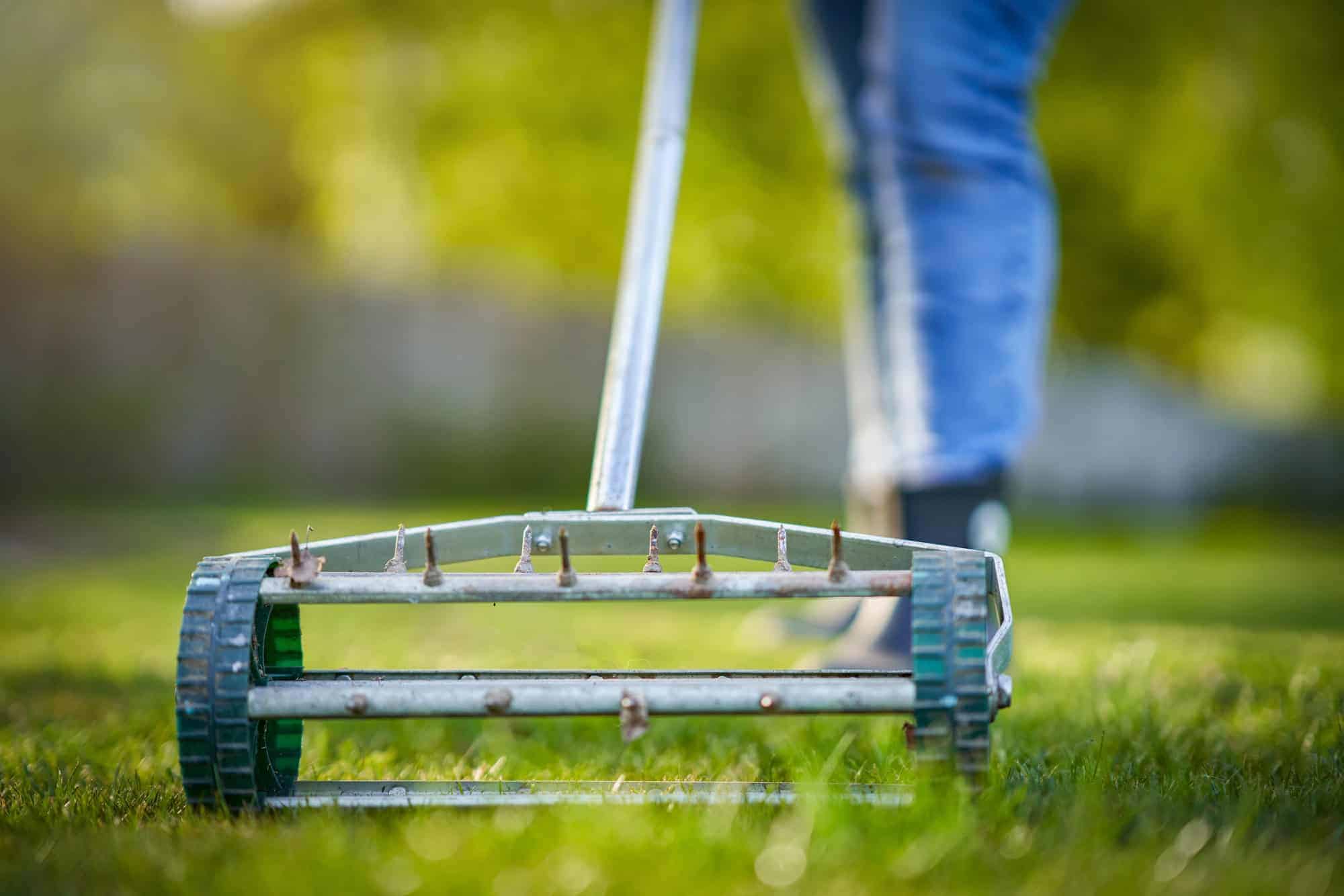
- A bottle of liquid aerator is a wetting agent that helps water soak into the top of the soil for a short time, and it does almost nothing for compaction.
- A garden fork or a hollow-tined tool opens the soil to the depth roots need, and a top dressing keeps the holes from closing.
- A bottle is worth buying only as an extra on top of fork or tine work, never as a replacement for it.
Why a Bottle Cannot Do What a Fork Does to Packed Soil
Your lawn is hard underfoot, the water sits in puddles after rain, and the shelf at the garden centre promises to aerate the whole lot for pennies. It is a tempting deal. It is also the wrong tool for the problem.
Packed soil needs gaps, and gaps need something physical to make them. Push a garden fork into the turf, rock it from side to side, and you have made a channel for air and water. A bottle of liquid cannot do that. If you want the bottle as well, it goes on about a week before the core work, but the fork or tine does the job, and a top dressing worked into the holes finishes it.
The job waits until any standing water has drained away. Late autumn and winter are the best times to act on a waterlogged lawn. Neither the fork nor the bottle helps while the lawn is still under water.
What Is Actually in the Bottle
Liquid aeration involves applying a chemical solution. The main active ingredient is usually a wetting agent, also called a soil surfactant, which is designed to help water move into the soil and spread through it. Many bottles also contain humates, which are well-decomposed dark organic matter that can affect the soil’s structure, texture and water-retention capacities.
Some add nutrients too: magnesium, potassium and amino acids that carry nitrogen. These can make the lawn greener, but that is a feed. It is not an opened-up soil.
The wetting agent does have a real effect, and Professor Roch Gaussoin, PhD, of the Department of Agronomy and Horticulture at the University of Nebraska-Lincoln, explains it. “Putting a wetting agent onto the soil makes the surface less hydrophobic [water-repelling],” Gaussoin says. Water that used to bead and run off sinks in instead.
That is a change in how water behaves where it lands. It removes no soil and leaves no gap behind. Compaction is a shortage of space between soil particles, and spraying the surface with a surfactant cannot make that space.
What the Turf Specialists Found
Chris Lemcke, national technical director at Weed Man, a network of locally owned lawn care professionals, is blunt about it. “Liquid aeration products will have almost no effect on compaction, especially in the short term,” Lemcke says.
Gaussoin agrees, and adds that the evidence behind the products is thin. “These products aren’t extensively tested by independent agencies and when they are, the results are negative or not positive,” Gaussoin says.
Depth is the next problem. “Liquid aeration products don’t penetrate into the soil like the depth of a coring tine, which can go down four or five inches,” Gaussoin says. That is 10 to 13 cm, which is where the roots you are trying to help are working.
Even the water benefit fades. “We see some limited short-term increases in water infiltration, but they don’t last very long because the plant continues to create organic matter,” Gaussoin says. Treat a bottle as a short-term boost.
Three other claims on the label deserve a hard look.
- Loosening sodium-affected soil. Some products contain gypsum, which pushes sodium off the soil and opens it. The catch is how rare the problem is. “I’ve been doing this for 35 years and looked at literally thousands of soil samples, and I’ve only seen sodium-affected soils twice,” Gaussoin says. Your lawn is unlikely to be one of them.
- Breaking down thatch. Products often claim to contain microbes that clear thatch. Gaussoin cautions that testing has shown very mixed results.
- A tidier lawn. A liquid leaves no holes or plugs behind. Gaussoin points out that core aeration holes fill in quickly, and the plugs help as they break down and spread back into the soil.
Quality also varies widely. Many products make claims nobody has proved and list vague ingredients. If you buy one, look for a label that names an active nonionic surfactant, such as sodium lauryl sulfate.
What Opens Compacted Soil Instead
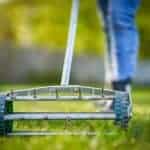
The cheapest tool is a garden fork. Space each set of holes 10 to 15 cm (4 to 6 in) apart and push down as far as you can, ideally to the full depth of the tines. Rock the fork from side to side to enlarge each hole. The step-by-step version is in the post on aerating a hard lawn.
The effort pays off in the roots. Spiking lets air and water move among the grass roots, which helps the lawn cope with both drought and waterlogging. On a soaked, packed lawn the water pushes air out of the spaces between soil particles, and roots that sit in that can drown. Holes give the water somewhere to go.
Wait until the standing water has drained before you start. On a small area, sweep the water off the lawn into a border first. For a waterlogged lawn the holes should ideally be 10 to 15 cm (4 to 6 in) deep.
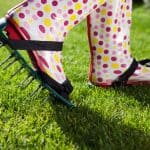
Heavy clay changes the advice. RHS advisers say a hollow-tined aerator suits clay or waterlogged soil better than a fork. It makes wider holes and pulls out plugs of soil, which relieves compaction more effectively. A second lawn guide, from Family Handyman, also rates coring above solid spikes. Sweep up the plugs, then rake a top dressing into the holes. Hollow-tine work on clay is best done every three to four years.
A fork is the simplest option, and for most lawns aerating every two to three years is adequate. Do not overdo it. Too much aerating can stress the roots. On a big lawn the work is hard, so concentrate on the worn or compacted areas, or take a different section each autumn. You can also hire or buy a powered aerator.
Top dressing is what stops the holes closing. Mix three parts sandy loam, six parts sharp sand and one part well-rotted home-made compost, measuring the parts with a bucket. The sharp sand is the washed, gritty kind sold for gardening, which is not the same as builders’ sharp sand. Ready-made top dressing works too. Apply it at 2 to 3 kg per sq m (4 to 7 lb per 10 sq ft), which is about a shovelful each time, and work it into the holes with the back of a rake or a broom. It should soon disappear. If a lot stays on the surface, use less next time. If it vanishes fast, use a little more. On heavy soil the mix improves the texture and drainage, which encourages better rooting and denser grass.
If you plan to overseed, aerate first. Lemcke explains why a bottle cannot stand in. “When you [core] aerate, you pull the plugs that break down and cover the seed, allowing for greater germination. Seeds also fall into the aerator holes and will germinate in the holes as well. This will not happen when using a liquid aeration product,” Lemcke says. The overseeding method goes hand in hand with it.
One caution on timing: aerating in spring can unearth weed seeds and bring up weeds you did not want. Do not work bone-dry soil either. You will barely break the surface.
When a Bottle Is Still Worth Buying
A liquid product has a place as a helper. “When a product containing a wetting agent is used in combination with core aeration, we see positive effects,” Gaussoin says. On dense clay, the extra water penetration can help the tines of a mechanical aerator go in more easily.
The cost is low. Expect to pay about $1 (76p) per 1,000 sq ft (93 sq m) to apply one yourself. Hiring a lawn care company runs $150 to $200 (£113 to £151) for a single treatment. Core aerators start at around $200 (£151), and they can end up the shrewder long-term spend. They do a better job, and you do not pay for each treatment. Manual aerating tools cost less, and you can rent a machine.
If you do mix a bottle with core or fork work, the method is simple.
1. Check the soil is damp, not soggy. If there has been no recent rain, water the lawn 24 hours before.
2. Check the application rate on the label, then spray evenly at the stated dilution with a backpack, pump-up or hose-end sprayer.
3. Water deeply to carry the solution in.
4. Wait around a week before the core aeration.
The best windows for cool-season grasses are early autumn or spring, and you can apply a bottle at any time. If the lawn is still hard after a bottle, the bottle was never going to fix it. A hard lawn needs the fork or the tine.
How to Stop the Soil Packing Down Again
Compaction comes back. Soil packs down from foot traffic, mowing and even rainfall, and heavy machinery, especially after building work, does worse damage. Heavy recreational use and active pets add to it. A sticky, glue-like layer of puddled soil can form near the surface of a wet lawn, and walking on it makes it worse, so keep off waterlogged areas.
Where people always walk the same line, the grass wears and the soil packs hardest, and the post on a muddy shortcut across the lawn covers how to protect a path like that.
A simple routine keeps the lawn open.
- If the lawn is prone to waterlogging, spike it every few years in autumn. That avoids emergency action after a wet winter.
- Top dress after each aeration so the holes fill with sand and loam instead of collapsing.
- Stay off the lawn while it is saturated, and avoid heavy loads across it.
- Skip aerating when the soil is waterlogged or bone dry, and wait for the ground to drain.
If the lawn stays under water after rain, the problem is larger than a spiking job. Heavy clay can drain poorly across the whole garden, and a drainage system is worth considering if you have somewhere for the water to go, such as a ditch, drain or soakaway. For the lawn itself, look at a powered or hollow-tined aerator. A bottle will not shift it.