
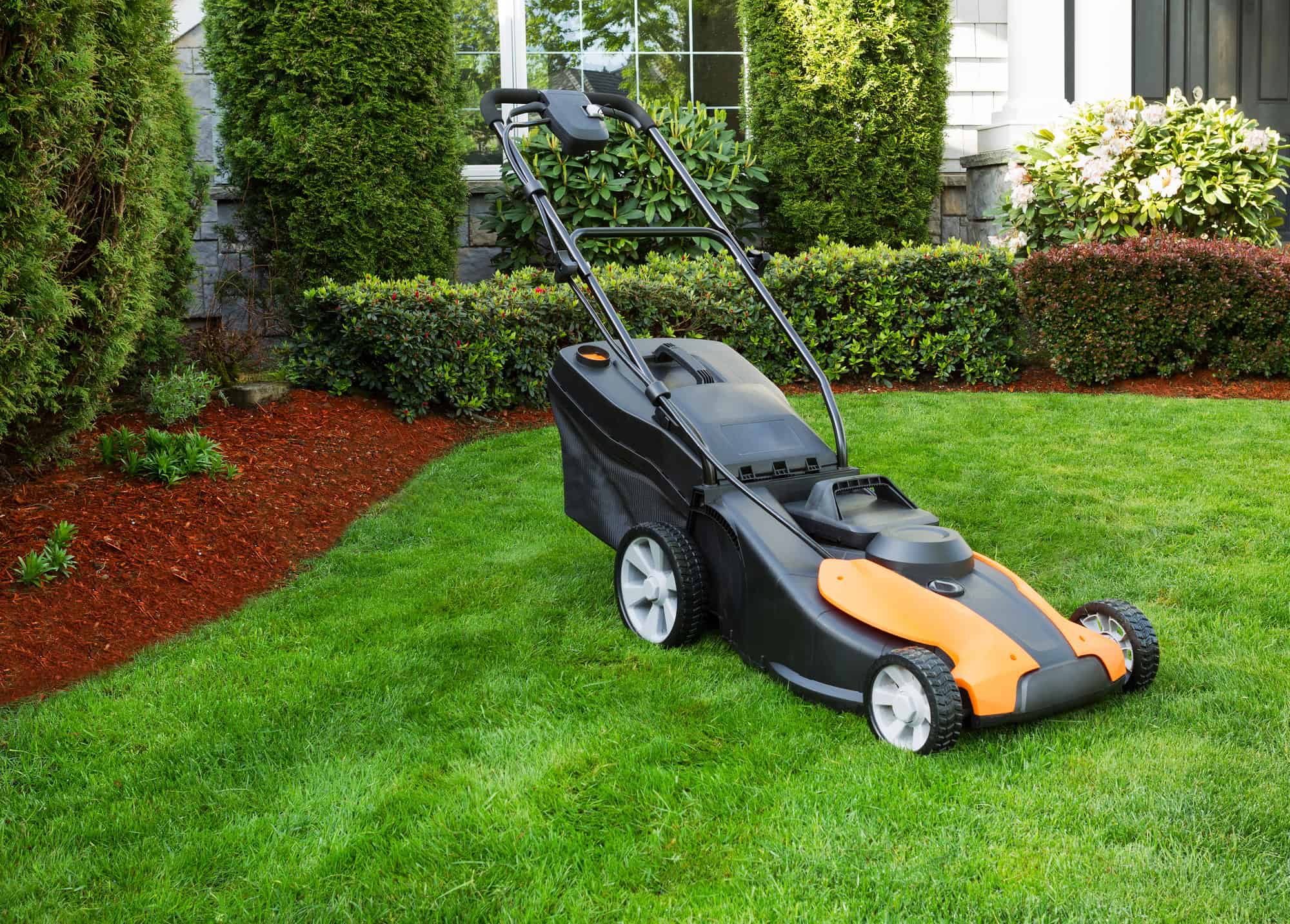
- Cutting width sets how long a lawn takes: 30 to 34 cm (11.8 to 13.4 in) for lawns under 50 square metres (538 sq ft), 35 to 40 cm (13.8 to 15.7 in) from 50 to 150 square metres (1,615 sq ft), and wider than 40 cm (15.7 in) above that.
- Four measurements with a tape and a walk round the garden, the lawn size, the narrowest gap, the slopes and where a cable reaches, tell you more than the price label does.
- A wider deck saves time on open grass and costs you time round borders, so bigger is only better when the lawn is open.
Why Your Mower Takes Forever on the Open Grass and Fights You Round the Borders
You push the mower out, and it is either a nightmare round the flowerbeds or it takes all afternoon to cross the lawn. Either way, the width of the deck is the first thing to check.
The fix is to measure before you buy anything. Measure the lawn, read the cutting width band that matches its size, then check the power source against the same measurement. Which? testers define cutting width as the size of the mower blade: the larger the blade, the more grass it cuts on each pass. Their bands are 30 to 34 cm (11.8 to 13.4 in) for lawns under 50 square metres (538 sq ft), 35 to 40 cm (13.8 to 15.7 in) for lawns from 50 to 150 square metres (1,615 sq ft), and wider than 40 cm (15.7 in) for anything bigger.
Their warning on the two ways to get it wrong is blunt. Too large a cutting width on a small lawn and you struggle to manoeuvre in tight corners. Too small a cutting width on a large lawn and the job takes much longer.
Measure the Lawn and the Gaps Before Anything Else
You need four numbers before you open a shop page.
1. Lawn size. Measure the length and the width with a tape, or count your paces after checking one pace against the tape. Multiply the two. For a lawn that is not a rectangle, split it into rectangles and add them up. The answer in square metres puts you in a band.
2. The narrowest gap. Measure the tightest point the mower has to pass through: a gate, the space between two beds, the gap between a shed and a fence. The mower’s overall width, wheels included, has to fit through that gap, whatever the lawn size says.
3. The slopes. Note any bank. Roger Cook, contractor for This Old House, advises that mowers should not be operated on slopes of more than 15 degrees, a rise of 1 foot in every 4 (30 cm in every 1.2 m). On shallow grades, mow across the slope. Mowing up and down a hill invites an injury if you slip.
4. Where a cable reaches. Stand at the socket you would use and walk to the far corner of the lawn. If the cable stops short, a corded mower needs an extension lead, which changes the power source choice below.
Write the four numbers on a card.
What Cutting Width Does on Every Pass
Each pass cuts a strip as wide as the cutting width, so the number of strips and the number of turns grows as the width shrinks. The arithmetic is simple. A lawn of 150 square metres (1,615 sq ft) needs 375 m (1,230 ft) of walking with a 40 cm (15.7 in) deck, as the area divided by the width gives the strip length. A 30 cm (11.8 in) deck needs 500 m (1,640 ft) for the same lawn. That is a third more walking for ten centimetres (3.9 in) less deck.
A wide deck on a small lawn struggles in tight corners. RHS advises cutting corners that are too tight or boxed in for the mower separately with lawn shears or a strimmer, and a wide deck leaves more of that job.
Push mowers cover a narrow range: between 18 and 22 inches (46 to 56 cm). The 18 inch (46 cm) end suits small lawns and stores easily, at the cost of more passes. The 22 inch (56 cm) end is heavier and harder to turn, and gets through the grass much faster. These sizes sit above the first two Which? bands, as the push mower source counts a small yard as up to 2,000 square feet (186 sq m). When the figures disagree, let the narrowest gap and the power source decide. Reel mowers run narrower, often 13 inches (33 cm) and up to 20 inches (51 cm), while electric and battery mowers typically run from 14 to 21 inches (36 to 53 cm).
Mowing a large lawn can take more than an hour, and RHS says a model with a wider cut could save significant time for only a modest increase in price. Which? gives the other side: if you spend more on a mower, you are often paying for features such as wider cutting widths, self-propelled drive and longer battery life, not for guaranteed better performance. Price is very rarely an indication of how good a mower is. Pay for width when your lawn asks for it, and stop there.
Match the Power Source to the Same Measurement
A wide deck on a weak machine stalls, and a strong machine on a tiny lawn is a waste. Check each type against your card.
Hand-push reel mowers suit small, flat lawns of about 2,000 square feet (186 sq m) or less, and an 18 inch (46 cm) reel is ideal for yards up to that size. They struggle in tall, thick grass.
Corded electric mowers are lightweight and ideal for a small lawn near a plug. Typical prices run £120 to £150 (about $160 to $200). The cable is the limit: the cord can be limiting in larger gardens, and electric mowers are not as powerful as petrol. Fit a residual current device (RCD) to the plug, so the mower stops if the cord is cut, and start near the socket and work away from it. The corded electric mowers for small gardens post covers the small lawn case.
Cordless mowers need one sum: battery runtime against lawn size. Battery runtime is typically 30 to 60 minutes, and battery mowers top out at about one third of an acre (1,349 sq m) before needing a recharge. Some cut for more than 30 minutes while others run out within 20. Typical prices run £350 to £500 (about $465 to $665). Buy one with a replaceable battery: survey data shows the most common fault with cordless mowers is the battery dying. Batteries need to cool down before they begin to charge, so two or more is best for a full day in the garden with several battery tools, and a good charging time is around one hour, while some mowers take more than six. The battery specs of a cordless mower are worth reading before you buy.
Petrol mowers suit medium and larger lawns. Standard 19 and 22 inch (48 and 56 cm) decks can tackle yards up to half an acre (2,023 sq m) in about an hour, and petrol handles thick grass, weeds and rough, uneven ground. A good one costs £350 to £550 (about $465 to $730), with a full annual service at £75 to £90 (about $100 to $120). They weigh more than 30 kg (66 lb), so a self-propelled model saves effort.
Beyond half an acre the answer changes. Lawn tractors handle larger areas, and ride-on mowers are really just for very large lawns, at £1,200 to more than £5,000 (about $1,600 to $6,650). Robot mowers start at around £600 (about $800), and some models cut lawns of 5,500 sq m (59,200 sq ft) and more. For a really large lawn, RHS also suggests converting some of it to meadow.
Rotary, Cylinder or Hover: What the Finish and the Ground Tell You
A rotary mower has a single horizontally spinning blade. The cut is not as fine as a cylinder’s, but it cuts longer grass and handles uneven surfaces much better. It has a single blade, so there is no bottom blade to set against it.
A cylinder mower cuts with a scissor-like action: the highest quality cut, very low cutting heights and stripes. That suits a fine, bowling-green lawn. The price of that finish is care. Incorrectly set bottom and cylinder blades cause torn grass, and the advice is to take cylinder mowers to a professional for sharpening. A cylinder mower on a bumpy lawn of long grass is the wrong tool.
A hover mower is a type of rotary that sits on a cushion of air instead of wheels. It is relatively light to handle and copes with fairly rough grass and a few bumps. Self-propelled versions are not available. A basic hover costs around £75 (about $100) and a larger one with a collection box around £150 (about $200), and hovers do not leave a very smart finish. On long grass, cut narrower strips so the blade does not clog.
When to Stop Shopping and Keep the Mower You Have
An uneven finish with torn grass can come from blunt blades, grass left very long, a mower operated too fast, the cutting height set to maximum, and a hover mower floating over the grass rather than cutting it. Start with the blade. All mowers need their blades sharpened at least once a year, and rotary mowers need sharpening twice a season, while a reel mower goes two to three years between sharpenings. A dull blade rips grass and leaves jagged edges that turn brown, heal slowly and invite disease. Switch the mower off and unplug it, or take the spark plug lead off a petrol mower, before you go near the blade, or pay a hardware shop to sharpen it. Cylinder mowers are best left to a professional. Sharpen first, then judge the mower.
If the mower still struggles, run your card against it. A deck that fits through the narrowest gap, suits the band for your lawn size and has a power source that covers the whole lawn is the right mower, whatever the label says. A mower that fails a check is the wrong size for the job. If it is also broken, the half-price rule for a broken mower tells you whether to repair or replace it.
To stop the mistake coming back, keep the card with the four numbers and take it to the dealer. Ask the person at the counter to match the deck width and power source to it. When the lawn grows, or you move, measure again. The numbers belong to the lawn, not to the mower.
