Can you seed and fertilise at the same time? Yes, and in most cases you should. Applying a starter fertiliser at the point of seeding gives the young grass plants access to the nutrients they need from the moment they germinate, which means faster establishment, stronger roots, and a thicker lawn in less time. The catch is that the wrong type of fertiliser applied at the wrong rate can burn the germinating seeds or kill the seedlings before they ever get going. Getting this right is the difference between a lawn that fills in within six weeks and one that comes up in thin, patchy clumps that take months to recover.
This guide explains which fertilisers are safe to use alongside grass seed, which ones to avoid, how to apply them together, and what to do in the weeks after sowing to give your new grass the best possible start.
Why Seeding and Fertilising Together Makes Sense
Grass seed germinates with a small reserve of energy stored inside the seed coat. That reserve is enough to push a root down into the soil and a shoot up towards the light, but it runs out within days of germination. From that point on, the seedling is entirely dependent on whatever nutrients are available in the soil around it.
If the soil is nutrient-poor, as many garden soils are after years of neglect or after the disturbance of preparing a new seedbed, the seedling stalls. Growth slows, the root system stays shallow, and the plant is vulnerable to drought, competition from weeds, and disease. A well-timed fertiliser application puts the nutrients in the soil before the seedling needs them, so there is no starvation gap between the stored energy running out and the roots finding food.
The nutrient that new grass needs most is phosphorus. While nitrogen drives leaf growth in established lawns, phosphorus is the key nutrient for root development, and root development is the priority for a seedling. A strong root system anchors the plant, allows it to access water deeper in the soil, and supports the vigorous top growth that will follow once the roots are established. This is why starter fertilisers have a different NPK balance from standard lawn feeds.
Which Fertiliser to Use When Seeding
Starter Fertiliser
A starter fertiliser is specifically formulated for use at the point of sowing. It has a higher phosphorus content relative to nitrogen and potassium, typically with an NPK ratio such as 10-18-10, 5-10-5, or similar. The elevated phosphorus promotes rapid root development in the new seedlings, while the moderate nitrogen provides enough leaf growth to get the plant photosynthesising without pushing it to grow faster than its roots can support.
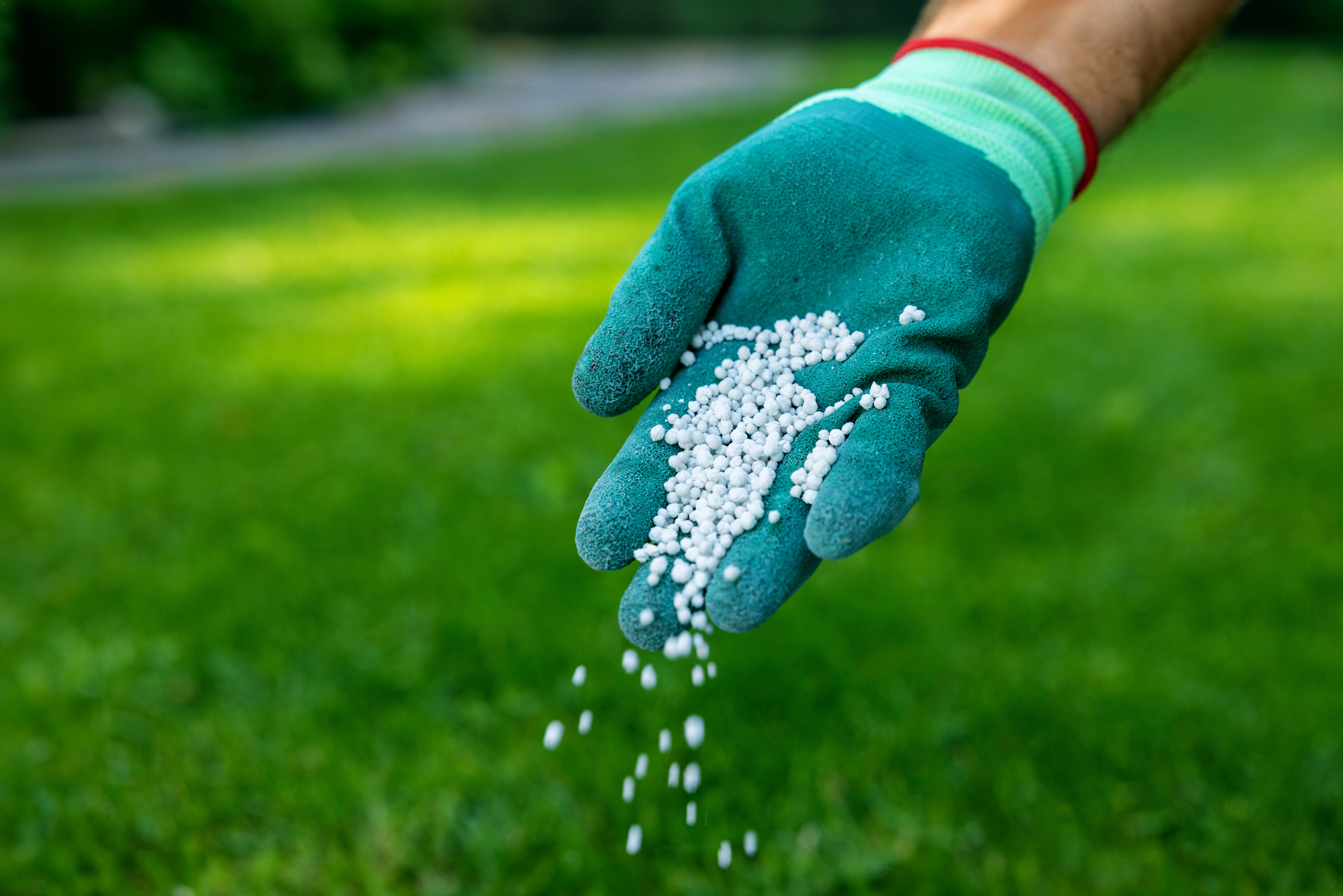
Starter fertilisers are available in both granular and liquid form. Granular products are more convenient for large areas and can be applied with the same spreader you use for the seed. Liquid products are useful for smaller areas and can be watered in at the same time as the first irrigation. Either type is safe to apply at the same time as sowing, provided you follow the recommended rate on the label.
Slow Release Organic Fertiliser
A slow release organic fertiliser such as blood, fish, and bone meal or pelleted poultry manure can also be used at the point of seeding. The nutrients are released gradually as soil microorganisms break down the organic matter, which provides a sustained feed over 6 to 12 weeks without the risk of overwhelming the young seedlings. The lower concentration of immediately available nitrogen makes organic products inherently safer for use alongside seed than quick-release synthetics.
The trade-off is that organic fertilisers are slower to take effect. In cold spring soils, the microbial activity needed to release the nutrients is low, and the seedlings are unlikely to receive much benefit for the first two or three weeks. In warmer autumn soils, the breakdown is faster and the organic approach works very well. Our guide on autumn lawn feeding covers product selection for that season.
Standard Lawn Fertiliser (Use with Caution)
A standard lawn fertiliser with a high nitrogen content, such as 20-5-10 or 25-5-5, is designed for established grass and is not ideal for use at the point of seeding. The high concentration of immediately available nitrogen can damage the developing root tips of newly germinated seedlings, causing what lawn care professionals call fertiliser burn. The seedling roots are extremely delicate in the first two weeks of growth, and a strong dose of nitrogen at this stage does more harm than good.
If a standard lawn feed is all you have available, apply it at no more than half the recommended rate for established lawns. This reduces the nitrogen concentration to a level the seedlings can tolerate while still providing some nutritional benefit. A proper starter fertiliser is always the better choice if you can get one.
Weed and Feed Products (Avoid Completely)
Never use a weed and feed product at the same time as seeding. These combination products contain a herbicide alongside the fertiliser, and the herbicide will kill the grass seedlings just as readily as it kills weed seedlings. The pre-emergent component prevents germination entirely, while post-emergent herbicides damage or kill young plants that have already emerged. Wait at least 8 to 12 weeks after sowing before applying any weed and feed product. Our article on when to weed and feed covers the safe timing in detail.
How to Apply Seed and Fertiliser Together
The application method depends on whether you are sowing a new lawn from scratch or overseeding an existing one. The principles are the same but the preparation is different.
New Lawn from Scratch
Prepare the soil as you would for any new seeding: clear the area, dig or rotavate to 150 to 200 millimetres deep, rake to a fine tilth, and firm by treading. Before sowing the seed, apply the starter fertiliser at the rate recommended on the label, typically 35 to 50 grams per square metre for a granular product. Rake the fertiliser into the top 10 to 15 millimetres of soil so it is incorporated into the seedbed rather than sitting on the surface.
Then sow the grass seed on top at the recommended rate, using the cross-hatching technique of two passes at right angles for even coverage. Rake the seed in lightly, roll or firm the surface, and water immediately. The seed and fertiliser are now in the same zone of soil, with the fertiliser slightly deeper where the roots will find it as they grow down.
This layered approach, fertiliser below and seed above, is the standard professional method. It puts the nutrients where the roots are heading and keeps the seed at the shallow depth it needs for light-triggered germination. For a complete walkthrough of the soil preparation and sowing process, see our guide on how to seed a new lawn.
Overseeding an Existing Lawn
For overseeding, the preparation is different but the fertiliser timing is the same. Mow the existing lawn short, to about 20 millimetres, and scarify or rake the surface vigorously to remove thatch and expose bare soil. If the lawn is compacted, aerate with a hollow-tine aerator or a garden fork before seeding. These steps give the seed direct contact with the soil, which is the single most important factor in germination success.
Apply the starter fertiliser at the recommended rate, then scatter the grass seed at about half the rate you would use for a new lawn, typically 15 to 25 grams per square metre. Rake the seed in lightly, top-dress with a thin layer of compost or fine topsoil if available, and water. The existing grass will shade the seedlings for the first few weeks, which reduces moisture loss but also reduces light, so a slightly higher seeding rate than the minimum is a good idea to account for the lower germination percentage in shaded conditions.
Our guide on how often to overseed covers the broader strategy for maintaining a thick, healthy sward through annual overseeding.
When to Seed and Fertilise
The best time to seed and fertilise at the same time is early to mid-autumn, from late August through to the end of September. Soil temperatures are still warm enough for rapid germination, autumn rainfall provides consistent moisture, and weed competition is at its lowest. The fertiliser feeds the seedlings through their establishment phase, and the grass enters winter with a developing root system ready to grow strongly the following spring.
The second-best window is mid-spring, from mid-April to the end of May. Rising soil temperatures and increasing daylight support both germination and nutrient uptake. The risk is that spring-sown grass faces heavier weed competition, and you cannot use a pre-emergent herbicide at the same time as seeding, so you will need to manage weeds by hand for the first couple of months. Our article on spring seeding mistakes covers the timing pitfalls.
Avoid seeding and fertilising in summer (June to August) unless you can commit to twice-daily watering. The heat stresses seedlings and the fertiliser can burn in hot, dry conditions. Avoid winter (November to February) entirely, as soil temperatures are too low for germination and the fertiliser will sit unused in the soil until spring, losing effectiveness to leaching and microbial breakdown in the meantime.
How Much Fertiliser to Use with Seed
Follow the rate on the starter fertiliser label. Most products recommend between 35 and 70 grams per square metre depending on the formulation. Do not exceed the recommended rate in an attempt to give the seedlings a bigger boost. More is not better with fertiliser at the seeding stage. Excess nitrogen and phosphorus in the soil can inhibit root growth, cause seedling burn, and create conditions that favour fungal disease.
If you are using an organic fertiliser instead of a dedicated starter product, apply at the standard rate recommended for established lawns. Organic products release nutrients so slowly that the risk of over-feeding young seedlings is minimal, even at full rate.
For overseeding into an existing lawn that was last fed within the previous four weeks, reduce the fertiliser rate by half or skip it entirely. The existing grass has already absorbed nutrients from the recent feed, and the soil is unlikely to be depleted enough to warrant a full additional application. Over-feeding an existing lawn while overseeding can produce a flush of vigorous growth in the established grass that shades out the new seedlings before they can compete.
What to Do After Seeding and Fertilising
Watering
Keep the seedbed consistently moist for the first 14 days. Water two to three times per day in dry weather, using a fine sprinkler or a hose with a gentle rose attachment. The surface should be damp to the touch but not waterlogged. Heavy watering will wash both seed and fertiliser into puddles and low spots, creating bare patches on higher ground and over-concentrated areas in the dips.
After the seedlings emerge, gradually reduce the frequency while increasing the depth of each watering session. This encourages roots to grow downwards in search of moisture, which is exactly what the phosphorus-rich starter fertiliser is there to support. By week four, you should be watering every other day at most, and by week six, transitioning to a normal established-lawn schedule. Our guide on how much water a lawn needs covers the volumes and timing.
Mowing
Wait until the grass reaches 60 to 75 millimetres tall before the first cut, typically four to six weeks after sowing. Set the mower to its highest setting and remove no more than a third of the blade length. A sharp blade is critical at this stage, as a dull blade will tear young seedlings out of the loosely consolidated soil. Lower the cutting height gradually over subsequent mows. More detail on the first mow and height progression is in our article on when to start mowing.
Second Feed
Do not apply a second fertiliser feed for at least six to eight weeks after sowing. The starter fertiliser provides enough nutrition to carry the seedlings through their initial establishment, and adding more too soon risks burning the still-developing root system. After eight weeks, a light application of a balanced lawn fertiliser at half the normal rate will give the establishing grass a boost. Build up to a full feeding programme from the following season.
Weed Control
Do not apply any herbicide for at least 12 weeks after seeding. Young grass is vulnerable to selective herbicides, and the stress of chemical treatment on top of the stress of establishing can weaken or kill it. If weeds appear, remove them by hand. A thick, well-fed sward will outcompete most weeds on its own once it is established. For persistent weed problems after the 12-week window, our guide on when to apply weed killer covers the safe options.
Common Mistakes When Seeding and Fertilising Together
The most common mistake is using the wrong type of fertiliser. A high-nitrogen quick-release lawn feed applied at full rate alongside seed will burn a large percentage of the germinating seedlings. Always use a starter fertiliser or a slow-release organic product at the rates described in this article.
The second most common mistake is applying a weed and feed product at the same time as seeding. The herbicide in these products will kill the grass seedlings. This is the single most frequently asked question in lawn care forums, and the answer is always the same: weed and feed and new seed do not mix. Wait at least 12 weeks.
The third mistake is over-applying fertiliser in the belief that more nutrients will produce faster growth. Seedling roots are delicate and cannot handle high concentrations of salts in the soil. Stick to the label rate, or go slightly under if you are unsure.
The fourth mistake is failing to water the fertiliser in after application. Granules left on the soil surface in dry conditions will not dissolve and reach the root zone. In wet conditions, undissolved granules can create localised hot spots of concentrated nutrients that burn the seedlings directly beneath them. Water lightly but thoroughly on the day of application.
The fifth mistake is fertilising a newly overseeded lawn that was already recently fed. The existing grass does not need another dose, and the double application can produce excessive growth that smothers the new seedlings.
Lawn Seeding Frequently Asked Questions
Can you seed and fertilise at the same time in spring?
Yes. Mid-April to the end of May is the best spring window. Use a starter fertiliser with a high phosphorus content and sow the seed at the recommended rate. Water consistently for the first two weeks and avoid any weed killer for at least 12 weeks after sowing.
Can you seed and fertilise at the same time in autumn?
Yes, and autumn is the best time to do it. Warm soil, increasing rainfall, and low weed pressure create ideal conditions. Apply a starter fertiliser at the point of sowing and the seedlings will establish quickly, giving them the full winter and spring to develop deep roots.
What NPK ratio should a starter fertiliser have?
Look for a ratio with phosphorus as the highest or second-highest number, such as 10-18-10, 5-10-5, or 4-12-8. The elevated phosphorus supports root development, which is the priority for new seedlings. Avoid ratios with very high nitrogen, such as 25-5-5, as these are designed for established lawns and can burn young roots.
Can I use bone meal instead of a starter fertiliser?
Bone meal is a good source of phosphorus and can be used as a natural alternative to a synthetic starter fertiliser. Apply at 70 to 100 grams per square metre and rake it into the seedbed before sowing. It releases phosphorus slowly over several weeks, which suits the gradual development of new seedling roots.
Will fertiliser burn grass seed?
The seed itself is unlikely to be damaged by contact with fertiliser granules, but the germinating seedling can be burned if the nitrogen concentration in the surrounding soil is too high. This is why starter fertilisers have moderate nitrogen levels and why high-nitrogen quick-release products should be avoided or used at half rate.
How long should I wait between fertilising and seeding if I cannot do both at once?
If you apply fertiliser first, wait one to two weeks before seeding to allow the product to dissolve and disperse through the soil. If you seed first, wait at least four weeks until the seedlings are well established before applying any fertiliser other than a starter product.
Can I overseed and fertilise on the same day?
Yes. Apply the starter fertiliser, scatter the seed at half the new-lawn rate, rake in lightly, and water. The process is the same as for a new lawn, with the additional step of mowing the existing grass short and scarifying before application to ensure good seed-to-soil contact.
Do I need a starter fertiliser or will a normal feed work?
A starter fertiliser is always the better choice because its higher phosphorus content supports the root development that seedlings need most. A normal lawn feed will provide some benefit but its high nitrogen content is less useful at this stage and carries a higher burn risk. If using a normal feed, apply at no more than half the recommended rate.
Sources
- Royal Horticultural Society. “Lawns: Sowing Seed.” RHS Gardening Advice. https://www.rhs.org.uk/lawns/seed-sowing
- The Lawn Association. “Establishing New Grass from Seed.” Technical Guidance Notes.
- Sports Turf Research Institute (STRI). “Starter Fertiliser Trials in Amenity Turf.” Applied Research. https://strigroup.com/
- British Seed Houses. “Seed and Fertiliser Application Guide.” Professional Guidance. https://www.britishseedhouses.com/
- Defra. “Code of Good Agricultural Practice for the Protection of Water.” Nutrient Management Guidance. https://www.gov.uk/