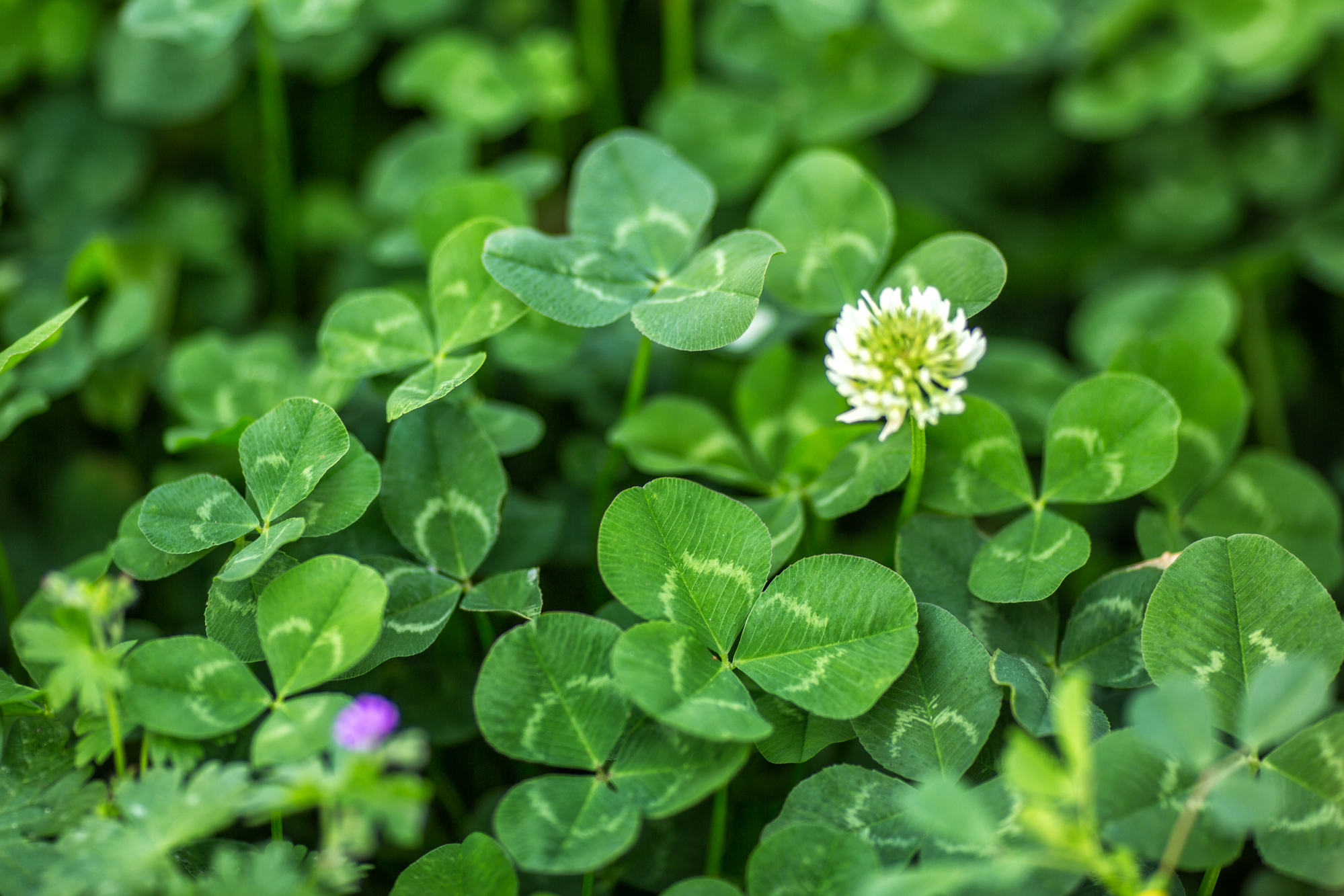
Learning how to control clover in your lawn starts with knowing what you are dealing with. The clover that shows up in most British lawns is white clover, Trifolium repens, a low-growing perennial with three-lobed leaves marked by a pale chevron and small white or pinkish flower heads from late spring through to autumn. It spreads by creeping stems called stolons that run along the soil surface, rooting at intervals and forming dense patches that expand outward year on year.
Clover appears in lawns for three main reasons. The first is low nitrogen. Grasses depend on soil nitrogen to grow, but clover is a legume that fixes atmospheric nitrogen through bacteria in its root nodules and feeds itself. When nitrogen levels in the soil drop, grass thins out and clover fills the gaps. The second is compaction. Clover tolerates poor soil structure better than most grasses, so it thrives in heavily walked areas where the grass is struggling. The third is close mowing. Cutting the lawn below 25 millimetres weakens the grass by reducing its leaf area, and clover, which grows flat against the ground, gains the upper hand.
If all three factors are present at once, clover will spread quickly. The good news is that all three are within your control, and addressing them is the foundation of any long-term clover management strategy.
Is Clover in Your Lawn a Problem?
This is worth asking before you reach for the weed killer, because the answer is not the same for everyone. Clover has genuine benefits. It fixes nitrogen and shares it with surrounding grass through root exudates and decomposing leaf matter, effectively providing free fertiliser. It stays green in dry spells when grass has gone dormant. It supports pollinators, with white clover flowers being one of the most important food sources for honeybees and bumblebees in the UK. And it requires no feeding, no irrigation, and very little attention to persist.
The drawbacks are mostly aesthetic. Clover has a different leaf texture and colour from grass, which creates an uneven, patchy look that bothers some lawn owners. The flower heads attract bees, which can be a concern in lawns used by young children or by anyone with a bee sting allergy. If left unchecked over several years, clover can dominate a weakened lawn to the point where grass is reduced to a minority, and recovering a pure grass sward from that point is difficult.
Many lawn owners now take a middle ground, accepting a small percentage of clover in the lawn as a net positive and only intervening when it starts to dominate. A lawn with 10 to 20 percent clover by area gets the nitrogen-fixing and drought-resilience benefits without the clover taking over visually. If that balance appeals to you, the cultural controls described below will keep it in check. If you want clover gone entirely, the combination of cultural and chemical methods later in this article will get you there.
How to Control Clover in Your Lawn with Cultural Methods
Cultural control means changing the growing conditions so that the grass outcompetes the clover naturally. This is the most effective long-term approach and should always be the first step, whether or not you plan to use herbicides as well.
Feed the Lawn
Nitrogen is the key. Clover thrives in nitrogen-poor soil because it can fix its own. Grass cannot. Applying a nitrogen-based lawn fertiliser two to three times per year tips the balance back in the grass’s favour by giving it the nutrient it needs to grow thick and dense enough to crowd out the clover. A spring feed in April, a summer feed in June, and an autumn feed in September with the appropriate seasonal product will make a visible difference within a single growing season.
The spring and summer feeds should be higher in nitrogen to promote leaf growth and green colour. The autumn feed should be lower in nitrogen and higher in potassium to harden the grass for winter. Our guide on fertilising fundamentals walks through product selection and application rates in detail.
Raise the Mowing Height
Mowing too short is one of the fastest ways to encourage clover. At a cutting height of 15 to 20 millimetres, the grass leaf area is so reduced that it cannot photosynthesise enough to maintain a dense sward. Clover, which grows flat and hugs the ground, is barely affected by the mower at that height and fills every gap the weakened grass leaves.
Raising the mowing height to 30 to 40 millimetres gives the grass a much larger leaf surface, which means more photosynthesis, more energy, and more vigorous growth. The taller grass also shades the soil surface, making it harder for clover stolons to root and new clover seedlings to germinate. This single change can reduce clover coverage noticeably within a couple of months. For more on finding the right cutting height, see our article on what mowing height is best.
Aerate Compacted Areas
Compaction restricts grass root growth and reduces air and water movement through the soil. Clover is less affected because it has a shallower root system and can tolerate tighter soil. Aerating the lawn with a hollow-tine aerator in autumn or spring opens up the soil, allows grass roots to grow deeper, and improves drainage, all of which favour the grass over the clover.
Pay particular attention to areas with heavy foot traffic, near gates and paths, and anywhere the soil feels hard and unyielding when you push a screwdriver into it. These are the spots where clover gets its strongest foothold. Our guide on what aerating a lawn does explains the process and the different tools available.
Overseed Thin Areas
Clover colonises bare or thin patches in the lawn. If your grass has gaps, whether from wear, drought damage, disease, or shade, those gaps will fill with clover before the grass has a chance to recover. Overseeding thin areas with a hard-wearing grass seed mix in early autumn or mid-spring fills those gaps with grass instead and closes the door on clover before it can move in.
Prepare the area by raking the soil surface lightly, scatter the seed at the recommended rate, and keep the soil moist until the seedlings are established. Avoid applying any herbicide for at least eight weeks after overseeding, as most selective weedkillers will damage young grass seedlings. More detail is in our guide on when to overseed your lawn.
How to Control Clover in Your Lawn with Herbicides
If cultural controls alone have not reduced the clover to an acceptable level after a full growing season, a selective herbicide can be used to kill the remaining clover without harming the grass. This is the faster route to a clover-free lawn, but it should be used alongside cultural improvements, not instead of them. Spraying clover out of a lawn that is still underfed, closely mown, and compacted will give you a temporary result at best, because the conditions that favour clover are still present and it will return.
Choosing the Right Product
Look for a selective lawn herbicide that lists clover on the label. The active ingredients most effective against clover are fluroxypyr, clopyralid, and MCPA, often used in combination. Products marketed as “lawn weedkiller” or “weed and feed” typically contain one or more of these ingredients. Check the label carefully to confirm clover is listed as a target weed, as not all selective herbicides are equally effective against it.
Avoid non-selective herbicides such as glyphosate for spot-treating clover in an established lawn, as they will kill the grass along with the clover. Non-selective products are only appropriate if you are prepared to reseed the treated area afterwards. For timing advice on herbicide use, see our article on when to apply weed killer to lawn.
When to Apply
Apply selective herbicide when the clover is actively growing, typically from late April through to September. The clover needs to be in full leaf and growing vigorously so that it absorbs the herbicide through its foliage and translocates it to the roots. Treating dormant or stressed clover in cold weather, drought, or after a recent mowing will reduce the effectiveness of the product.
Choose a dry, still day with temperatures between 10 and 25 degrees Celsius. Rain within six hours of application can wash the product off the leaves before it has been absorbed. Wind carries spray drift onto plants you did not intend to treat, including flower borders and vegetable plots where broadleaf herbicides can cause serious damage.
Application Method
For small patches, a ready-to-use spray bottle gives the most control. For larger areas, a knapsack or pump sprayer with a flat fan nozzle delivers an even coverage. Walk at a steady pace and apply the product in overlapping passes to avoid missed strips. Do not mow the lawn for at least three days before and after treatment, as the clover needs a full canopy of leaves to absorb the herbicide and the grass needs time to recover from any stress.
One application will kill most of the visible clover, but a second treatment four to six weeks later is usually needed to catch any plants that survived or any new growth from the stolons. After the second treatment, the clover should be dead and the gaps it leaves behind can be overseeded with grass to prevent reinfestation.
Removing Clover by Hand
For small infestations, hand removal is a viable option that avoids chemicals entirely. White clover spreads by stolons, so the technique is to lift the entire network of creeping stems rather than just pulling the visible leaves.
Use a hand fork or daisy grubber to loosen the soil around the edge of a clover patch, then work inward, lifting the stolons and roots as you go. Try to get the entire root system out in one piece. Any fragments of stolon left in the soil can regrow, so be thorough. The best time for hand removal is spring or early autumn when the soil is moist and the roots come out cleanly. In dry summer conditions the soil is hard and the roots tend to snap, leaving pieces behind.
After removing the clover, rake the bare soil, apply a light dressing of topsoil or compost, and overseed with grass. Water the area regularly until the new grass is established. Without overseeding, the bare patch will fill with clover again, or with something worse.
Preventing Clover from Coming Back
Killing or removing clover is only half the job. If the conditions that allowed it to establish in the first place are not corrected, it will return within a season or two. The prevention strategy is the same as the cultural control strategy: keep the lawn well fed, mow at the right height, aerate compacted areas, and overseed any thin patches before clover can colonise them.
A lawn that receives three feeds per year, is mown at 30 to 40 millimetres, is aerated annually, and has no bare patches will resist clover invasion almost indefinitely. The grass is simply too thick and too vigorous for the clover to compete. This is the approach used by professional lawn care companies, and it works because it addresses the root cause rather than the symptoms.
If you want to reduce your reliance on synthetic fertiliser as part of a more organic lawn care approach, consider using an organic nitrogen source such as blood, fish, and bone meal or a seaweed-based feed. These release nitrogen more slowly than synthetic products but still provide enough to keep the grass competitive. The trade-off is that results take longer to show, so patience is needed in the first season.
Living with Clover: The Mixed Lawn Approach
Not everyone wants to eradicate clover, and there are strong arguments for keeping it. A mixed lawn containing grass and a moderate amount of clover is easier to maintain, cheaper to feed, more drought-tolerant, and better for wildlife than a pure grass lawn. This is why an increasing number of lawn care professionals and environmental organisations now recommend clover as a deliberate lawn component rather than a weed to be eliminated.
If you want to manage clover rather than remove it, the approach is to control its spread without trying to kill it. Mow regularly to remove the flower heads before they set seed, which reduces bee activity and prevents the clover from self-seeding into new areas. Feed the lawn lightly with nitrogen once or twice per year to keep the grass competitive, but do not overfeed, as very high nitrogen levels will suppress the clover more than you want. And accept that the lawn will have a slightly different texture and appearance through the year as the clover and grass go through their respective growth cycles.
For those who want to go further and actively introduce clover, our guide on how to plant clover in existing lawn covers variety selection, seeding rates, and establishment.
Clover Control at a Glance
For quick reference, the most effective control programme follows this sequence. In early spring, apply a nitrogen-rich lawn fertiliser and raise the mowing height to at least 30 millimetres. In late spring, once the clover is in active growth, treat with a selective herbicide containing fluroxypyr or clopyralid if the infestation is heavy, or continue with cultural methods if it is light. In early autumn, aerate compacted areas with a hollow-tine aerator and overseed any bare patches left by the dead clover. Apply an autumn lawn feed to strengthen the grass for winter. The following spring, reassess and repeat any steps that are needed. Most lawns will show a dramatic reduction in clover after one full year of this programme, and near-total control after two.
How to Control Clover In Your Lawn – Frequently Asked Questions
What is the fastest way to control clover in your lawn?
A selective herbicide containing fluroxypyr or clopyralid applied in late spring or summer when the clover is actively growing will kill it within two to three weeks. Follow up with a second application four to six weeks later for any survivors. Cultural controls such as feeding and raising the mowing height should be used alongside the herbicide to prevent the clover from returning.
Will feeding my lawn get rid of clover?
Regular nitrogen feeding will gradually reduce clover by making the grass thick and competitive enough to crowd it out. This takes one to two growing seasons to show full results. Feeding alone will not eliminate a heavy infestation, but it will prevent clover from spreading and will reduce its coverage noticeably over time.
Does mowing height affect clover?
Yes. Mowing below 25 millimetres weakens the grass and favours clover, which grows flat against the ground. Raising the cutting height to 30 to 40 millimetres gives the grass more leaf area for photosynthesis and shades the soil surface, making it harder for clover to spread. This is one of the simplest and most effective clover control measures.
Is clover good for a lawn?
Clover fixes nitrogen from the air, stays green in drought, supports bees and other pollinators, and requires no feeding. It is a net positive in many lawn situations, and a growing number of lawn owners now keep it deliberately. The main drawbacks are the uneven texture compared with pure grass and the attraction of bees to the flower heads.
Can I remove clover without chemicals?
Yes. Small patches can be dug out by hand using a fork or daisy grubber, taking care to remove all the stolons and roots. For larger areas, improving the grass through regular feeding, higher mowing, and aeration will gradually outcompete the clover without any herbicide. Hand removal combined with overseeding is the most effective chemical-free approach.
When is the best time to treat clover with weed killer?
Late spring through to early autumn, when the clover is in active growth and temperatures are between 10 and 25 degrees Celsius. Avoid treating in cold weather, drought, or immediately after mowing. Apply on a dry, still day and do not mow for three days before or after treatment.
Will clover come back after treatment?
If the underlying conditions that favour clover are not corrected, it will return within one to two seasons. Herbicide kills the existing clover but does not prevent new plants from establishing. Long-term control requires ongoing cultural management: regular feeding, correct mowing height, aeration, and overseeding thin areas.
How long does it take to get rid of clover in a lawn?
With herbicide and cultural controls combined, most of the visible clover will be gone within four to six weeks. Full control, meaning the clover does not return, typically takes one to two full growing seasons of consistent management. The key is persistence with feeding, mowing, and aeration rather than a single treatment.
Sources
- Royal Horticultural Society. “Clover in Lawns.” RHS Gardening Advice. https://www.rhs.org.uk/weeds/clover
- The Lawn Association. “Clover Management in Domestic Lawns.” Technical Bulletins.
- Sports Turf Research Institute (STRI). “Selective Herbicide Use in Amenity Turf.” Applied Research. https://strigroup.com/
- Health and Safety Executive. “Plant Protection Products: Approved for Amateur Use.” Pesticide Guidance. https://www.hse.gov.uk/
- Plantlife. “Managing Lawns for Wildlife.” Conservation Guidance. https://www.plantlife.org.uk/