
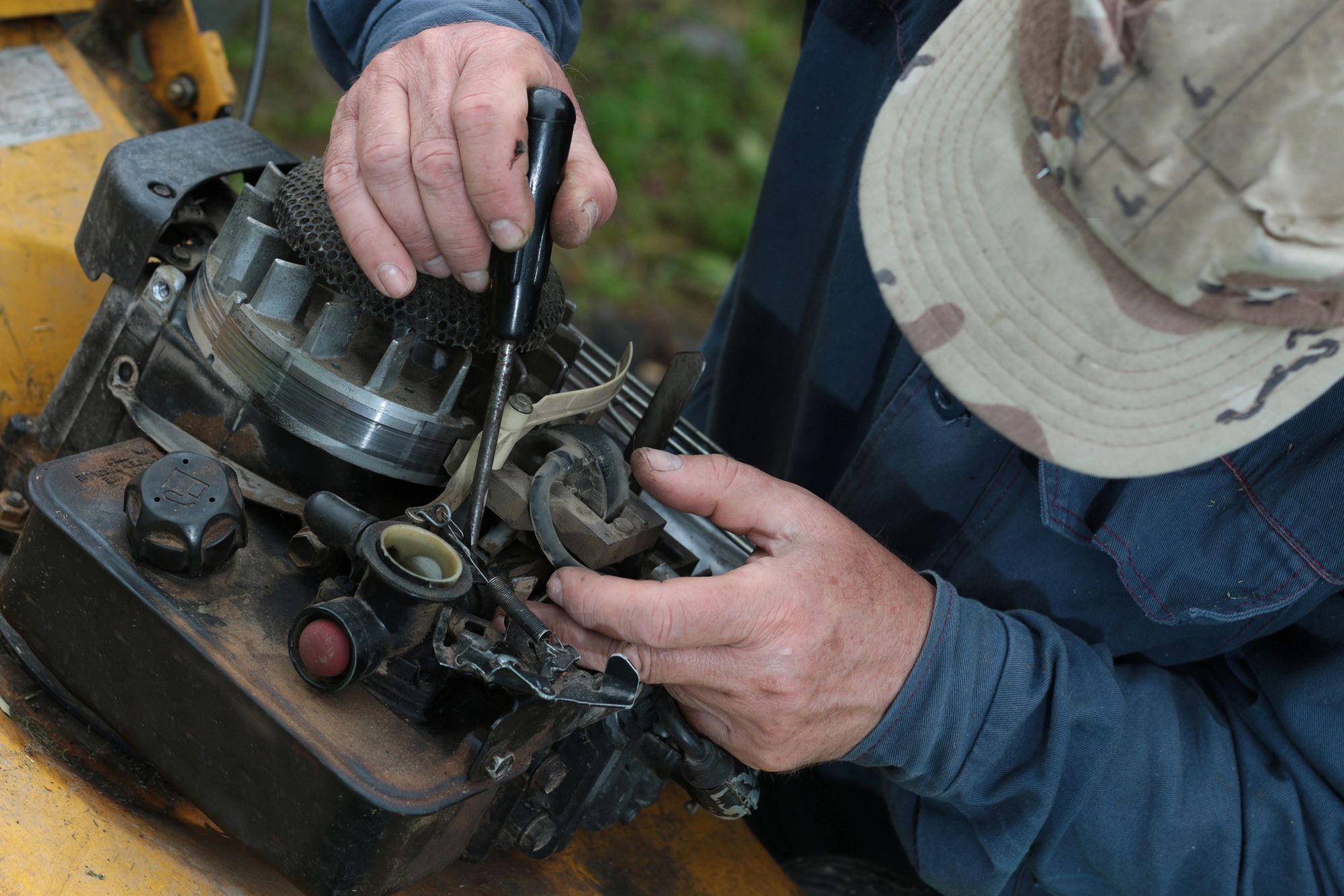
A throttle cable that has seized with rust and grit turns a good mower into a frustrating one. The engine fights you when you try to start it, the revs stick where you do not want them, and the choke refuses to open or close on command. The fix is cheap and takes well under an hour. You need a can of penetrating oil, a silicone lubricant, a couple of basic hand tools and a photo taken before you pull anything apart. Do it yourself and you save the £40 to £60 (around $50 to $80) a repair shop would charge for the same job.
Most people blame the engine when a mower will not run cleanly. Often the fault sits in the cable that controls it. Learning to spot that difference, and to free the cable when it sticks, is one of the most useful skills a mower owner can pick up.
What the Throttle Cable Does and Why It Seizes
The throttle cable is a Bowden cable: a thin steel inner wire that slides inside a flexible outer housing. One end connects to the control lever on the handle, the other to the throttle and choke mechanism on the engine’s carburettor. When you move the lever, the inner wire pulls or releases against the fixed housing, opening the throttle plate to raise the revs or closing the choke plate to help a cold start. The whole system depends on that inner wire gliding freely inside its sleeve.
Grit, moisture and dried-out grease are what stop it gliding. A mower lives in damp grass and dusty air, and fine debris works its way into the ends of the housing. Moisture then rusts the steel wire, while old lubricant hardens into a sticky varnish. The wire drags, binds, and eventually locks in place. A sharp kink in the outer housing does the same thing by pinching the wire against the sleeve. Once friction builds up, the return spring on the carburettor can no longer pull the lever back, so the control feels stiff, vague or stuck solid.
The Symptoms That Point to a Cable, Not the Engine
Cable faults and fuel faults can look alike, so it pays to read the signs before you strip a carburettor you did not need to touch. A sticking cable shows itself in the controls rather than the running. The lever moves but springs only part of the way back. It feels gritty or needs real force to shift. The engine will not climb to full revs wherever you set the lever, or it sits stuck on fast idle. On a cold start, the choke plate will not close when you select choke, so the engine will not catch.
Compare that with a fuel problem, where the lever moves normally but the engine stumbles, surges or dies from a blocked jet or stale petrol. A quick check settles it: with the engine off and the spark plug lead removed for safety, take off the air filter cover and watch the choke plate while a helper works the lever. If the plate does not move in step with the lever, the cable is your culprit, not the carburettor.
Leaving a sticking cable also costs more than a stiff lever. An engine held at the wrong speed runs rich or lean for the conditions, which wastes fuel and lets the engine overheat under load. A throttle that will not drop to idle keeps the blade spinning fast when you want it slow, and a choke stuck part-closed floods the engine and fouls the spark plug on every cold start. None of that damage is expensive on its own, but it stacks up over a season into the kind of bill the cheap fix below avoids.
Free the Cable Step by Step
Start with the simple adjustment. Take off the air cleaner assembly so you can see the choke plate. Set the control lever to the choke position, then pull on the cable’s outer jacket near its clamp until the choke plate fully opens. Hold it there and tighten the clamp with the cable in that position, then refit the air cleaner. That single move re-tensions a cable that has slipped and often restores full travel on its own.
If the wire is still hard to move or fully stuck, free it properly. Disconnect both ends of the cable from the mower. To lift the cable out you will usually remove a bolt and take apart the lever assembly near the handle, so take a photo first to guide the rebuild. At the engine end, loosen the clamp holding the cable and unhook the inner wire from the carburettor. Pour penetrating oil into the top of the outer housing, grip the exposed inner wire with pliers, and work it up and down to break the rust and drag loose. Keep working until the wire slides freely and the penetrating oil has drained through. Then squirt a silicone lubricant into the housing to keep the wire moving, and reinstall the cable, using your photo to reconnect the lever correctly.
Why Silicone Beats a Penetrating Spray for the Final Lubrication
The two products do different jobs, and swapping them is a common mistake. A penetrating oil such as a specialist penetrant or a maintenance spray (about £5 to £8, or $6 to $10) has a very low surface tension, so it creeps into the tight gap between wire and housing and breaks the bond of rust and hardened grease. That is what frees a seized cable. It is a poor long-term lubricant, though: it washes off, thins out and can leave the wire prone to sticking again in cold, damp conditions.
A silicone or PTFE spray (around £6 to £10, or $8 to $13) is the finishing lubricant. Its carrier evaporates and leaves behind a dry, slippery film that dust and grass clippings do not cling to, so the wire keeps sliding for months. Skip the silicone and rely on penetrating oil alone, and the cable stiffens again within weeks as the oil dries and grit sticks to what remains. Use penetrating oil to free the wire, silicone to keep it free, and the repair lasts a full season.
When to Replace the Cable, and How to Stop It Seizing Again
Some cables are past saving. A sharp kink in the housing, frayed strands on the inner wire, or corrosion that has eaten into the steel all mean the cable will fail again soon, and a frayed wire can snap mid-cut and leave the engine stuck at full throttle. Replace it rather than nurse it. A universal Bowden throttle cable that you cut to length fits most walk-behind mowers and costs about £8 to £15 (roughly $10 to $19); a brand-specific part for a Mountfield, Honda, Flymo or similar runs £12 to £25 (about $15 to $32). Measure the old cable’s inner and outer lengths before you buy, as these parts come in several sizes and shapes.
Prevention costs almost nothing. At the end of the mowing season, run a few drops of silicone lubricant into the cable ends and work the lever through its full travel to draw it in. Store the mower somewhere dry rather than a damp shed floor, where condensation drives the rust that seizes the wire in the first place. Keep the cable routed in smooth curves with no tight bends, and a kink is the one fault that lubrication cannot cure.
Your Next Steps
Before you reach for tools, confirm the cable is the problem by watching the choke plate move against the lever with the plug lead off. Try the clamp adjustment first, then free a stuck wire with penetrating oil and finish with silicone. If the wire is kinked, frayed or corroded, fit a cut-to-length replacement and note the measurements before you order. A yearly drop of silicone and dry storage keeps the control crisp for years. For more walk-behind mower fixes you can do at home, browse the maintenance guides on lawnandmowers.com.