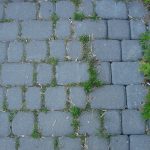
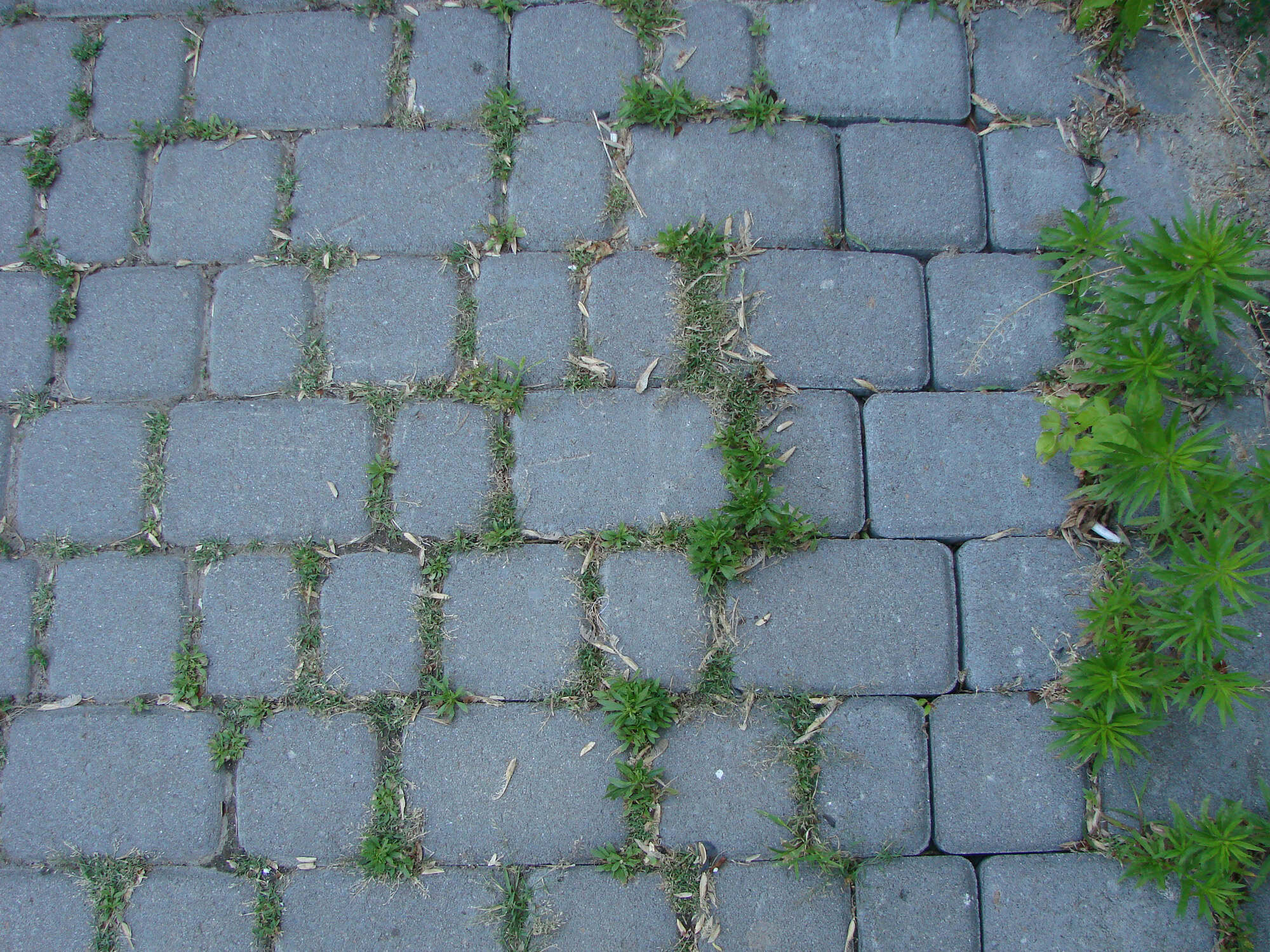
- The weeds in your paving joints are not growing up through the slabs, they are rooting in the grit and dirt that has collected in the gaps, which is why pulling the tops off never works for long.
- A paving knife, a stiff wire brush and a kettle of boiling water clear most of it in an afternoon, with no weedkiller and no stain left on the stone.
- Clear the joints out and refill them properly and the weeds and moss struggle to come back, as you have taken away the soil and shade they need.
The weeds are not breaking the slabs, they are living in the dirt between them
Walk out onto the patio in autumn and the gaps between the slabs have filled in again: green tufts of grass, a flat rosette of something leathery, a spreading mat of moss gone slick in the damp. It looks as though the weeds are forcing their way up through solid paving. They are not. The joints between slabs slowly fill with windblown grit, dead leaves and washed-in soil, and that thin seam of dirt is all a weed seed needs. Once you see the problem as a long, narrow flower bed running between your slabs, the fix makes sense. You are not fighting the stone. You are clearing out the soil the weeds live in.
Why paving fills with weeds and moss in the first place
Paving joints are a hostile place to grow, and that is exactly why certain plants take them over. According to the Royal Horticultural Society, the usual colonisers are grassland and waste-ground species that blow in as seed, such as annual meadow grass, sowthistle and chickweed, along with creeping plants that spread in from a nearby lawn or border, including oxalis, speedwell and mind-your-own-business. Deep-rooted weeds like dandelions, docks and creeping cinquefoil dig in too, their taproots reaching down through the joint into the base below.
The shallow root run, poor soil and constant foot traffic keep these weeds small. That sounds like good news, but it is not: a stunted weed still flowers and sets seed, topping up the seed bank in the joints for next year. This is also why pulling the green tops off and walking away fails. The root stays in the joint, the seed is already in the soil, and the weed is back in a fortnight. The job is not to tidy the tops, it is to empty the joint.
Moss and the green film alongside it are a different problem with the same root cause. Algae, lichens and mosses settle on hard surfaces that stay shaded and damp, which is most patios through autumn and winter. The RHS points out that they do not damage the stone, but they make it slippery, and a mossy patio or a slimy set of steps is a real fall risk in wet weather. Damp, shade and still air are what they want, so the shadiest, least-used corner of the patio is always the worst.
Clear the joints without reaching for weedkiller
The RHS does not support weedkiller on paving and recommends clearing weeds by hand, and for a home patio that is both cheaper and kinder to the drains the surface runs off into. Here is the order that works.
Start with a block paving knife, sometimes sold as a weeding knife. It is a short hooked blade that runs down the joint, cutting roots and levering the whole weed out, grit and all. One costs about £6 to £10, or $8 to $14, from Screwfix, Wickes, B&Q, Amazon or the hardware aisle at Home Depot. Draw it along every joint and hook out the loose material as you go.
For the moss and the fine green film, switch to a stiff paving brush with angled wire bristles. A long-handled one saves your back and costs around £10 to £18, or $12 to $22. Scrub hard along the joints and across the face of the slabs. The bristles lift moss, seedlings and the packed dirt they root in out of the gaps in one pass.
For deep-rooted weeds that snap off and leave the taproot behind, a dandelion weeder or a narrow weed puller reaches down into the joint. Where the root simply will not come out of a tight gap, the RHS notes that cutting off the top growth again and again starves the root and kills it over time. It is slower, but it works, and it costs nothing.
Boiling water and a pressure washer for the green film
Two more tools finish the job, and neither needs a chemical. A kettle of boiling water is the simplest weedkiller there is. Poured straight onto a weed in a joint, it ruptures the plant’s cells and collapses the leaves and shallow roots within a day or two. It works best on young growth and the fine weeds in narrow joints, and you can see why it became a classic test against salt and vinegar for driveway weeds: it leaves no residue, costs nothing beyond the energy to boil it, and will not stain the stone or harm the soil beside the patio. Keep it off nearby border plants and off your own feet.
A pressure washer earns its place on moss and algae. A medium domestic model, about £70 to £150 or $90 to $200, blasts the green film and the joint dirt out together. Work at a low angle and keep the lance moving, as a narrow jet held still will scour the surface off soft stone and cut away jointing sand. On block paving you will almost always need to re-sand the joints afterwards, which leads to the part that actually keeps the weeds away.
Stop the moss and weeds coming back
Clearing the joints is the satisfying part. Keeping them clear is what saves you doing it all again next autumn, and it comes down to taking away the two things weeds and moss need: soil and shade.
First, refill the joints properly. Once a joint is scraped out, brush in fresh kiln-dried jointing sand on block paving, or repoint slab joints with mortar. The RHS method for loose or crumbling pointing is to chip it out with a cold chisel and a stiff brush, then fill the gap with a dry mortar mix or a ready-made jointing compound, and keep off the area until it hardens. A tub of brush-in jointing compound covers a small patio for about £25 to £40, or $30 to $50. A firm, filled joint leaves no open seam of dirt for a seed to land in.
For a gravelled path or seating area that keeps throwing up perennial weeds, the RHS suggests lifting the gravel and relaying it over a heavy-grade biodegradable weed membrane, which blocks the light the weeds below need to photosynthesise and smothers them. A roll runs about £10 to £25, or $15 to $30, and the woven grades let rain drain through while still blocking the light.
Timing helps too. Autumn is the right moment to clear and refill joints: the weeds are easier to lift out of damp soil, moss is at its thickest and most visible, and a joint you fill now sets before the worst of the winter wet arrives. Leave a scraped-out joint open through winter and it simply fills with washed-in silt again, ready for the first seeds of spring. Clearing the patio and then leaving the gaps bare is half a job, and the half you skip is the half that keeps the weeds out.
Last, deal with the shade where you can. Cutting back a low branch or lifting a dense shrub that overhangs the patio lets in light and air, and dries the surface faster after rain. A patio that dries out is one moss struggles to hold. And if you like the softer look, the RHS even suggests planting low creepers such as creeping thyme, Corsican mint or Mexican fleabane into the gaps on purpose, so something you want fills the space before something you do not.