- The brown, worn patches a hot summer leaves behind knit back into the lawn fastest if you reseed them now, while the soil still holds its summer warmth and the rain has come back.
- Cut the dead area out cleanly, loosen and level the soil underneath, then sow at 15 to 25g per square metre (half to three quarters of an ounce per square yard) and cover the seed so the birds cannot strip it.
- Keep the patch damp until the new grass roots, and by spring it fills in level with the lawn around it instead of staying a thin scar you mow over all year.
Autumn is a short window, and it closes fast
Every lawn carries the marks of the summer by now. A worn track to the shed, a yellow ring where a paddling pool sat, a scorched patch the heat cooked brown and never brought back. Leave those gaps open and they do not stay still. Moss creeps in, weed seed lands on the bare soil and roots before grass can, and the next heavy rain washes a shallow hollow into a muddy dip. The grass around the edge does not spread sideways fast enough to close a gap of any size on its own.
Autumn is the better of the two times to put that right, and the reason sits in the soil. Early autumn soil still holds the warmth banked over summer, while the air above has cooled and the rain has returned. Cool-season lawn grasses germinate best when the soil sits between about 8 and 18C (46 to 65F), which is close to where it lands in September and October. Warm ground drives fast germination, the cooler air takes the drought stress off the young seedlings, and the whole patch gets weeks of root growth before the cold shuts things down. Grass sown now spends autumn building the deep roots that let it green up early and hold firm through next summer. The Royal Horticultural Society puts it plainly: “Spring and autumn are the ideal times to repair a lawn, when the weather is damp and cool.”
Miss the window and you wait. Seed sown into cold soil in late autumn sits there, swells, and rots before it sprouts. Seed sown in spring has to race the drying weather and compete with every weed waking up at the same time. The few weeks from now to the middle of autumn are the easy stretch, which is why professional groundstaff do their heaviest overseeding and patch work in early autumn rather than any other time of year.
Cut the patch out and get the soil right first
The job that fails is the one where seed gets scattered on hard, dead ground and watered once. The job that works starts under the surface. Mark the damaged area as a rough square or rectangle rather than trying to follow the ragged edge of the dead grass. Straight cuts are easier to firm and blend, and squaring it off lets you lift out the worst of the compacted, lifeless turf instead of seeding over it.
Slice around the square with a half-moon edging iron or the flat edge of a spade, then cut underneath and lift the dead turf out to a depth of about 5cm (2in). Fork over the soil left in the bottom of the hole to break up the pan that heat and foot traffic have packed down. This is the step most people skip and the one that decides the result. Grass roots cannot push into compacted ground, so loosening it is what lets the new sward anchor. Work a few handfuls of topsoil or sieved garden compost into the loosened base to lift it back to a level surface and give the seed something open and crumbly to root into, then firm it gently with the back of a rake or the flat of your hand. You want it level with the surrounding lawn and firm enough to walk on without sinking, not hard.
If the patch sits under a tree or on the shaded side of the house, buy a shade-tolerant seed mix rather than a standard one. If it is a wear patch on a route everyone walks, a hard-wearing utility mix with ryegrass in it stands up to feet far better than a fine ornamental blend. Matching the seed to the spot is the difference between a repair that lasts and one that thins out again within a year. A box of good patch-repair or hard-wearing lawn seed runs about £10 to £15 a kilogram (roughly $13 to $19), and a kilogram covers a lot of patches at the right rate.
Sow at the right rate and keep the birds off
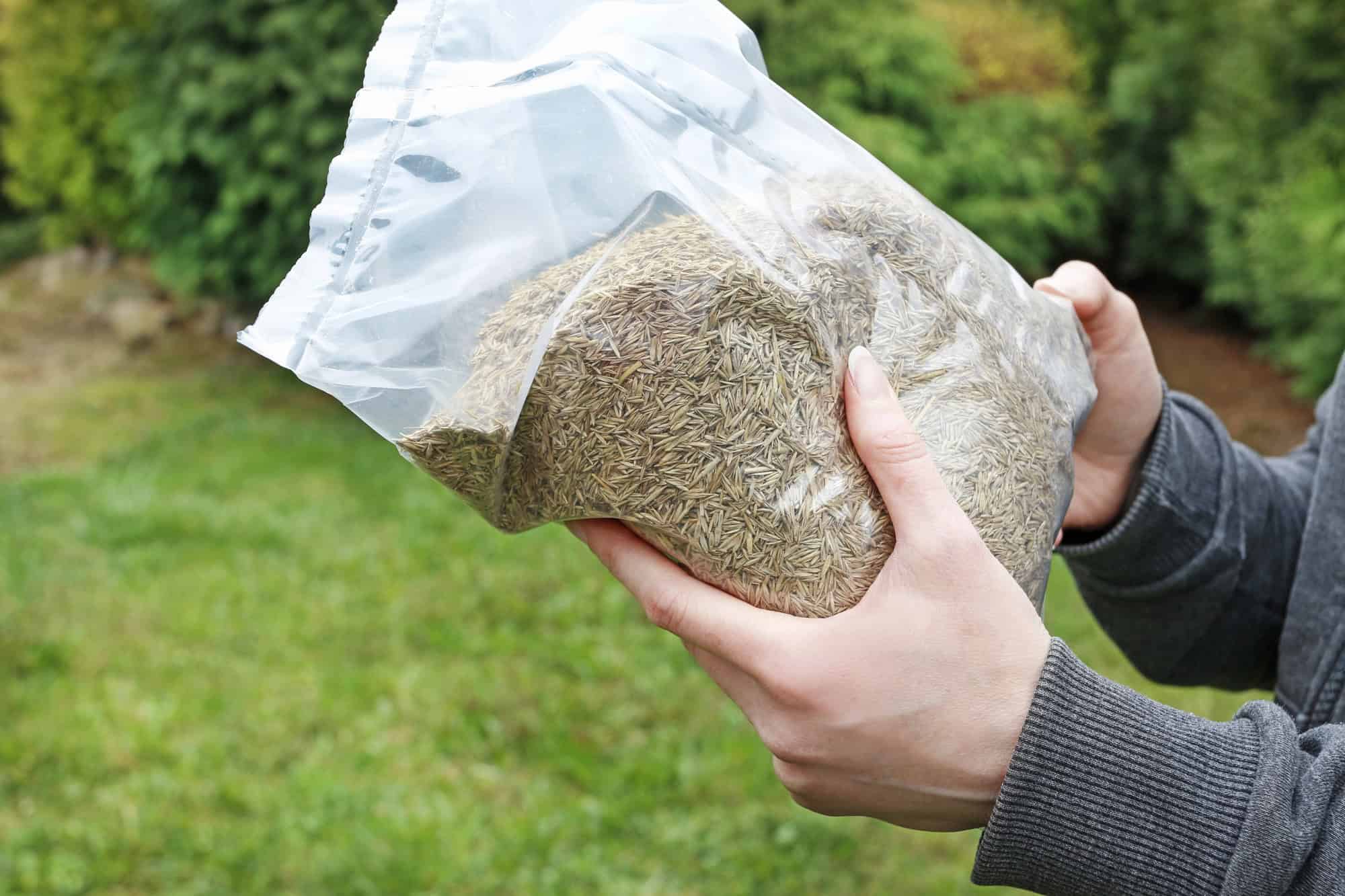
Scatter the seed evenly across the prepared soil at 15 to 25g per square metre, which is half to three quarters of an ounce per square yard, or roughly a generous handful to the square metre. Resist the urge to pile it on. Sown too thick, the seedlings come up in a dense mat, compete with each other for light and water, grow weak and spindly, and fall to damping-off fungus that thrives where air cannot move between crowded shoots. Sown too thin, you get a sparse patch that takes all season to knit. The stated rate exists for a reason, and a cheap kitchen scale takes the guesswork out of the first patch you ever do.
Rake the seed in lightly so it sits in contact with the soil rather than on top of it, then cover it. A thin scattering of sieved topsoil or compost over the seed holds moisture against it and hides it from birds, who will clear an open patch of seed in an afternoon given the chance. On a patch you walk past often, a sheet of garden fleece pegged over the top does the same job and warms the soil underneath a touch as well. Water it in with a fine rose on the can, not a hard jet that floats the seed into one corner.
There is a trick worth knowing for a cold snap or a patch you want up quickly. Mix the seed through a little moist multi-purpose compost, seal it in a bag or under cling film, and keep it somewhere no warmer than 15C (60F). Check it daily, and once you see tiny white roots breaking from the seed, usually after about three days, sow the pre-sprouted mix straight onto the prepared soil. It gives the seed a head start the open ground cannot, and it is how you get grass moving when the weather has turned marginal.
For bigger gaps, drop in turf instead
Seed is cheap and blends in perfectly, but it is slow, and on a large bare area or a spot that has to take traffic again soon, turf gives you an instant repair. The groundwork is identical: cut the dead area into a square, slice it out to about 5cm (2in), fork and level the soil, and firm it. Then cut a matching square of healthy turf, either from a fresh roll or lifted from an out-of-the-way corner of your own lawn where a gap will not be noticed.
Lay the new piece into the hole and press it down so it sits dead level with the lawn around it. A piece that stands proud dries out along its edges and gets scalped by the mower; one that sits low collects water and dies back. Knock the edges together with the back of a rake to close the joins, then brush a dry, sandy top dressing into the seams so the turf and the lawn grow together rather than leaving a visible outline. Water it thoroughly, and keep watering, as a newly laid square has no roots into the ground beneath it yet. If you have top dressed the rest of the lawn this autumn, the same sandy mix is exactly what you want brushed into these joins. There is more on that job in our guide to top dressing a lawn in autumn.
The part that gets you a lawn by spring
Whether you seeded or turfed, the repair lives or dies on water. New grass and fresh turf both dry out fast until they have rooted into the ground below, and a patch that sprouts and then dries in a warm spell is lost for good. The seedlings have no root depth to draw on, so a few dry days finish them. Keep the soil damp, not soaked, through the first few weeks and whenever autumn turns dry after that. Natural rainfall does most of the work this time of year, but check the patch yourself rather than trusting the sky.
Stay off the new grass until it has had its first cut, and when that first mow comes, make sure the blade is sharp so it slices the tender new leaves cleanly rather than tugging the unrooted seedlings out of the ground. Set the mower high and take only the tips. A blunt blade on young grass pulls plants clean out of soft soil, so a dull mower can undo weeks of work in one pass. Feed the lawn with an autumn lawn feed rather than a summer one if it needs it: the autumn blends are high in potassium and low in nitrogen, which pushes root growth and toughness through winter instead of soft leafy top growth that the cold would only burn off.
Do it now and the timing pays you back on a delay. The patch roots through autumn, sits quiet over winter, and comes away with the rest of the lawn in spring as thick, even grass rather than the thin scar you would otherwise be mowing over for another full year. That gap between the small job today and the full lawn in spring is the whole point of repairing now rather than waiting for the weather to warm up.