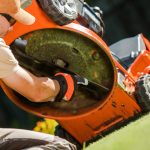

A sharp mower blade cuts grass; a dull one tears it. That single difference decides how healthy a lawn looks and how well it fights off disease. Sharpening and rebalancing a blade sounds like garage-level mechanics, but on most walk-behind rotary mowers it takes under an hour, costs less than £20 ($25) in tools, and needs nothing more exotic than a file and a bench vice. Here is how to do it properly, and why each step earns its place.
Why a Blunt Blade Damages the Grass
A sharp blade slices each grass leaf cleanly in one pass. A blunt one hammers and rips the leaf, leaving a ragged, shredded tip instead of a clean cut. Those torn ends dry out and turn brown or white within a day or two, which is why a lawn cut with a dull blade looks pale and uneven even straight after mowing.
The bigger cost is disease. A torn leaf has a large, open wound where a clean cut would seal quickly, and that wound is an easy entry point for fungal diseases like red thread and rust. A ragged lawn also loses more water through its damaged tips and can scorch in strong sun. So a blunt blade does not just make the lawn look rough; it makes the grass work harder and leaves it open to infection. There is a cost to the mower too. A dull, nicked or bent blade throws the cut off balance and forces the engine to labour through thick or damp grass, which burns more fuel and adds wear.
Set Up Safely Before You Touch the Blade
Gather the kit first: a bench vice, a flat file, a socket or ratchet set, a spark plug wrench, a wire brush, a stiff 2×4 timber offcut, gloves and safety goggles. A can of penetrating spray such as WD-40 loosens the blade bolt. The outlay is small, and a 10-inch bastard mill file, the workhorse of the job, costs only about £8 to £12 ($8 to $14).
Safety comes before anything else, and it is not a formality here. Pull the spark plug wire off the plug and tape it back against the housing so it cannot flick onto the plug. Better still, unscrew the spark plug itself with the plug wrench. The reason is mechanical, not box-ticking. If the piston is sitting at the top of its compression stroke, a knock to the blade as you work can shove the engine over that point and fire it into its power stroke, snapping the blade round hard enough to break a hand. Taking the plug out relieves that compression and removes the risk entirely.
Get the Blade Off Without a Fight
Tip the mower on its side with the carburettor and air filter facing up, not down. Tipping it the wrong way lets petrol and oil drain into the air filter, and the mower then starts hard and smokes when you next run it. If the fuel cap has a vent hole, expect a little petrol to seep out, so work outdoors, keep a rag handy and keep flames well away.
Before you loosen anything, dab a spot of paint on the face of the blade that points down toward the grass. Blades go back on upside down all the time, and one fitted the wrong way up will not cut. The paint mark tells you which face goes outward on reassembly, and it saves an hour of head-scratching later over why a freshly sharpened mower leaves the grass untouched.
Now free the bolt. Wedge the 2×4 between the blade end and the mower deck so the blade cannot spin, and never use your foot for this. Spray the nut or bolt with penetrating oil, wait a minute, then turn it anticlockwise with a long-handled wrench. It will be tight; slipping a length of steel pipe over the handle gives the extra force to crack it loose. One warning: a few older mowers run their blades the other way and use a reverse-thread fastener that undoes clockwise, so check which way yours turns before you lean on it.
Sharpen to a Butter-Knife Edge, Not a Razor
Clamp the blade in the bench vice and scrub off rust and caked grass with the wire brush, leaving your paint mark intact. Put your gloves and goggles on. Working with the flat file, follow the existing bevel on each cutting end. Hold the file at the same angle the factory ground into the edge, usually around 30 degrees, and push it along the bevel in smooth strokes, moving from one end to the other.
Aim for an edge about as sharp as a butter knife, not a razor. This trips people up, but it is deliberate. Mower-blade steel is relatively soft, and a fine razor edge on soft steel rolls over, chips and blunts within a few cuts, above all the first time the blade clips a stone. A slightly blunter, stronger edge holds far longer and still slices grass cleanly. Thirty to fifty strokes usually gets there. Remember the file only cuts on the push stroke, so lift it on the way back rather than dragging it. If it stops biting into the metal, the file is worn and needs replacing.
For curved mulching blades that are awkward to file, a rotary multi-tool with a grinding wheel gives more control than a large angle grinder. Whatever tool you use, keep the pressure light. Grinding too hard overheats the thin steel, and an overheated blade loses its temper and goes soft, which ruins it for good.
Balance the Blade or Pay for It Later
A freshly filed blade almost never comes off both ends even, and an uneven blade is a problem. Hang it on a nail through its centre hole and watch. If one end drops, that end is heavier, and you file a little more metal off that heavier end until the blade hangs level, sitting flat like the arms of a letter T.
This is the step home sharpeners skip most, and it is the one that protects the mower. A blade heavier on one side spins thousands of times a minute off-centre, and the resulting vibration hammers the crankshaft bearings and the oil seal, and over time can bend the crankshaft itself. That turns a five-minute balancing check into an engine repair. The same vibration travels up through the handle and makes mowing rougher and more tiring. A simple cone-shaped blade balancer costs only about £5 to £8 ($5 to $10) and makes the nail test more precise, though the nail alone does the job.
Refit, Tighten Firmly and Test
Tip the mower back onto its side, slide the blade onto the shaft with your painted face pointing outward, and start the nut or bolt by hand. Wedge the 2×4 back against the blade, this time on the opposite side so it holds while you tighten, and pull the fastener up firmly. Do not go light here. An under-tightened blade is a common mistake and a real problem: it can shift on the shaft, throw off the engine timing and leave the mower hard to start, and at worst it can work loose while the blade is spinning. Set the mower upright, refit the spark plug and its wire, and give it a test start on level ground to check it runs smoothly with no new vibration.
How often you need to do this comes down to how much grass you cut. For a lawn under an acre (0.4 hectares) mown once a week, sharpening twice a season, once at the start and once around midsummer, keeps the edge keen. Cut more grass than that, or mow several lawns, and every two to four weeks is closer to the mark. Watch the lawn for the tell-tale signs between services: torn, frayed or clumped grass and pale tips mean the edge has gone.
One judgement call at the end. If the blade is cracked, bent, worn thin or deeply pitted from stones, do not sharpen it, replace it. A new blade costs around £12 to £25 ($15 to $32), less than the damage a failing blade will do, and taking the old blade to the shop gets you an exact match. For a straight sharpen, though, the file-and-balance routine above beats the roughly £24 ($30) a shop charges, and it takes about the same time as loading the blade into the car.