Knowing how to water new turf is the single most important factor in whether your freshly laid lawn takes root or fails. Turf rolls arrive pre-grown but severed from the soil they were raised in, and until new roots push down into your ground, every strip is surviving on stored moisture alone. Get the watering right in the first few weeks and you will have a rooted, established lawn within a month. Get it wrong and you will end up with curling edges, brown patches, and gaps that weeds will happily fill.
This guide covers exactly how to water new turf from the day it is laid through to the point where it is fully rooted, including how much water to apply, how often, what time of day is best, and the common mistakes that catch people out. If you are planning to lay turf this spring or autumn, bookmark this page. The watering schedule here is the difference between a lawn that thrives and one that needs tearing up and starting again.
How to Water New Turf: The First 24 Hours
Watering should begin within 30 minutes of the first rolls going down, not after the entire lawn has been laid. On a warm day, turf left unwatered for more than a couple of hours will start to dry out from the edges, and once those edges curl and go crisp, they are very difficult to recover. If you are laying a large area, water the completed sections while the rest is still being put down.
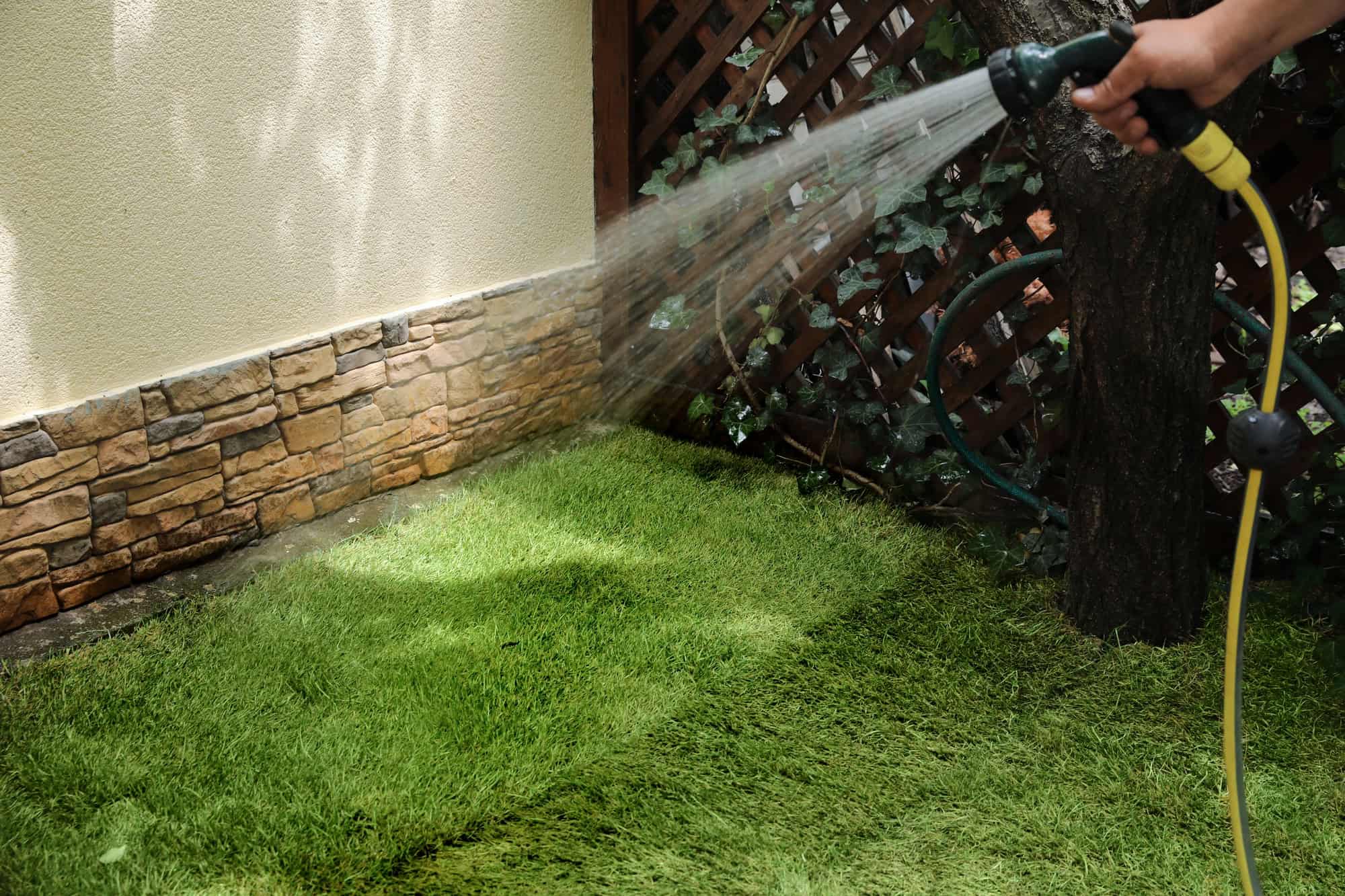
The target for the first watering is to soak the turf thoroughly so that both the turf layer and the top 50 to 75 millimetres of the soil underneath are damp. This usually takes around 15 to 20 minutes of steady watering per area with a sprinkler, or the equivalent from a hose with a gentle spray attachment. Avoid using a jet nozzle or open hose end, as the force of the water can dislodge the turf and wash away the prepared soil beneath.
To check whether you have applied enough, lift a corner of a freshly watered roll. The soil underneath should be dark and moist to the touch, not dusty or pale. If it is still dry, keep watering. Overwatering at this stage is far less dangerous than underwatering, so err on the side of giving it too much rather than too little.
How to Water New Turf: Weeks One and Two
For the first 14 days after laying, the turf has no functioning root system in your soil and is entirely dependent on surface moisture. This is the critical window where most new lawns succeed or fail.
Water once per day, ideally in the early morning between 6 and 10 am. Early morning watering gives the turf the full day to absorb moisture before the heat of the afternoon, and it allows the leaf surface to dry before evening, which reduces the risk of fungal disease. If early morning is not possible, late afternoon after 4 pm is the next best option. Avoid watering in the middle of the day when evaporation is highest, and avoid late evening watering as the turf will sit wet overnight.
Each session should deliver around 10 to 15 litres per square metre, which translates to roughly 20 to 25 minutes with a standard oscillating sprinkler. The goal is to keep the soil beneath the turf consistently moist without it becoming waterlogged. If puddles are forming on the surface and not draining within a few minutes, you are applying too much at once. In that case, split the watering into two shorter sessions with a gap of an hour or so between them to let the water soak in.
On hot or windy days, you will need to increase the frequency. Temperatures above 25 degrees Celsius or a steady breeze can double the rate of moisture loss from the turf surface. On those days, a second lighter watering in the late afternoon will prevent the edges from drying out. Keep an eye on any turf laid on slopes or next to paths and driveways, as these areas dry out faster than the middle of the lawn due to heat reflected off hard surfaces and water running downhill.
How to Water New Turf: Weeks Three and Four
By the start of the third week, the turf should be starting to root into the soil beneath. You can check this by gently tugging a corner of a roll. If there is resistance, roots are forming. If the roll still lifts freely, continue with the week-one schedule.
Once rooting has begun, start reducing the frequency while increasing the depth of each watering. Move from daily watering to every other day, but extend the sprinkler time by around 50 percent so that each session delivers more water deeper into the soil. This encourages the new roots to grow downwards in search of moisture rather than staying near the surface. A shallow-rooted lawn will always be more vulnerable to drought and heat stress, so this transition from frequent-and-light to less-frequent-and-deep is one of the most important things you can do for long-term lawn health.
By the end of week four, most turf laid on well-prepared soil will be firmly rooted and you can move to a normal watering routine. In the UK, this often means no supplementary watering at all for much of the year, relying on rainfall to keep the lawn going. Our guide on how often you should water your lawn covers the established-lawn schedule in detail.
How Much Water Does New Turf Need?
As a general rule, new turf needs around 25 millimetres of water per week for the first two weeks, delivered in daily applications. From week three onwards, it needs around 25 to 30 millimetres per week delivered in two or three deeper sessions.
If you do not have a rain gauge or water meter, there is a simple way to measure output. Place four or five empty tuna tins or similar flat-bottomed containers around the area covered by your sprinkler and run it for a timed period. After 15 minutes, measure the depth of water in the tins. If the average is around 5 millimetres, you know your sprinkler delivers roughly 20 millimetres per hour, and you can calculate the run time from there.
Rainfall counts towards the weekly total. If you get 10 millimetres of rain on a Tuesday, reduce or skip the next scheduled watering accordingly. There is no benefit to watering on top of rain, and doing so can push the soil into a waterlogged state that suffocates the new roots and invites fungal problems. Checking the total water your lawn needs with a gauge takes the guesswork out of the equation entirely.
Best Time of Day to Water New Turf
Early morning between 6 and 10 am is the best window. The air is cooler, wind is typically lighter, and the grass has the full day to absorb the moisture and dry its leaves before nightfall. Watering at this time also means less is lost to evaporation compared with the middle of the day.
If early morning is not practical, late afternoon after 4 pm is acceptable, particularly in the first two weeks when keeping the turf moist is the overriding priority. The risk of fungal disease from evening moisture is real but secondary to the risk of the turf drying out completely.
Avoid watering between 11 am and 3 pm. On a sunny day, water droplets sitting on the grass blades can act as tiny lenses that scorch the leaf surface, and the rapid evaporation in midday heat means a large proportion of the water you apply never reaches the roots. You end up using more water for less benefit. For a wider look at timing, our article on when to water your lawn covers seasonal and regional considerations.
Signs of Underwatering
The first sign that new turf is not getting enough water is the edges of individual rolls starting to curl upwards and pull away from each other, leaving visible gaps. If the turf has been down for less than two weeks, these gaps are a warning that the rolls are shrinking as they lose moisture. Left unchecked, the edges will go crisp and brown and the turf will not root into the soil beneath.
Other signs include the grass taking on a blue-grey or dull appearance rather than a bright green, footprints remaining visible for more than a few seconds after walking on the lawn, and the soil beneath the rolls feeling dry and dustite when you lift a corner to check. If you spot any of these, water immediately and thoroughly, then increase the frequency or duration of your regular schedule.
Turf that has been badly underwatered for several days will go brown and straw-like. In many cases it will recover if soaked heavily and kept moist for a week, as the grass crowns are tougher than they look, but recovery is slow and the lawn will look patchy for several weeks. Prevention is far easier than cure. If you are heading away from home for a few days shortly after laying turf, arrange for someone to water in your absence or set up a timer-controlled sprinkler system.
Signs of Overwatering
While underwatering is the more common problem, overwatering can be equally damaging, particularly on clay soils or lawns with poor drainage. The signs of overwatering include water pooling on the surface that does not drain within 10 to 15 minutes, a spongy or squelchy feeling when you walk on the turf, and a sour or musty smell coming from the soil.
Waterlogged soil drives out the air that roots need to grow, so a new lawn that is kept constantly saturated will root very slowly or not at all. In severe cases, the turf will develop yellow patches and the roots will turn brown and slimy, a condition called root rot that is very difficult to reverse.
If you suspect overwatering, stop watering for two to three days and let the top layer of soil dry out slightly before resuming. On heavy clay soils, consider shorter but more frequent watering sessions to avoid overwhelming the drainage capacity of the soil. If drainage is a persistent problem across the entire lawn, you will want to address it before laying turf in the future. Our article on drainage and soil health covers the preparation work in detail.
Watering New Turf on Slopes
Slopes are the most challenging areas to water because gravity pulls the water downhill before it has time to soak into the soil. The top of a slope dries out first, the bottom gets waterlogged, and the middle gets an uneven amount depending on the gradient.
The best approach is to use a sprinkler set to a low flow rate and run it for a shorter period, then wait 30 to 45 minutes for the water to absorb before running it again. Two or three short cycles will deliver the same total amount of water as one long session but with much better absorption and far less runoff.
If the slope is steep enough that even gentle sprinkler water runs off immediately, hand-watering with a hose and a fine rose attachment gives you more control. Focus on the upper third of the slope, which dries fastest, and let gravity do some of the work distributing moisture downward. Pegging the turf with biodegradable turf pins on steep slopes also helps prevent the rolls from sliding as the water loosens the soil underneath.
Can You Walk on New Turf?
Ideally, no. For the first two weeks, keep all foot traffic off the new turf to give the roots the best chance of establishing undisturbed. Every footstep compresses the soil beneath the turf and can break the fragile new root connections that are just starting to form.
In practice, you will need to walk on it to water it. When you do, use a plank or board to spread your weight over a wider area and avoid concentrated pressure on any one spot. Move the plank as you go rather than walking directly on the turf. This is especially important on wet turf, which compacts more easily than dry.
After two to three weeks, once the turf has started to root and resists a gentle tug, light foot traffic is fine. Hold off on heavy use, children playing, and garden furniture for at least four to six weeks to give the roots time to develop fully. The same applies to mowing. Wait until the grass has grown to around 50 millimetres and the turf is rooted before making the first cut, and set the mower height to its highest setting so you remove no more than a third of the blade length.
Watering New Turf in Different Seasons
Spring
Spring is the second-best time to lay turf in the UK after autumn. Soil temperatures are rising, rainfall is usually reliable, and the grass is entering its main growth phase. Watering demands are moderate. In a typical British spring, natural rainfall will supply some or all of the water your new turf needs, but you should still check the soil beneath the rolls daily and top up with the sprinkler whenever it feels dry. Do not assume that a grey sky or a light shower has done the job. Light drizzle often wets only the leaf surface without reaching the soil below.
Summer
Laying turf in summer is the most challenging option because of the heat and the risk of drought. If you must lay in summer, do it early in the morning on a cool or overcast day and begin watering immediately. You will almost certainly need to water twice a day for the first two weeks, once in the early morning and again in the late afternoon. Water use can be three to four times higher than a spring or autumn laying, so factor this into your planning. Check whether your area has any hosepipe restrictions in place before committing to a summer laying date.
Autumn
Autumn is considered the best time to lay turf in the UK. The soil is still warm from summer, which encourages fast root growth, but the air is cooler and rainfall is more frequent, which reduces watering demands. Most autumn-laid turf will root fully with little or no supplementary watering beyond what nature provides, though you should still check and water if conditions turn dry. The turf then has the entire winter and spring to develop a deep root system before facing its first summer.
Winter
Laying turf in winter is possible but not ideal. The grass is dormant or semi-dormant and root growth is very slow, so the turf will sit on the surface for longer before rooting. Watering is rarely needed in winter as rainfall and low evaporation keep the soil moist, but waterlogging can be a problem on heavy soils. Avoid laying turf on frozen ground or when prolonged frost is forecast, as the freeze-thaw cycle can lift the rolls and break any early root connections.
Common Mistakes When Watering New Turf
The biggest and most common mistake is not watering enough in the first week. People lay the turf, give it one good soak, and then assume it will be fine. It will not. New turf needs daily attention for at least 14 days, and on hot or windy days it needs checking twice. Treat it as a daily commitment, not a one-off task.
The second most common mistake is watering at the wrong time. Midday watering in sunshine wastes water to evaporation and can scorch the leaves. Late-night watering leaves the grass wet for hours in the dark, which encourages fungal disease. Stick to early morning wherever possible.
The third mistake is failing to adjust for weather conditions. A watering schedule that works perfectly in a cool, still April will leave the turf parched in a hot, windy June. Use the soil moisture check rather than the calendar to decide when to water. Lift a corner, feel the soil, and water if it is dry. This simple habit will prevent both underwatering and overwatering more reliably than any fixed timetable.
Other common errors include using a high-pressure jet that dislodges the turf, watering only the visible areas while forgetting edges and corners, and walking repeatedly across the same path to reach the sprinkler, which compacts the soil and damages the turf in that strip. A long hose or a sprinkler with a timer solves most of these problems.
Preparing the Soil Before Laying Turf
Good watering will not save turf laid on badly prepared soil. The ground underneath needs to be level, free of large stones and debris, lightly firmed but not compacted, and ideally improved with a thin layer of topsoil or compost. A well-prepared base absorbs and holds water evenly, which means the turf roots into the full area rather than just the wetter spots.
If your soil is heavy clay, mixing in sharp sand or a soil improver before laying will help with drainage and prevent the waterlogging problems described earlier. If the soil is very sandy and drains too fast, adding organic matter will improve its water-holding capacity. Getting the soil health right before the turf goes down makes every watering session more effective and gives the roots the best possible environment to grow into.
Rake the surface to a fine tilth, remove any stones larger than about 20 millimetres, and lightly roll or tread the area to firm it without compacting it. The finished surface should be about 20 millimetres below the level of any adjacent paths, patios, or edging, so that the turf sits flush once it is laid. Water the prepared soil lightly the day before laying if conditions are dry, as turf laid on bone-dry ground will lose moisture into the soil faster than you can replace it from above.
When to Start Mowing New Turf
Hold off on mowing until the turf has rooted. This is typically three to four weeks after laying, though it can take longer in cool weather or on heavy soils. Test by tugging gently on the turf. If it resists and does not lift, it is safe to mow.
For the first cut, set the mower to its highest setting and remove no more than a third of the grass blade length. Scalping new turf by cutting too short will stress the grass and slow root development. Lower the cutting height gradually over the following weeks, dropping by one notch per mow until you reach your preferred height. For most UK lawns, a cutting height of 25 to 40 millimetres works well for the first season. More detail on mowing technique is in our guide on how to achieve the perfect cut.
Use a mower with a sharp blade. A dull blade tears the grass rather than cutting it cleanly, which opens the plant to disease and gives the lawn a ragged, pale appearance. If you have not checked your blade recently, our article on how sharp lawn mower blades should be explains what to look for and when to sharpen.
When to Feed New Turf
Do not feed new turf for the first four to six weeks after laying. The turf was grown in a professional nursery with optimised nutrition, so it arrives with enough nutrients to sustain it through the rooting period. Adding fertiliser too early can burn the shallow roots and do more harm than good.
After six weeks, a light application of a balanced lawn fertiliser will give the establishing grass a boost. Choose a product with a balanced or slightly nitrogen-heavy NPK ratio, such as 10-5-5 or similar, and apply at half the recommended rate for established lawns. Build up to full-rate feeding over the following months as the root system matures. Our guide on fertilising fundamentals covers product selection and application timing in more detail.
New Turf Frequently Asked Questions
How often should I water new turf?
Once per day for the first two weeks, twice per day in hot or windy conditions. From week three, reduce to every other day as the turf begins to root. By week four or five, move to a normal established-lawn watering schedule, which in the UK often means relying on rainfall alone.
How long should I run the sprinkler on new turf?
Around 20 to 25 minutes per area with a standard oscillating sprinkler. The goal is to deliver 10 to 15 litres per square metre per session, wetting the soil to a depth of 50 to 75 millimetres. Use the tuna tin method described in this article to calibrate your sprinkler if you are unsure of its output.
Can I lay turf in summer?
Yes, but it requires more work and water. Lay early in the morning on a cool or overcast day, water immediately, and expect to water twice per day for the first two weeks. Check for hosepipe restrictions in your area before committing to a summer laying date.
How do I know if my new turf has rooted?
Gently tug a corner of a roll. If there is resistance and the turf does not lift freely, roots have formed. Most turf laid on well-prepared soil will start to root within 10 to 14 days and be firmly anchored by week three or four.
What happens if new turf dries out?
The edges will curl, the colour will fade to blue-grey or brown, and the turf will stop rooting. If caught early, a thorough soaking followed by consistent daily watering will usually bring it back. Badly dried turf that has gone straw-coloured will take several weeks to recover and will look patchy until new growth fills in.
Should I water new turf in the rain?
Only if the rain is light enough that the soil beneath the turf remains dry. Light drizzle often wets only the grass blades without reaching the root zone. Lift a corner and check the soil. If it is moist to the touch, skip the watering. If it is dry, water as normal regardless of what the sky looks like.
Can I water new turf too much?
Yes. Overwatering causes waterlogging, which drives out soil air and can lead to root rot. If you see standing water on the surface that does not drain within 15 minutes, or the lawn feels spongy underfoot, reduce watering frequency or split sessions into shorter bursts with a gap between them.
Sources
- Royal Horticultural Society. “Laying Turf.” RHS Gardening Advice. https://www.rhs.org.uk/lawns/turf-laying
- The Lawn Association. “Establishing and Caring for New Turf.” Technical Guidance Notes.
- Sports Turf Research Institute (STRI). “Irrigation Management for Newly Laid Turf.” Applied Turf Research. https://strigroup.com/
- Met Office. “Gardening by the Weather: Watering and Irrigation.” UK Climate Data. https://www.metoffice.gov.uk/