The sprinkler you stand on the lawn decides three things: how evenly the water lands, how much of it is lost to wind and evaporation before it ever soaks in, and whether the far corners stay green while the middle goes soggy. There are four main types on the shelf, and they are not interchangeable. Each is built for a particular size and shape of lawn, and choosing the wrong one is the reason so many lawns end the summer with dry brown stripes a few feet from a patch that never dried out. Pick the type that fits your lawn and most of the watering problem solves itself.
Oscillating Sprinklers for Square and Rectangular Lawns
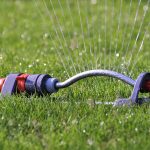
The oscillating sprinkler is the familiar one: a curved bar drilled with jets that sweeps a fan of water slowly back and forth, laying it down in a rectangle. That rectangular footprint is its great strength, because most lawns are square or oblong and this is the only common sprinkler that waters into the corners rather than around them. A mid-range model covers somewhere between about 200 and 370 square metres (very roughly 2,000 to 4,000 square feet), and the spray is gentle enough not to wash out seed, which makes it the right choice over a freshly sown patch. Most have a slider to narrow the width and the reach, and the individual jet holes can be blocked with a cocktail stick to stop it watering the patio.
Its weakness is the flip side of that fine, soft spray. The small droplets are easily blown off course by even a light breeze and they evaporate quickly in heat, so an oscillating sprinkler run in the middle of a hot, windy afternoon can lose a large share of its water before it reaches the grass. Run it in the still air of early morning or evening and that problem largely disappears. The pattern is also slightly heavier in the centre of the sweep than at the two ends, so on a long lawn it pays to overlap the passes or shift the sprinkler once. Hozelock models sit around £20 to £28 (roughly $25 to $35) and the Gardena Aqua S around £17 (about $21), all widely sold at B&Q, Home Depot, Amazon and most garden centres.
Rotary and Impact Sprinklers for Big, Open Lawns
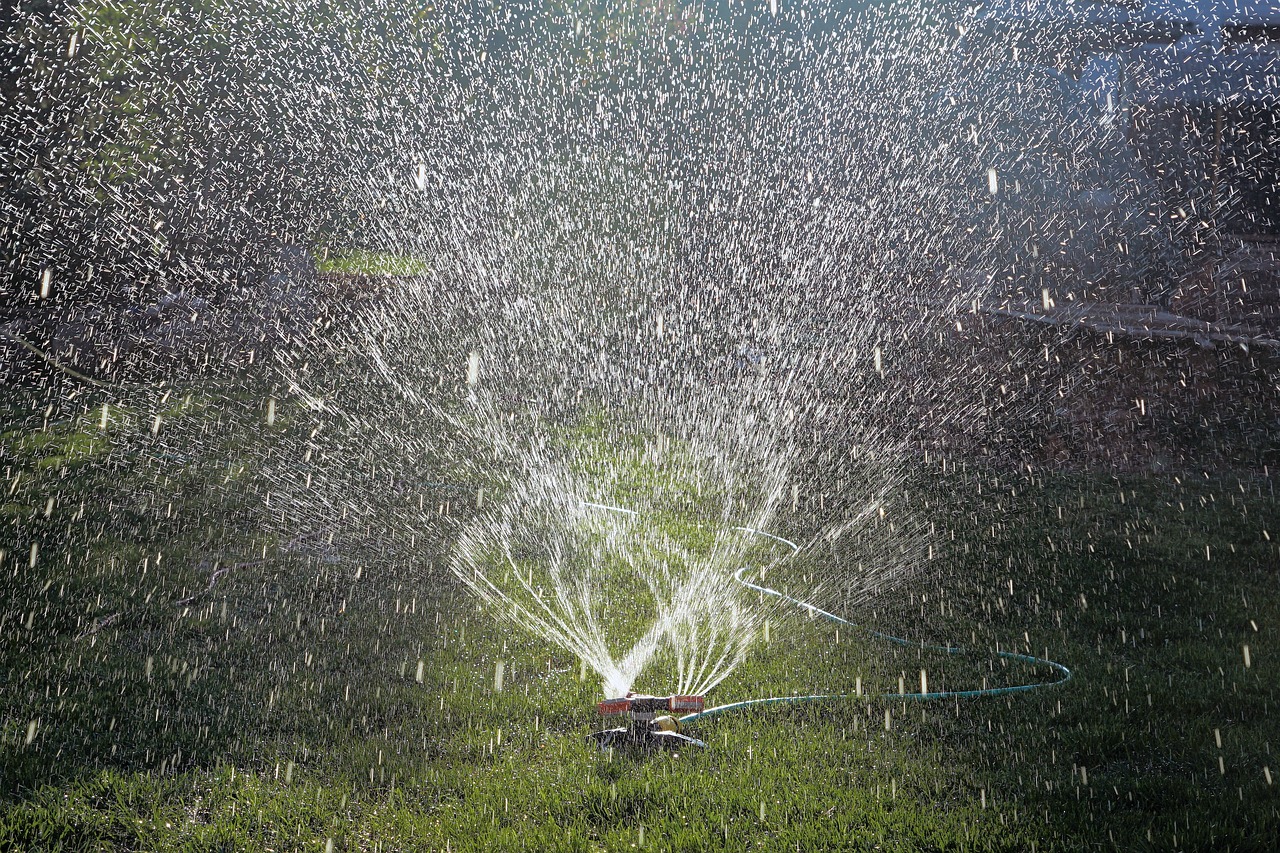
Where the lawn is large and open, a sprinkler that throws in a circle makes more sense, and there are two kinds. The impact sprinkler is the old brass-and-steel design that fires a single jet and steps round with the familiar tick-tick-tick, and it has the longest throw of anything you can buy off the shelf, so it covers the most ground from one position. Its coarse, heavy droplets punch through wind far better than an oscillator’s mist, which makes it the tool for an exposed, breezy site. The trade-off is that a circle leaves the corners of a square lawn dry, and the watering is heavier close to the head than at the edge of its reach.
The rotary or gear-driven sprinkler is the gentler, quieter relative, sending out two or three rotating streams in a circle. It is more uniform than an impact and far less prone to wind drift, and because it lays water down at a lower rate it is the better choice on a slope or on heavy clay, where an impact would deliver water faster than the ground can absorb it and send the surplus running off down the hill. A simple impact on a spike costs around £10 to £20 (roughly $13 to $25), while a tripod-mounted version lifts the head higher to clear long grass and reach further across a paddock or large back lawn. Match the type to the site, not just the price, since a cheap impact on a small clay slope will waste more water than a dearer rotary saves.
Where Soaker Hoses and Pop-Ups Fit
Two other options come up a lot, and it helps to know their honest limits. A soaker hose, the porous pipe that weeps water along its whole length, is superb for borders, beds and rows of vegetables, but it is the wrong tool for a lawn. It only wets a narrow strip either side of the pipe, so to cover a lawn evenly you would need it snaked back and forth every few inches, and even then the coverage is patchy. Use it among your plants and water the grass with something that throws.
At the other extreme is a permanent in-ground system of pop-up heads, which disappears below the surface until the water comes on. This gives the most even coverage of all and waters without anyone lifting a finger, but it is a costly, fixed installation that only makes sense for a large or much-loved lawn. If you do go that route, the heads fitted with multi-stream rotator nozzles are the ones to ask for, because they hold a very even precipitation rate across the whole pattern, which is the gold standard professional greenkeepers aim for and the thing every portable sprinkler is only ever approximating.
How to Match One to Your Lawn and Prove It Is Even
The shape of the lawn points to the type. A rectangle wants an oscillating sprinkler, a large open circle or an irregular space wants an impact or rotary head you can set in the middle, and an exposed, windy garden wants the coarse droplets of an impact or rotary over the drift-prone mist of an oscillator. A slope or a clay soil wants the lower, gentler rate of a rotary to stop water running off. Low household water pressure is worth a thought too, because oscillating and rotary heads cope with modest pressure, while an impact needs a decent head of pressure to throw its full distance.
One practical addition decides how much of this you actually keep up with: a simple tap timer. A battery timer that screws onto the outside tap (around £15 to £25, roughly $19 to $32) switches the sprinkler on before dawn and off again after your measured run time, so the watering happens at the best hour of the day whether or not you are up to move it. It also ends the commonest waste of all, the sprinkler left running for hours because someone forgot it, which floods the soil, runs off down the path and drowns the very roots you are trying to help. If the lawn is too big for one sprinkler position to reach, resist buying an ever bigger head and instead water it in two or three sessions across different mornings, moving the sprinkler each time and overlapping the patterns slightly so no strip is left dry.
Whatever you buy, there is a simple test that turns guesswork into fact. Set out five or six straight-sided containers, empty tuna tins or jam jars, in a line across the area the sprinkler covers, run it for half an hour, then measure the depth of water in each. The tins nearest the head and farthest away will usually hold very different amounts, and that picture tells you where to reposition the sprinkler and how long to run it so the whole lawn gets a fair share. A lawn wants roughly 25mm (one inch) of water a week including any rain, so once you know how long your sprinkler takes to drop an inch into the tins, you know how long to run it. Even watering is the whole game, because the dry zones brown off while the over-watered ones stay soft and invite disease. Finish the job by watering in the cool of early morning, giving the lawn a proper soak deeply and less often, and reaching for a wetting agent if the ground has dried so hard that the water beads and runs off instead of soaking in.