A robot mower trims a little grass every day and mulches the clippings back into the lawn, so the grass never grows long enough to need collecting. For the right garden it removes mowing from the to-do list entirely. The technology changed sharply over the past two years: the buried boundary wire that used to define where the machine could go is being replaced by satellite positioning and cameras, which makes setup faster and the price of entry lower. Two types of garden still defeat even the best of them, and knowing whether yours is one of them saves a great deal of money.
Before spending several hundred pounds, it helps to understand how these machines cut, how they find their way, and where they fail.
How a Robot Mower Actually Cuts
A robot mower works nothing like the petrol machine in the shed. Instead of a single heavy blade taking off several centimetres once a week, it carries a small disc fitted with three or four razor blades, each about the size of a craft knife tip, spinning fast and shaving a few millimetres off the top of the grass on most days. The clippings are tiny and fall back between the blades, where they break down and return nitrogen to the soil, a process that feeds the lawn through the season and removes the job of emptying a grass box. Because it cuts so little so often, the lawn stays at a constant height and develops a fine, dense surface that many owners find tidier than a weekly cut.
The machine lives in a docking station plugged into an outdoor socket. It heads out on a schedule you set, mows until the battery runs low, returns to charge, then resumes, covering the lawn in overlapping random or mapped patterns. A rain sensor on most models sends it home in wet weather, lift and tilt sensors stop the blades within a fraction of a second if a child or pet picks it up, and a PIN code plus an alarm deters theft. The blades themselves cost only a few pounds for a pack and need swapping every one to three months depending on lawn size.
The End of the Boundary Wire
For years a robot mower meant pegging a perimeter wire around the entire lawn and every flower bed, a half-day job that broke if a fork or aerator cut the cable. Newer models drop the wire in favour of three approaches. RTK, short for real-time kinematic positioning, pairs the mower with a small fixed antenna on a wall or post that corrects satellite signals to centimetre accuracy, so you simply walk the mower around the boundary once in an app to draw the map. Vision-based models use onboard cameras to read lawn edges, obstacles, and beds as they go. The most capable machines add LiDAR, which fires laser pulses to build a three-dimensional map of the garden and steer around objects in real time.
Each method has a weakness worth knowing before you buy. RTK depends on a clear view of the sky, so the fixed antenna needs open positioning and the lawn needs to sit away from heavy tree cover and tall walls that block satellite signals. Vision systems can struggle in low light or heavy shade. LiDAR copes best with clutter but sits at the top of the price range. The practical upshot is that a wire-free mower set up in twenty minutes suits an open, sunny lawn far better than a shaded plot hemmed in by mature trees.
What They Cost and Which Model Suits Which Garden
Prices span a wide range. Entry-level wire-guided models for small lawns start around 350 to 500 pounds (about 440 to 630 dollars). Wire-free camera models such as the Worx Landroid Vision sit around 600 to 900 pounds (about 750 to 1,130 dollars). Established RTK machines from Husqvarna and Segway Navimow run from roughly 900 to 1,600 pounds (about 1,130 to 2,000 dollars), and the most capable LiDAR and all-wheel-drive models from brands like Mammotion reach 2,000 pounds or more (about 2,500 dollars and up). These are sold at garden centres, large hardware retailers, and online through Amazon and specialist dealers.
Match the machine to the lawn rather than the headline features. The single number that drives the choice is lawn area: every model lists a maximum coverage, and buying one rated close to your lawn size leaves it running for hours unnecessarily, while a model rated well above your area mows quickly and lasts longer. For a small, simple rectangle, a budget wire model does the job for the lowest outlay. For a medium open lawn with a few beds, a wire-free camera or RTK model removes the cable headache. For a large or oddly shaped plot split across several areas, look for RTK or LiDAR with the ability to store multiple mapped zones and cross narrow links between them. Check the rated slope figure too, usually given as a percentage, because a machine rated for 25 percent will stall and slip on anything steeper.
The Two Gardens That Defeat Them
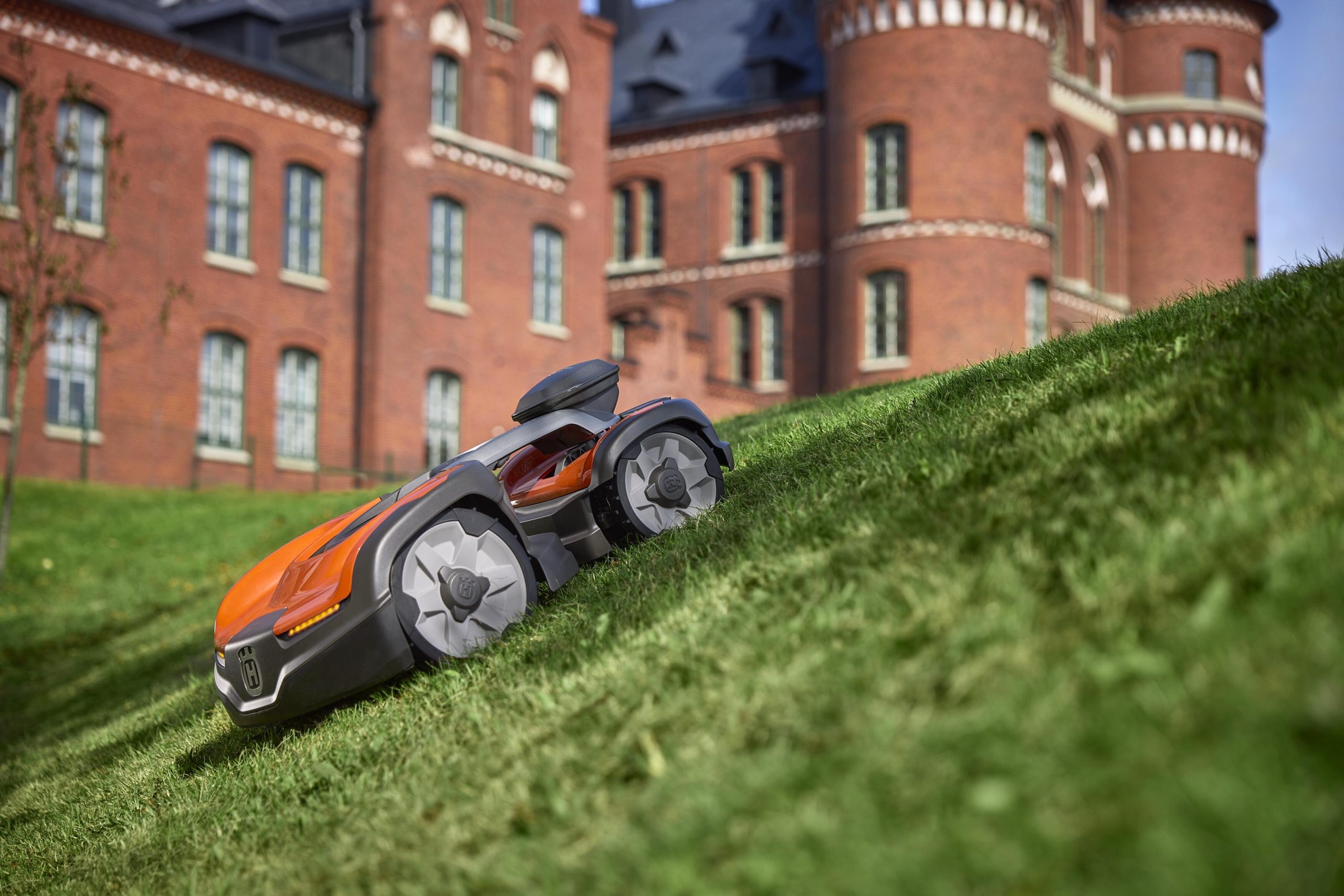
The first is the steep or banked garden. Robot mowers grip with rubber wheels and depend on traction, and once a slope passes the rated gradient the wheels spin, the machine slides, and it either gives up or scalps the turf as it slithers. All-wheel-drive models climb more, often up to 45 percent, but a steep bank still beats most machines, and a slope that drops toward a pond or road raises a safety concern no schedule can fix. For ground like that, a lightweight push mower or a strimmer remains the safer tool.
The second is the small, complex, heavily planted garden. A plot broken into narrow strips, threaded with stepping stones, tree roots, low branches, and tight gaps between beds gives a robot mower constant obstacles to read and little open grass to cover. Wheels catch on raised edges, the machine bumps repeatedly off the same border, and shade from trees blocks both the satellite signal an RTK model needs and the light a camera model relies on. On a lawn like that the mower spends more time stuck or rerouting than cutting, and a ten-minute push round with a small electric mower does a neater job. The honest test before buying is to walk your lawn and ask whether a machine the size of a cat could roll across most of it unobstructed in the sun. If the answer is yes, a robot mower will earn its place. If the lawn is small, steep, shaded, or chopped into fiddly corners, the money is better spent elsewhere.
Running costs are modest but worth counting. The mowers draw little power, charging for pennies a day, and the main ongoing spend is blades at roughly 8 to 15 pounds (about 10 to 19 dollars) for a multi-pack, replaced every one to three months. Most machines need a winter clean, a check of the wheel motors and contacts, and storage indoors out of frost. The docking station and charging contacts collect grass and need wiping clear, and the underside of the cutting disc benefits from a brush-off every few weeks to keep the small blades spinning freely. None of this approaches the fuel, oil, spark plug, and air filter routine of a petrol mower, which is part of the appeal.
Set realistic expectations for the first week. A robot mower does not deliver an instant transformation; it works by holding the grass at a fixed height once it has caught up, so a long lawn needs a conventional first cut before the robot takes over. Plan the schedule so the machine runs in daylight when children and pets are indoors, even though the safety sensors are reliable, and walk the garden once to remove hose ends, dog toys, fallen fruit, and low wire arches that can trap it. Owners who map the lawn carefully, set sensible no-go zones around ponds and beds, and keep the docking area clear get years of hands-off mowing. Those who expect it to handle an obstacle course unattended tend to find it beached behind a plant pot.