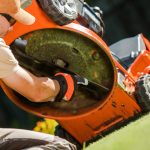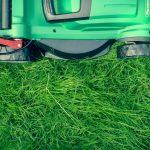
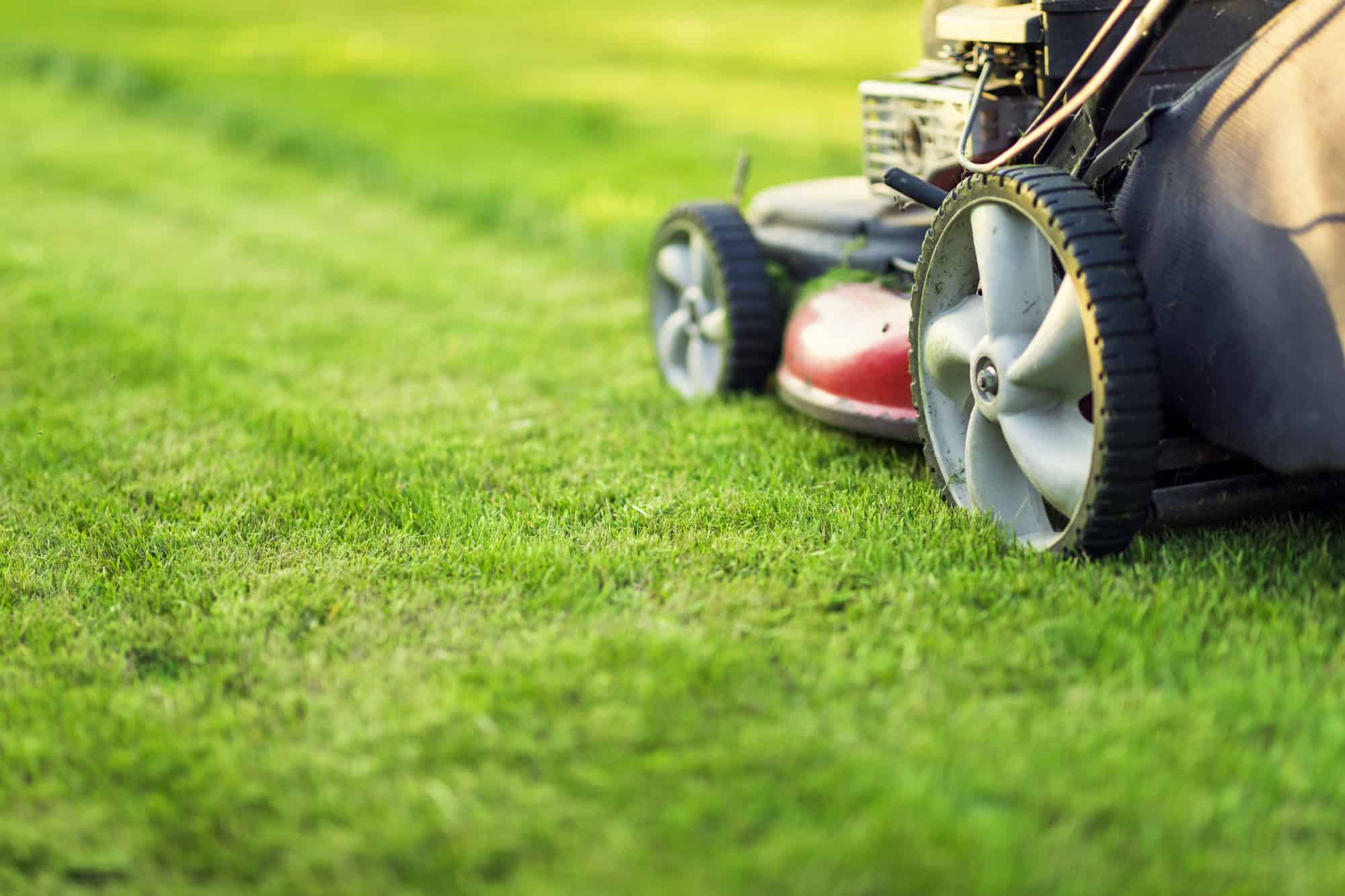
You mow the lawn, step back to admire it, and there they are. Bald, brown patches every few metres where the mower has taken the grass right down to the soil. These scalp marks usually appear on the high points of an undulating lawn, around tree roots, and along the edges where the mower wheels drop off a level. They are not a mower fault in most cases. They are the predictable consequence of how a fixed-height rotary deck interacts with a lawn that is not perfectly flat. Once you understand the geometry, the fix is simple enough to do in a single afternoon.
This is one of the most common questions in lawn forums and one of the most badly answered. Most advice suggests raising the mower height and leaving it there. That works in the short term but it does not solve the underlying problem, which is that the deck cannot follow ground contours that the wheelbase can. Here is the full picture and the practical fixes that work.
The Geometry of Why a Mower Scalps
A rotary mower deck is rigid. The blade spins at a fixed distance below the four wheel hubs, set by your cutting height adjuster. The wheels sit on the ground surface and dictate the deck position. So far so simple. The problem starts when the ground is not flat. When the mower passes over a bump, the wheelbase straddles the high point and the blade tip, which is roughly in the centre of the deck, dips closer to the bump than the wheels suggest. If the bump is 2cm (about 0.8 inches) higher than the surrounding turf and your cutting height is set to 3cm (1.2 inches), the blade hits the bump at 1cm (0.4 inches) above soil level. That is scalping territory.
The same geometry works in reverse around tree roots, hose holes, and the lip where a flower bed has been carved into the lawn. Wheels straddle the dip, the deck sits low across the gap, and the blade clips the leading edge of the next high spot.
Wider decks make this worse. A 53cm (21 inch) deck spans more variation than a 35cm (14 inch) deck, so it scalps more easily on uneven ground. This is one of the reasons professional groundsmen on cricket squares and bowling greens use narrow cylinder mowers rather than wide rotaries. A narrow deck follows contour better.
The Six Causes of Scalping, In Order of How Common They Are
Most scalping comes down to one of six causes, often working together. Diagnosing which one is driving your bald patches makes the fix obvious.
The first is cutting height set too low. The rule from every turf-science programme is to remove no more than one-third of the grass blade in a single cut. If the lawn has grown to 8cm (about 3.2 inches) and you cut to 3cm (1.2 inches), you have removed five-eighths of the blade in one pass. The grass at the high points loses its photosynthetic surface and turns brown within 48 hours. The fix is to raise the deck. A general-purpose lawn should cut at 35 to 50mm (about 1.4 to 2 inches), with 25mm (1 inch) reserved for fine ornamental lawns on perfectly flat ground.
The second is uneven ground that the mower cannot follow. Bumps, hollows, tree roots breaking surface, and worn patches around hose taps all create scalping risk. The fix is topdressing in autumn with a sandy loam mix to fill the hollows over time, and rolling out the worst bumps in late winter when the soil is moist enough to compress. Topdressing material is sold by Rolawn, Boughton or Westland at around £9 to £14/$12 to $18 for a 20kg bag, enough to cover roughly 4m2 (about 43 sq ft) at the correct 5mm (0.2 inch) depth.
The third is uneven tyre pressure on a self-propelled or ride-on mower. If one rear tyre is at 14 psi and the other is at 8 psi, the deck tilts by half an inch across its width. On a narrow walk-behind that is usually negligible, but on a ride-on with a 100cm (39 inch) deck it produces a clear scalp line on one side every pass. Check tyre pressures with a basic dial gauge before each spring service.
The fourth is a misaligned or warped deck. On older mowers, especially those that have been driven over a kerb or jolted on a hard impact, the deck can sit a few millimetres lower on one side. The fix is to level the deck on a flat surface using the manufacturer’s adjustment screws, or to take it to a service dealer for a proper deck balance.
The fifth is a damaged or worn blade. A bent blade tip drops lower than the rest of the cutting arc and scalps in a circular pattern as the mower moves forward. A blade thinned by years of sharpening can flex downward at speed and dip below its rated cutting height. Replace blades when they have lost more than 2mm (about 0.08 inches) of cutting edge depth from new, or when any visible bend, crack or chip is present.
The sixth is mowing speed. Walking too fast with a self-propelled mower or driving too fast on a ride-on stops the deck following ground contours through its trailing wheels. Slow down to a steady walking pace, around 4 km/h or 2.5 mph, and the scalping marks reduce visibly even before any other change.
The Single Best Upgrade for Uneven Lawns: Gauge Wheels and Rollers
If your lawn is properly undulating and you do not want to spend three years topdressing it flat, the right hardware fix is gauge wheels or a rear roller. Both stop the deck from dropping into hollows because they ride on the ground surface immediately beside the blade.
Gauge wheels are small free-spinning wheels mounted to the front, sides, or rear of the deck. On ride-on mowers they typically retrofit for around £25 to £45/$32 to $58 per pair from Husqvarna, John Deere or Cub Cadet dealers and they make a noticeable difference on lumpy ground. On walk-behinds, a rear roller works better. The Hayter Harrier 41 (around £750/$960) is a popular example of a rotary mower with a built-in rear roller, which adds the bonus of mowing stripes. The roller bridges short hollows the wheels alone would drop into, holding the blade height steady across small undulations.
For cylinder mowers, the rear roller is integral to the design, which is why a quality cylinder mower scalps far less than a comparable rotary on bumpy ground. If your lawn is otherwise good quality but uneven, a Allett Liberty 35 or a Husqvarna 540 cylinder (both in the £700 to £1,000/$895 to $1,275 range) is the right machine.
How to Recover the Bald Patches Once They Have Happened
Scalped grass will usually recover on its own within 2 to 3 weeks if the crown of the plant has not been damaged. The crown sits at soil level and is the growth point from which new leaves emerge. If the mower took the blades down but did not damage the crown, the grass will tiller out from the base and refill the patch.
You can speed recovery by raising your cutting height immediately, watering the affected patches deeply once a week, and applying a light feed of a balanced fertiliser such as Westland SafeLawn (around £12/$15 for 150m2) at the rate on the box. Avoid mowing the scalped areas at all until you can see at least 3cm (1.2 inches) of new growth, which gives the plant time to rebuild its photosynthetic surface.
For severe scalps where the soil is exposed and the crown is gone, overseed the bare patch with a hard-wearing seed mix such as Rolawn Medallion (around £18/$23 for 750g) or Pennington Smart Patch (around £20/$25). Loosen the soil to 1cm (0.4 inches) with a hand fork, sow at 35g/m2, cover with a thin sprinkle of topsoil or sieved compost, and water daily until germination, which takes 7 to 14 days at typical late spring temperatures.
What Happens If You Just Keep Scalping
Repeated scalping of the same spots eventually kills the grass at those points and opens the soil to weed colonisation. Annual meadow grass, broadleaf weeds and pearlwort all establish faster than perennial ryegrass on bare ground, and within a season the bald patches become weed patches that need full chemical or mechanical control. The cost of avoiding the problem (raising the deck, topdressing, fitting gauge wheels) is a fraction of the cost of dealing with the weed colonisation that follows persistent scalping.
The summary is short. Set the deck higher than you think it needs to be. Slow down. Check the tyres. Replace bent blades. And for the most uneven lawns, fit a rear roller or use a cylinder mower. Those five changes will eliminate 90 percent of domestic scalping in a single season.