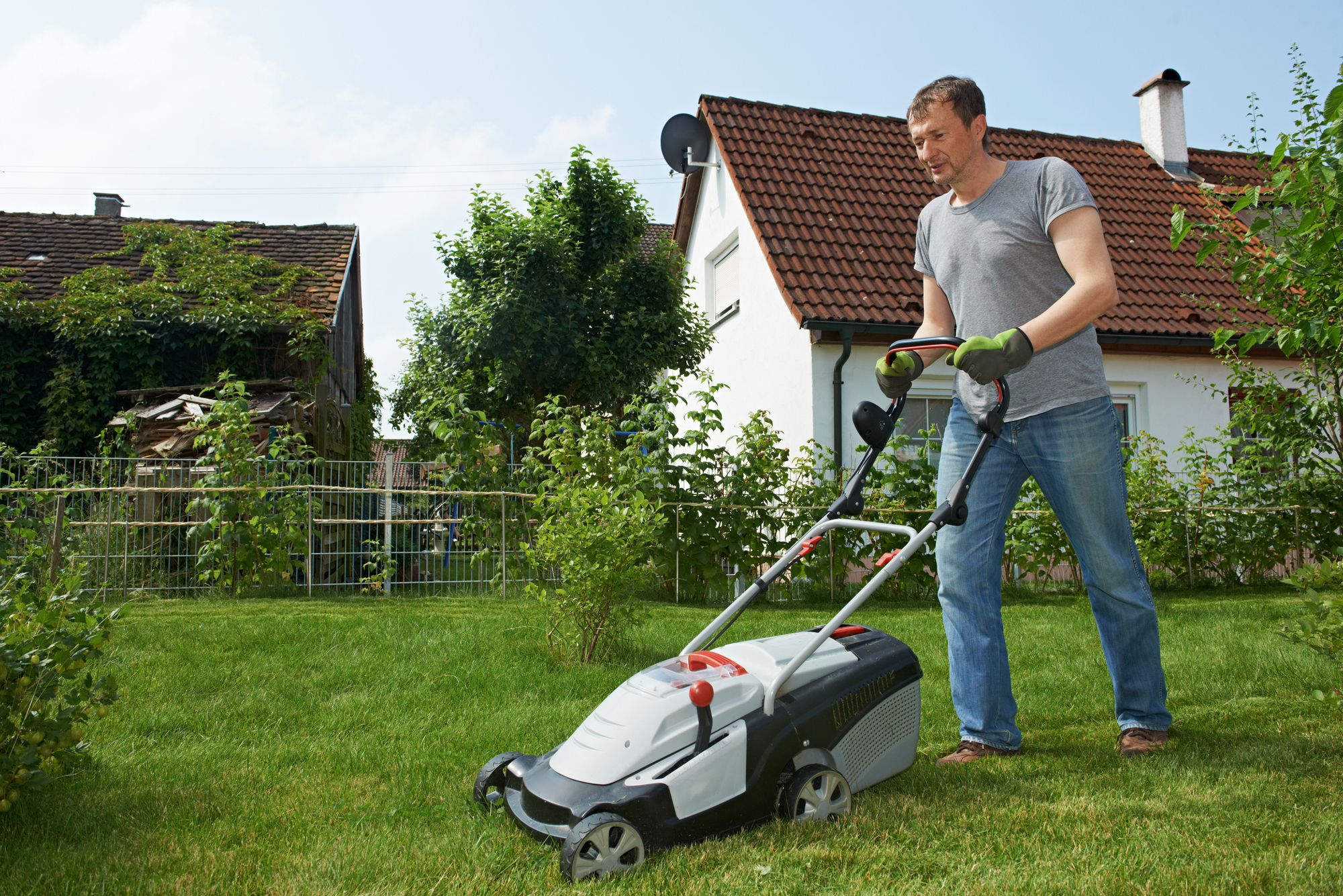
Cutting width sets how many lengths of the lawn you walk. Nothing else on the spec sheet changes that number. Engine size, self-propelled drive, a bigger grass bag: all of those change how pleasant the laps feel. Only the deck width changes how many laps there are. Work out the number before you buy, and you will pick a mower that fits the ground you own rather than the one on the shop floor.
The sum is simple. Take the lawn area, divide it by the effective cutting width of the deck, and you have the distance you walk in a single cut. Effective width is the deck width minus the strip you overlap on every pass, which is usually 5 to 10 per cent of the deck on a mower with a decent side skirt. That one calculation will save you more argument in a showroom than any brochure.
Do the arithmetic before you look at a single mower
Take a 300m2 lawn (about 3,230 square feet), which is a typical rear garden on a modern estate. A 46cm (18 inch) deck divides into that area 652 times over, so you walk roughly 650 metres (about 710 yards) of passes with no overlap at all. Move up to a 53cm (21 inch) deck and the same lawn drops to about 570 metres (roughly 620 yards). That is the headline saving, and it is real, but it understates what happens on grass.
Now put the overlap back in. Nobody mows with a zero-width gap, and nobody should, as the outer few centimetres of any rotary deck cut slightly less cleanly than the middle. Allow 8 per cent. The 46cm deck now has an effective width of about 42cm, and 300m2 divided by 0.42m gives around 715 metres. The 53cm deck drops to an effective 49cm and gives about 615 metres. The gap has grown to roughly 100 metres (about 110 yards) of walking, every single cut. Mow thirty times between April and October and the narrower deck has walked you an extra three kilometres, close to two miles, for the same finished lawn.
Turns add to it. On a rectangular 20m by 15m lawn, the 42cm effective deck needs 36 passes and 35 turns. The 49cm deck needs 31 passes and 30 turns. Five fewer turns sounds trivial until you time yourself: a proper stop, lift, pivot and realign on a self-propelled petrol mower takes five to eight seconds, and it is the part of mowing that tires your arms. The stated saving is in metres. The felt saving is in turns.
The size bands and the garden each one actually suits
Deck widths cluster into a handful of bands, and manufacturers pitch each band at a lawn size for good engineering reasons rather than marketing ones. Here is where the real machines sit, with prices checked this month.
- 30 to 34cm (12 to 13 inches): courtyard lawns, front strips and anything under about 100m2 (1,075 square feet). The Bosch CityMower 18V-32-300 cuts 32cm and is rated by Bosch for lawns up to 300m2. It sells for around £190 as a bare unit and closer to £249 as a kit with a 4.0Ah battery at B&Q. Light, quiet, and it turns inside a flower bed.
- 36 to 42cm (14 to 17 inches): the sweet spot for small gardens up to roughly 200m2 (2,150 square feet). The Greenworks 40V 14 inch cordless push mower (MO40B410) runs about $339.99 on Amazon with its 4.0Ah battery, and the petrol Mountfield SP41, a 39cm self-propelled machine with a 123cc engine and a 40 litre collector, sits around £219. Mountfield rates it for lawns up to 250m2.
- 46 to 48cm (18 to 19 inches): the workhorse band for 200 to 500m2 (2,150 to 5,400 square feet). The Honda HRX 476 QY cuts 47cm (19 inches), runs a GCVx 170 engine with a rear roller, and is currently £1,175 against a £1,385 list price, with the offer running to the end of July.
- 51 to 56cm (20 to 22 inches): for 500m2 upward. The EGO Power+ LM2135E-SP cuts 52cm (21 inches) and comes as a kit with a 7.5Ah battery and rapid charger for around £879, down from a £959 list, and sells as the LM2135SP for about $749 at Lowe’s and Home Depot, with dealer prices dipping near $599. Honda’s equivalent, the HRX217VKA, cuts 21 inches (53cm) at an $879 list price.
- 76cm (30 inches) and up: ride-on territory. The John Deere S100 carries a 42 inch (107cm) deck behind a 17.5hp engine and lands around $2,599 new. Below about 1,500m2 (roughly 16,000 square feet) a ride-on spends more time reversing out of corners than mowing.
Why a wider deck is not automatically the better deck
A rotary blade does not chop grass. It slices it, and the slice only stays clean while the blade tip is moving fast enough. The ANSI/OPEI B71.1 safety standard caps blade tip speed at 19,000 feet per minute (about 5,790 metres per minute) for commercial machines, with residential mowers typically running nearer 17,000 feet per minute. Manufacturers design as close to that ceiling as they can, and for one simple reason: tip speed is what makes the cut clean.
Widen the deck and you lengthen the blade. A longer blade has more surface area dragging through air and grass, so it needs more torque to hold its rpm. Put a wide deck on a small engine or a modest battery and the rpm sags the moment you hit thick, damp growth. Tip speed falls with it, and the blade stops slicing and starts tearing. You can see the result the next morning: the lawn has a grey or whitish cast where every leaf carries a ragged, frayed wound instead of a clean edge. Those torn ends lose moisture fast and they are an open door for fungal disease. A lawn cut by an underpowered wide mower browns off in dry spells sooner than the same lawn cut by a narrower machine that held its blade speed.
Scalping is the second penalty, and almost nobody explains the mechanism. A mower deck rests on its wheels, and the blade sweeps a fixed height above the plane those wheels sit in. On uneven ground the wheels perch on the high points and the deck bridges the hollow between them. The wider the deck, the longer the span it bridges, so the more ground it can bridge over in one go. A 32cm deck follows a gentle hump and dip; a 53cm deck sails straight over the dip and shaves the crown of the next rise down to the soil. Scalped patches take weeks to recover, they let weed seed in, and on a bumpy lawn a wide deck will find them every time.
Then there is the gate. Plenty of side passages are 60cm (24 inches) wide. A mower’s body is always wider than its cutting width, typically by 5 to 10cm once you count the wheels and deck lip, so a 56cm machine can measure 64cm across and simply will not go through. Check the passage before you check the deck.
Square metres per amp-hour is the number that counts
Cordless buyers fixate on runtime in minutes, which is the least useful figure on the box. A wider deck pulls more current per pass and drains the battery faster. It also covers more ground per pass. What you want to know is how much lawn a battery cuts, not how long it hums for.
Run the sum on the manufacturers’ own claims. EGO rates the 52cm LM2135E-SP at up to 1,000m2 on a single 7.5Ah battery, which works out at about 133m2 per amp-hour. Bosch rates the 32cm CityMower at up to 300m2 on a 4.0Ah pack, about 75m2 per amp-hour. The wider deck delivers nearly twice the lawn per amp-hour while emptying the battery in less time. That is the trade the runtime figure hides completely.
Treat those numbers as ceilings. Manufacturers quote them on dry grass, cut short, at the top height setting, with no collection. Damp growth, a full collector and a low cutting height can halve them. Do the amp-hour maths, then take 40 per cent off, and buy the battery capacity that clears your lawn area with room to spare.
The overlap habit that wastes your Saturday
Watch most people mow and they lap the previous stripe by a third of the deck. On a 53cm mower that is a 17cm overlap, dropping the effective cutting width to 36cm. Our 300m2 lawn now takes 833 metres of walking. Trim the overlap to 5cm (2 inches), which is all a mower with a proper side skirt needs to leave no uncut ribbon, and the effective width climbs to 48cm and the distance falls to 625 metres. You have just saved yourself over 200 metres, more than 200 yards, without spending a penny. Line the inside wheel up on the edge of the previous cut instead of on the middle of it, and hold that line.
The last mistake is the expensive one: buying deck width for the lawn you wish you had. A 500m2 machine bought for a 180m2 garden with three island beds and a curved border will scalp the humps, refuse the side gate, and spend its life doing three-point turns around the magnolia. Meanwhile a 32cm cordless mower bought for a 600m2 (6,450 square feet) plot condemns you to well over a kilometre of walking every cut, and two battery changes to do it. Measure the lawn, divide by the effective width, and let the answer choose the mower.