If a patch of your lawn has been coated overnight in something that looks like grey ash, yellow scrambled egg, or a frothy beige crust climbing up the grass blades, the short answer is this: it is slime mould, it is not a disease, and it is not killing your grass. You can leave it alone and it will disappear on its own within a week or two, or you can break it up in five minutes with a hose. What you should not do is reach for a fungicide, because that is the one response that does real harm while solving nothing.
What Slime Mould Actually Is
Slime moulds are not fungi, despite the name, and they are not plant pathogens. They are primitive organisms that spend most of their life as a microscopic single-celled mass living in the thatch and soil, feeding on bacteria, decaying organic matter, and the films of moisture around dead plant material. For most of the year you never see them. Then, after a stretch of warm weather followed by heavy rain or a few nights of heavy dew, the organism creeps up onto the nearest tall structure, which on a lawn means the grass blades, to produce its spore-bearing fruiting bodies. That climb is what makes it suddenly visible. It is using your grass as scaffolding, nothing more.
The Royal Horticultural Society describes slime moulds as harmless and a sign of good biodiversity in the soil, and university turf programmes say the same thing. The most common types you will see on lawns are Physarum cinereum, which shows as a dusty grey to bluish coating, Mucilago crustacea, which forms a white to cream crust, and Fuligo septica, the one with the unfortunate common name of dog vomit slime mould because the fresh yellow stage really does resemble it. All three behave the same way. They appear fast, sit on the surface, release spores, and collapse into a dry powdery smear that the next mow removes.
The reason this is worth understanding is that slime mould looks alarming in a way its effect does not justify. People see grey or yellow material smothering green blades and assume the grass underneath is rotting. Part the blades and look at the base of the plant and you will almost always find healthy green tissue. The slime sits on the outside of the leaf and blocks a little light for a few days, which can cause very minor, temporary yellowing of the blade tips at worst. The crown and roots are untouched.
Why It Appears When It Does
Slime moulds fruit when two things line up: warmth and persistent surface moisture. Soil temperatures above roughly 15 to 20 degrees C (59 to 68 degrees F) combined with rain, irrigation, or heavy dew that keeps the thatch damp for several days will trigger the fruiting stage. That is why you see them through late spring and summer rather than in the cold months, and why they so often show up the morning after a thunderstorm breaks a warm dry spell.
Certain lawns produce them more often, and the pattern tells you something useful about your soil. A lawn with a thick thatch layer, the spongy band of dead stems and roots between the green growth and the soil, holds moisture at the surface for longer and gives the organism more to feed on. Shaded, poorly drained, or compacted areas stay damp longer after rain and so fruit more readily. None of this means the lawn is unhealthy. It simply means those spots hold water at the surface, which is the condition slime mould wants. If you see it return to the same patch every summer, that patch is telling you it drains slowly or carries heavier thatch than the rest of the lawn.
Because the organism feeds on decaying organic material rather than on living grass, it has no mechanism to infect or kill the plant. This is the single most important point and the one that separates it from genuine lawn diseases. Red thread, fusarium, and dollar spot are fungi that attack and consume living leaf tissue, and ignoring those does cause spreading damage. Slime mould is a saprophyte, a recycler of dead matter, and ignoring it costs you nothing.
How to Deal With It Without Causing Harm
If the appearance does not bother you, do nothing. The fruiting bodies dry out within a few days and the spores disperse, and the colony vanishes. This is the response every turf authority recommends first, because it costs nothing and the lawn is never at risk.
If you want it gone faster, the simplest method is a firm blast from a garden hose aimed at the affected blades. The water pressure breaks up the soft fruiting mass and washes it off the grass. Do this on a dry, sunny morning so the blades dry out afterwards rather than staying wet, which would only invite the colony to reform. A second option is to brush the area with a stiff broom or a besom, which knocks the dried spore masses off the blades and scatters them. Mowing also works, since it removes the top of the blade where the slime is sitting, but if you bag the clippings you simply move the spores to your compost heap, where they are equally harmless.
The mistake to avoid is treating slime mould as a fungal disease and spraying a fungicide. Fungicides do not stop slime moulds, because slime moulds are not fungi and do not have the biology these products target. A typical lawn fungicide costs around £15 to £25 ($19 to $32) for a bottle that treats a few hundred square metres, and applying it here buys you nothing except the destruction of beneficial soil fungi and microorganisms that actively help your lawn. You end up worse off than if you had walked past the patch. If you have already been tempted by an off-the-shelf “lawn disease” treatment, save it for an actual disease and use the hose here instead.
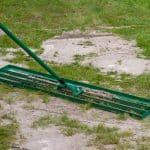
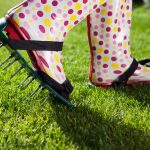
For anyone who wants to see slime mould less often, the fix is the same set of jobs that improve a lawn generally. Reducing a heavy thatch layer by scarifying in early autumn removes the damp organic material the organism feeds on. Improving surface drainage on a compacted area by spiking or hollow-tine aerating lets water move down rather than sitting at the surface. Cutting back overhanging growth that keeps a patch in permanent shade helps it dry after rain. Watering deeply and less often, rather than a light sprinkle every evening, keeps the surface drier between waterings. Do these and the conditions that favour fruiting become rarer, though no healthy lawn is ever fully free of the organism, nor needs to be.
It also helps to know how to tell slime mould apart from the problems that do need action, because the cost of confusing them runs both ways. Slime mould sits on top of the blades as a distinct grey, white, or yellow coating that you can rub off between finger and thumb, and the grass beneath stays green. A true fungal disease shows in the grass itself: red thread leaves pinkish-red needles and webbing knitting the blades together, fusarium produces brown patches ringed with a greasy pinkish margin, and dollar spot makes small straw-coloured circles with bleached lesions across individual blades. If the colour is in the leaf rather than sitting on it, and the patch is spreading and the grass is dying back, you are looking at a disease and should treat the underlying cause, usually excess thatch, poor airflow, or a feeding imbalance. If the material lifts off and the grass is fine underneath, it is slime mould and you can relax.
The thing to hold on to is that slime mould is one of the few lawn surprises that looks far worse than it is. It is a sign that your soil is alive and full of the microorganisms that break down organic matter and feed your grass. Hose it off if you cannot stand the look of it, ignore it if you can, and put the fungicide back on the shelf.