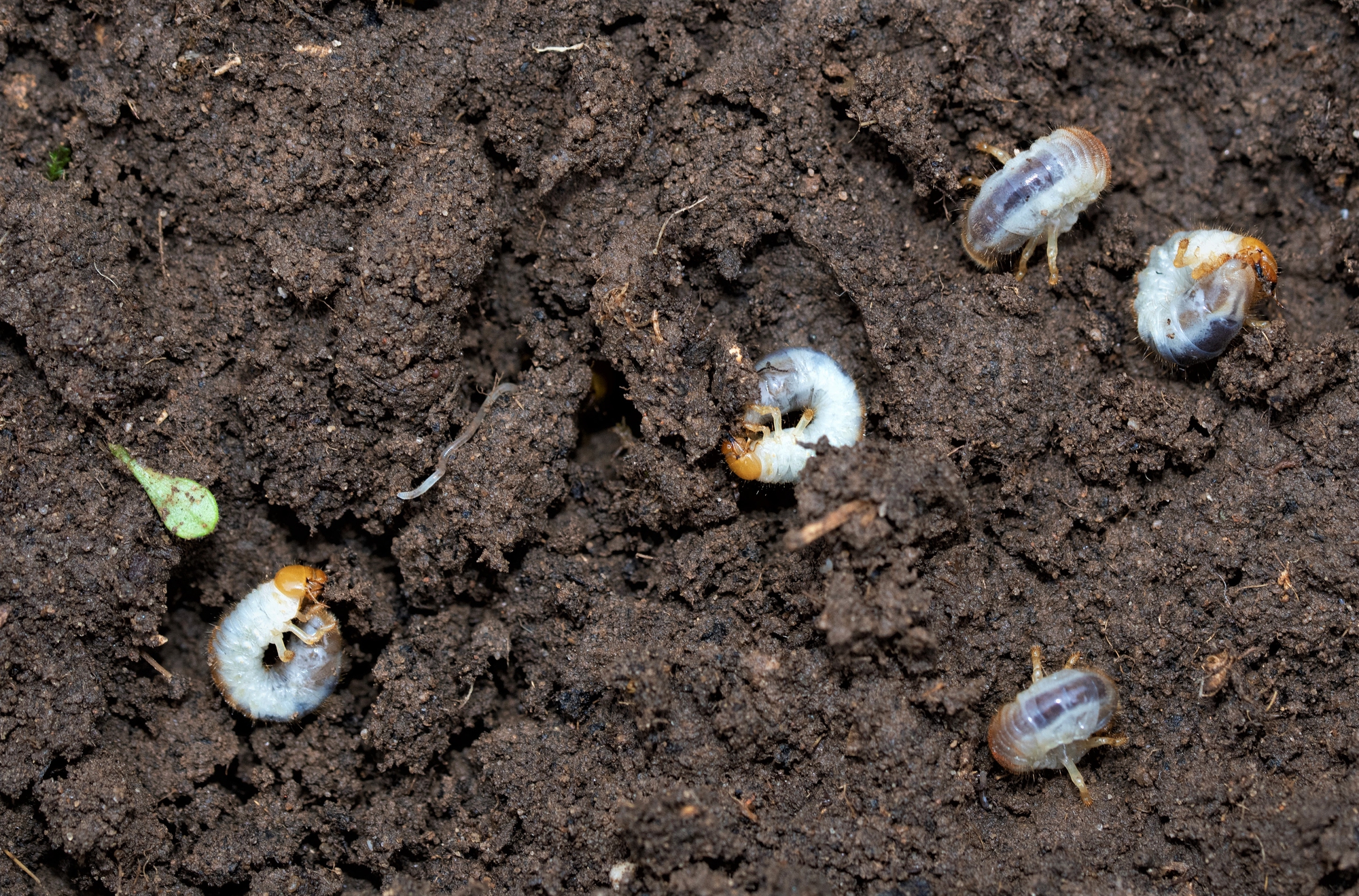
If patches of your lawn have started lifting like loose carpet, or you keep finding turf ripped up and scattered across the grass in the morning, the cause is underground. Chafer grubs eat grass roots through autumn, and the birds and animals hunting those fat grubs do the visible tearing. Early autumn is the closing window to treat them, and the fix costs less than a bag of feed.
How to tell chafer grubs from everything else
Roll back a loose patch of turf with your fingers. If chafer grubs are the problem, they sit in the top few centimetres of soil, easy to see. Each grub has a fat, creamy white body curved into a C shape, a light brown head, and three pairs of legs clustered near the head end. Garden chafer and Welsh chafer grubs, the two most often found in turf, reach about 18mm (three quarters of an inch) when straightened out. A cockchafer grub is bigger, up to 30mm (over an inch).
The clearest tell is how easily the turf lifts. Healthy grass is anchored by a dense root mat and resists a tug. Where grubs have chewed the roots away, the turf peels back with almost no resistance, like rolling a rug off the floor. Above ground you will see yellowing patches that spread as more roots fail.
Then there is the churning. Crows, magpies, rooks, jays, badgers and foxes rip up turf to reach the grubs and eat them. That torn, flung-about mess is often worse than the grubs’ own root damage. Leatherjackets, the larvae of crane flies, cause similar root loss, but they trigger far less turf-ripping. So a lawn that looks like something went at it with a rake points to chafers rather than leatherjackets.
It pays to rule out the lookalikes before you spend a penny. Drought scorch browns off in wide, even sweeps but leaves the roots intact, so the turf stays firmly anchored. Red thread shows fine pink threads on the leaf tips and does not loosen the surface. A dog urine patch is a sharp round scald ringed with darker green. Chafer damage is the one that combines yellowing, torn-up turf, and grass that peels back to reveal fat white grubs sitting in the soil. If the peel test turns up the grubs, you have your answer; if it does not, the trouble lies elsewhere and nematodes will do nothing.
Why the damage peaks now and keeps getting worse
The life cycle explains the timing. Adult chafer beetles fly up out of the turf at dusk in large numbers from late May into June. They lay eggs in the lawn, and those eggs hatch a few weeks later. The young grubs feed on roots quietly through summer and do little obvious harm. By early autumn they are close to full grown and eating at their hardest, which is exactly when root loss starts to show at the surface.
From there it snowballs. Severed roots cannot draw up water, so blades yellow and thin. Loosened turf invites more digging from birds and mammals, which opens the surface further and dries out what roots remain. The grubs overwinter as larvae, keep feeding in mild spells, and pupate in spring. Left through a wet autumn, a small hot spot can become a peeled, bare patch by late winter.
The hard part to accept: once the roots under a patch are gone, that grass will not bounce back. You are looking at re-seeding or re-turfing, not reviving. That is why catching the grubs while they are small does far more good than reacting to the bare patches later.
The one treatment that works, and the timing trap
For grubs in lawns there is a single control a home gardener can use: pathogenic nematodes, the species Heterorhabditis bacteriophora. These are microscopic worms you water into the turf. They hunt down the grubs, enter through natural body openings, and release a bacterium that kills the larva inside a day or two.
They only work in the right conditions. The soil has to be moist, and the soil temperature needs to sit between 12 and 20 degrees C (54 to 68F). Water the lawn before you apply and again straight after, so the nematodes can travel through the film of moisture around the soil particles and reach the grubs. Aim at the turf around the edges of a damaged patch too, to catch larvae spreading out from the worst spots.
Here is the trap that catches most people. By the time bare, torn patches appear, the soil is often too cold for the nematodes to do their job. Applied as a preventive from July to September, while the larvae are young and the soil is still warm, they work far better. Early autumn is the last dependable slot of the year. Push a soil thermometer 5cm (2 inches) into the ground and check you are still above 12 degrees C before you buy.
One more point: nematodes are alive and perishable. Use them as soon as you can after they arrive, keep them in the fridge until then, and follow the pack instructions to the letter. Lures and traps for the adult beetles exist, but their effect is uncertain, and they only catch beetles after the eggs have already gone into the lawn.
What it costs and how to apply it
A chafer grub nematode pack covering around 100 square metres (roughly 1,075 square feet) runs about 20 to 30 pounds (30 to 45 dollars). Larger programmes that cover 500 square metres cost more and often arrive as a set of timed applications. Garden centres stock some packs, and specialist mail-order suppliers carry the rest.
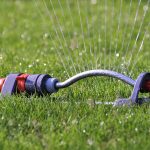
Application is quick. Tip the pack into water, then apply through a watering can fitted with a coarse rose or a hose-end sprayer, keeping the mix moving so the nematodes do not settle to the bottom. Water the treated area in well afterwards. A watering can costs 8 to 15 pounds (10 to 20 dollars), a hose-end sprayer 10 to 18 pounds (13 to 23 dollars), and a soil thermometer 6 to 10 pounds (8 to 13 dollars).
The watering step decides whether the treatment works at all. Nematodes move only through water films between soil grains. Apply them to dry ground and they strand near the surface, dry out, and die before they ever find a grub. Damp soil, watered in, is what carries them down to where the larvae are feeding.
Repair the mess and build turf that shrugs off grubs
For the torn patches themselves, the RHS steers gardeners to re-sow or re-turf in mid to late spring, once the grubs have moved deeper to pupate and will not chew the fresh roots. On patches you have cleared this autumn you can oversow now while the soil holds warmth, as cool-season grasses germinate in the 8 to 13 degrees C (46 to 55F) band, but keep your hopes modest if grubs are still active below.
Use a hard-wearing ryegrass mix, 8 to 18 pounds (10 to 23 dollars) a box, sown across torn ground at 15 to 25g per square metre (about half to three quarters of an ounce per square yard). Firm it with the back of a rake, then water. Netting or fleece over the patch keeps birds off the seed while it takes.
The longer game is a lawn tough enough to carry some root loss without collapsing. A well-fed, deeper-rooted sward copes with grubs far better than thin, hungry turf. An autumn feed high in potassium rather than nitrogen, 10 to 16 pounds (13 to 21 dollars), strengthens roots for winter. Raise the mowing height into autumn so more leaf drives deeper roots. Water in dry spells so stressed grass does not give way where grubs have already thinned the roots.
Next thing to do: roll back a suspect patch today and count the grubs underneath. Five or more in a 30cm (12in) square, with soil still above 12 degrees C, is a clear signal to order nematodes this week. Then mark next midsummer in the calendar. When you next see beetles swarming over the lawn at dusk in late May or June, that is the cue to book a preventive treatment for July to September and break the cycle before it starts.