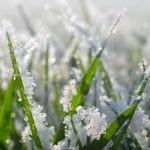

- The white on the grass is frost, and the brown shapes that appear days after someone crosses it are the crushed, dead blades left where feet pressed the frozen lawn flat.
- The fix costs nothing: keep off the lawn whenever it is white or crunches underfoot, and wait until it has fully thawed, usually by late morning.
- Set the lawn up for the cold by raising the mower a notch for the last cuts, clearing fallen leaves, and laying stepping stones on any line you cross every day.
Why a Few Footsteps Leave Marks That Last for Weeks
You cross the lawn on a white, crunchy morning to fill the bird feeder, think nothing of it, and a week later there is a trail of brown footprints printed into the grass exactly where you walked. The lawn looks as though something has burned it. What has happened is simpler, and it is worth knowing, as it points straight at the fix.
On a frosty morning every blade of grass is stiff with ice. The water held inside the leaf cells has frozen into tiny crystals, and the blade that bends softly underfoot in summer has turned brittle and glassy. Stand on it and the frozen blades do not spring back. They crack, and the ice crystals tear the cell walls apart from the inside. Those cells die, and over the following days the crushed blades turn yellow and then brown, printing the shape of your boots, the dog’s regular run, or the line you take to the shed. The marks can take many weeks to grow out, which is why a single careless morning shows up long after the frost itself has gone.
Greenkeepers and groundstaff have known this for a long time, which is why a sports pitch or a golf green is roped off, or its play held back, on a hard frosty morning. A single set of studs dragged across frozen turf leaves the same brown prints a dog does across a back lawn, and on a playing surface that is damage no club can afford. The reason the marks arrive so late is that the cells do not show their injury at once. The blade looks fine for a day or two, still green, and only browns once the ruptured cells have dried out and collapsed. By then the frost is a distant memory, the footprints seem to have surfaced from nowhere, and few people ever connect the trail of brown to the morning they made it.
The grass is not being killed by the cold. It is being killed by the pressure of a foot on a frozen blade. That distinction is the whole of the solution.
The One Rule: Keep Off Until It Thaws
Keep off the grass whenever it is white or crunches underfoot. Wait until the frost has lifted and the blades are soft and green again, which on most mornings means by late morning once the sun has been on it. The same holds after a hard freeze, when the ground underneath is solid. Reroute the dog onto the hard path, carry the bins round the edge rather than across the middle, and move the washing-line trips to the afternoon, and the lawn comes through the cold untouched.
This is the one piece of lawn care that asks you to do less, not more, and it is free. The marks it prevents are only cosmetic, and they do grow out in spring as fresh blades replace the dead ones. The catch is time. A route crossed every frosty morning right through the winter is bruised faster than the grass can recover in the cold, so the trail that would have faded by April instead deepens into a worn, muddy line that needs reseeding. An hour of patience each frosty morning is cheaper than a spring repair.
Set the Mower Higher for the Last Cuts
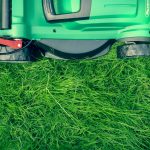
Grass keeps growing while the soil stays above about 7°C, which is roughly 45°F, so a mild spell in autumn and early winter can still leave you one more cut to make. Raise the mower about 5 millimetres, a quarter of an inch, higher than your summer setting for these last passes. A slightly longer blade has more leaf to catch the low winter light and keep the roots fed, and the extra length shields the crown of each plant, the growing point at the base, from the worst of the frost. Longer grass also stands up to winter wear far better than a tight, shaved finish that can barely regrow in the cold.
Never run the mower over frozen or frost-covered grass. The blade bruises and tears the brittle leaves exactly as a boot does, and the wheels press cold damage into two long lines behind you as you go. Wait for a dry, frost-free day, and stop mowing altogether once growth has clearly stopped for the year. Cutting a lawn that is not growing gains you nothing and leaves fresh wounds open through the wettest, coldest weeks.
Clear the Leaves and Give Yourself a Winter Path
Two small jobs keep a winter lawn out of trouble. The first is leaves. A wet mat of fallen leaves left lying over the grass blocks the light and traps damp against the blades, and a dark, airless, damp surface is where cold-weather diseases take hold, including the straw-coloured, yellow-brown patches that spread on lawns fed too heavily late in the season. Rake the leaves off through autumn with a spring-tine lawn rake, about £10 to £20, or $15 to $25, and pile them up for leaf mould or add them to the compost. A clear, dry surface is far less likely to come out of winter patched with disease.
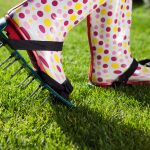
The second is the path you make without thinking. If there is a line you cross the lawn every day, to a shed, a bin store, an oil tank or a washing line, lay a run of stepping stones along it, set level with the soil so the mower rides straight over them in summer. Plain concrete or stone slabs are about £3 to £8 each, or $4 to $10, and they take the daily traffic that would otherwise bruise a frosted or sodden strip of grass to death over the winter. On ground that squelches and holds water, spike it with a fork so it drains and firms up, as a waterlogged lawn freezes harder and bruises more easily underfoot than a well-drained one.
One thing not to do is try to clear the frost itself. Hosing it off with cold water or walking it in to break it up both do more harm than the frost alone, driving the damage deeper into the blades. Frost lifts on its own within a few hours. Leave it to.
What the Frost Is Not Doing
A white lawn looks like damage unfolding in front of you, and plenty of people reach for a winter feed or a sheet to throw over it, sure the cold is finishing the grass off. The frost on its own is doing nothing of the sort. Lawn grasses are built to sit out freezing weather dormant and green up again in spring, and the cold slows them, hardens them off and does no lasting harm. Every brown mark a lawn carries into spring traces back not to the frost but to what pressed on the frozen blades while it lasted.
So the smartest move on a hard, frosty morning is also the laziest. Make a cup of tea, keep off the grass, and let the sun do the work. By the time the lawn has thawed it is soft, green and ready to walk on again, and the only footprints it will wear into spring are the ones from the mornings somebody forgot.