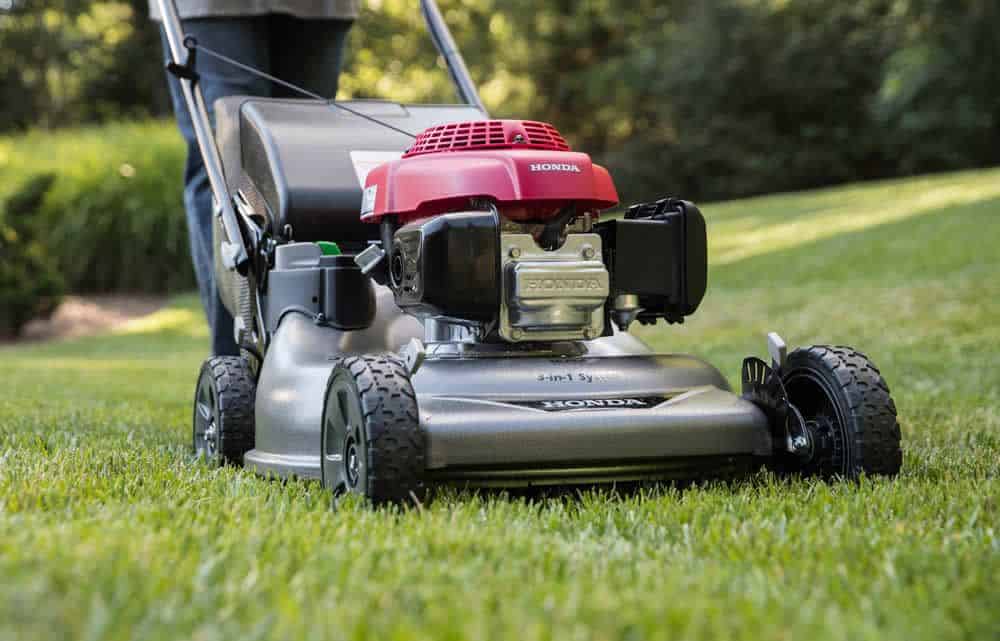
Walk through any allotment, golf club workshop or older suburban garage and there is a good chance you will see a Honda lawn mower from the 1990s or early 2000s, still cutting grass every Saturday. The grip is faded, the engine cover is patched with a sticker, and the owner will usually tell you they have replaced one or two blades, a spark plug a couple of times, and not much else. That kind of working life is the reason Honda has the reputation it has, and the reason a used HRG416 from twelve years ago can still sell for more than a new budget rotary on eBay.
If you are deciding what to spend on your next mower and want something you will not have to think about again for fifteen or twenty years, the case for Honda is worth understanding in detail. So is the case against, because the brand is in a peculiar transition moment that affects which model you should actually be buying in 2026.
The engine is the reason Honda mowers outlive most rivals
Almost every long-life Honda mower story comes back to the same component: the GCV-series overhead-cam engine. The GCV160 in the IZY range and the GCV200 in the HRX range share a design philosophy that prioritises clean combustion, low oil consumption and a long bearing life over outright peak power. Compression ratios are conservative, the cam is belt-driven from the crank, and the carburettor on older models or the EFI on newer premium ones is tuned to run lean and cool rather than aggressive.
The practical result is that Honda walk-behind engines routinely show up at independent small-engine shops with several thousand operating hours on them and still hold compression within factory tolerance. By comparison, the typical Briggs and Stratton or generic Chinese OHV engine fitted to budget machines starts losing compression noticeably after four or five seasons of hard use. None of this is mystery engineering. It is a more expensive build with better internal coatings, harder valve seats and tighter quality control on the casting, and you pay for that quality in the sticker price.
The deck is the second factor in long life. Honda’s Nexite resin deck, used on the HRX series since the mid-2000s, was developed in the United States and tested in conditions ranging from Florida humidity to Wisconsin road-salt overspray. Steel decks on cheaper mowers usually start rusting through within seven to ten years of garage storage. Nexite does not corrode at all and is one of the reasons twenty-year-old HRX mowers still sell for half their new price. Even the older steel-decked IZY models tend to outlast their cheaper rivals because the steel is thicker and better powder-coated than the budget norm.
The current line-up and what each model is actually for
The IZY HRG416 PK (around £450/$570 in 2026) is the entry point for petrol Hondas in the UK and a 16-inch (41cm) push mower that suits gardens up to about 350 square metres. It is the workhorse model that you will see in second-hand listings forever, partly because Honda has been making variants of this size for thirty years and parts interchange across generations.
Step up to the IZY HRG466 SK (around £700/$880) and you get a 46cm self-propelled version with a slightly larger fuel tank, designed for lawns between 350 and 600 square metres. The cutting deck is steel, the engine is the same GCV160, and the drive cable is a notorious wear point but inexpensive to replace at around £25/$32 from any Honda dealer.
The HRX537 HZ (around £1,500/$1,900) is the flagship 53cm self-propelled rotary, with the Nexite deck, the GCV200 engine and a hydrostatic drive that lets you adjust ground speed continuously rather than stepping through gears. It is overkill for a small back garden but a fair choice for lawns above 800 square metres or for anyone who plans to keep one mower for the next two decades. The cost per year over a 20-year life works out at around £75/$95, which is roughly the same as replacing a £200 budget mower three or four times during the same period and dealing with the disposal hassle each time.
The newer battery models, like the HRG 466 XB cordless self-propelled (around £540/$680 with a 4Ah battery and charger), use Honda’s own 56V platform and are aimed at owners who want to phase out petrol. They cut well but the long-term durability story is shorter, simply because the platform has not been in the field long enough to know how the batteries and motor controllers age past about seven years. The petrol Hondas, by contrast, have a 30-year track record to point at.
Why the buying calculation has changed in 2026
The complication for anyone buying a Honda right now is that the company announced in late 2023 that it would stop manufacturing petrol walk-behind mowers for the North American market and refocus on battery and commercial machines. Production wound down through 2024. The UK and European market is still being supplied through dealer stock and parallel imports, but the long-term direction is the same. Honda’s own road map points away from the GCV160 and GCV200 engines that built the brand’s reputation.
This does two things to your buying decision. The first is that there is currently a small window in which new old-stock petrol HRG416 and HRG466 models are still on UK dealer floors at competitive prices, often with end-of-line discounts of 10 to 15 percent. If you want a petrol Honda that you can run for the next twenty years on the strength of the reputation described above, mid-2026 is a sensible time to buy one. The second is that parts and service support will continue for at least another decade after final production, because Honda has publicly committed to maintaining the existing supply chain for replacement components.
For the battery side of the range, the calculation is different. Buying an HRG 466 XB today is essentially betting that the Honda 56V battery platform will still be supported with replacement packs in 2036. That is plausible but unproven. Compared with established battery platforms like Ego’s 56V system or DeWalt’s FlexVolt, which have been on the market longer and have larger user bases, the Honda battery range is a smaller, newer ecosystem.
How to look after one so it actually lasts 20 years
Most twenty-year-old Hondas that still work do so because their owners did three boring things consistently. They changed the engine oil every spring with around 0.55 litres of SAE 10W-30 (around £8/$10 a litre at any motor factor or Honda dealer), they cleaned or replaced the foam air filter twice a season at a cost of about £6/$8, and they replaced the spark plug every two or three years with the NGK BPR6ES that the manual specifies, which costs £4/$5 at any auto parts shop.
The two additional habits that separate twenty-year mowers from ten-year mowers are draining the fuel tank before winter storage and sharpening the blade once a year. Stale ethanol-blended fuel left in a carburettor over a damp winter is responsible for more dead Honda engines than wear is. A simple fuel stabiliser like Briggs and Stratton Advanced Formula (around £8/$10 a bottle) added in late October will eliminate this risk almost entirely. Blade sharpening, done either at home with a metal file for about 20 minutes a year or by a dealer for £15/$20, keeps the engine load low and the cut quality consistent.
Which Honda to buy today
If you have a garden up to 500 square metres and you want a single mower for the next twenty years, the HRG466 SK in petrol is still the best buy in 2026, even with the manufacturer’s strategic exit from petrol. Stock is available, the engine is proven, and the cost per year of ownership at around £35/$45 is lower than almost anything else you can compare it to. If your lawn is larger or you want the Nexite deck and hydrostatic drive, the HRX537 HZ is the long-game choice. If you have firmly decided to leave petrol behind, the HRG 466 XB is competent but pay close attention to battery warranty terms and consider an Ego LM2150E (around £570/$720) as a direct comparison.
The brand has earned its reputation the slow way, through thousands of mowers that simply keep starting on the second pull every May. Whether the petrol Hondas remain in production or not, the ones already sold will keep doing that work for many years to come.