Your petrol mower runs fine for ten minutes, then loses power, bogs down and cuts out. You yank the cord and nothing happens. Twenty minutes later, once it has cooled, it fires up first pull and repeats the whole cycle. If that sounds familiar in the muggy heat of late summer, the mower is overheating, and the culprit is almost always a part nobody thinks to clean: the engine’s cooling fins and the intake screen that feeds air over them. It is a five-minute fix with a brush, and skipping it is how a cheap tune-up job turns into a seized engine.
How an air-cooled mower engine keeps itself cool
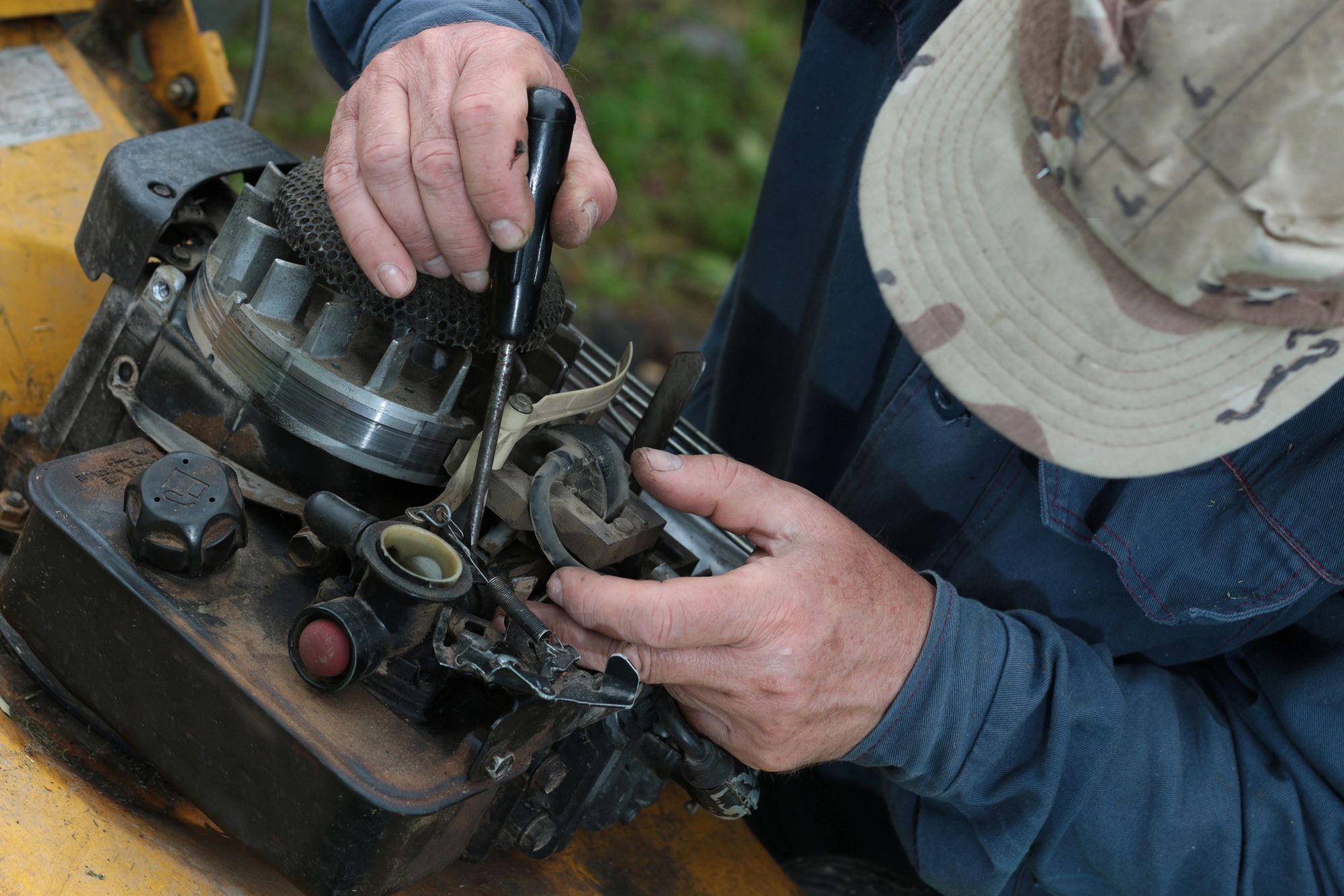
A walk-behind mower engine has no radiator and no coolant. It is air-cooled, and it relies entirely on moving air to carry combustion heat away. A fan cast into the flywheel spins with the engine and pulls air in through a mesh intake screen on top. A metal shroud, the plastic or pressed-steel housing bolted over the engine, channels that airstream down across a set of thin metal ribs, the cooling fins, cast into the cylinder and cylinder head. Those fins hugely increase the surface area of hot metal touching moving air, and that is how the engine dumps its heat.
The whole system only works while air flows freely. The screen has to stay open so the fan can draw air in, and the fins have to stay clean so heat can pass from metal to air. Choke either one and the engine has no way to cool itself.
Why late-summer heat tips a clogged engine over the edge
Every mow throws up fine clippings, chaff and dusty grass. A film of this debris drifts up under the shroud and settles between the cooling fins, and the oily haze from the engine makes it stick. Over a season it builds into a felt-like mat packed into the gaps, and that mat acts as insulation. Instead of shedding heat, the fins now trap it. The intake screen clogs the same way, so the fan pulls in less air just as the engine needs more.
Late summer is when this catches people out. Air temperatures are high, so the airstream starts off warmer and carries away less heat. Growth is thick and often damp, so the engine works harder and burns hotter to power through it. Add a season’s worth of caked fins on top and a marginal cooling system finally cannot keep up. The metal temperature climbs, the engine loses power, and a safety cut-out or plain heat stalls it. It will restart once cool, which is exactly why the fault feels random.
Left alone it stops being a nuisance and starts being expensive. Sustained overheating warps the cylinder head, blows the head gasket and triggers pre-ignition, where fuel lights before the spark and hammers the piston. Hot enough for long enough and the oil film breaks down, metal grinds on metal, and the piston scores or seizes in the bore. At that point you are looking at a new engine or a new mower. A brush and five minutes would have prevented all of it.
How to clean the cooling fins and intake screen
This is a job any owner can do. Work on a cold engine, and start by pulling the spark plug cap off the plug so the mower cannot fire while your hands are near the blade or the flywheel.
- Lift off or unscrew the mesh intake screen on top of the engine and brush it clean until you can see light through every hole. This is where air enters the whole system, so it has to be clear.
- Undo the few screws or bolts holding the blower housing and shroud, and lift it away to expose the cooling fins around the cylinder and head. Expect to find them packed with dry grass and greasy dust.
- Clear the fins with a soft brush, a burst of compressed air, or a thin tool worked between the ribs. Family Handyman and This Old House both suggest a screwdriver or even a lolly stick to rake out the packed debris. Get right down into the roots of the fins, not just the tips, and wear eye protection while you blow the dust out.
- Wipe oily buildup off the fins with a rag and a little engine degreaser so the next layer of dust has less to cling to.
- Refit the shroud and screen, making sure the housing seats properly. The shroud is not a cover you can leave off. It directs the airflow, and without it the fan just stirs hot air around the engine.
One thing to avoid: do not blast the engine with a pressure washer. It drives water into the bearings, the carburettor and the electrics, and it packs wet debris deeper into the fins rather than clearing it. A brush and compressed air are the right tools.
Two checks that finish the job: the air filter and the oil
A clogged cooling system is the main cause of overheating, but two other faults stack on top of it, and both are worth clearing while the shroud is off.
The air filter comes first. It meters the air feeding combustion, and a filter choked with dust starves the engine of air. The mixture runs wrong, the engine loses power and burns hotter working to compensate. If the filter is a paper element, replace it with the exact type in the manual, paper edges facing out. If it is an oil-soaked foam element, wash it in warm soapy water, let it dry fully, then work in a little clean oil before refitting. A fresh filter costs about £6 to £12 ($8 to $16).
Oil is the second check. Engine oil does not just lubricate, it carries heat away from the moving parts and spreads it through the crankcase. Run the engine low on oil, or on oil that has gone black and thin after a long season, and it transfers less heat and lets more friction build, both of which push temperatures up. Check the level on a cold engine for an accurate reading, top up with the grade the manufacturer specifies, usually a straight SAE 30 for a small four-stroke, and change it if it is old and dirty. A litre runs about £8 to £12 ($10 to $15).
Keep the engine cool for the rest of the season
Cleaning the fins fixes the immediate stall. A few habits stop it coming back before autumn is out.
Keep the blade sharp and do not scalp the lawn. A blunt blade and too low a cut force the engine to chew through grass rather than slice it, and that extra load is extra heat. Raise the cutting height in hot, thick conditions and take a little off the top more often instead of a heavy cut in one pass. Mow in the cooler morning or evening rather than the hottest part of the afternoon, when both the air and the engine start out warm. And after each cut, take a minute to brush the loose clippings off the engine top, the intake screen and the deck before they have a chance to work their way down into the fins.
Once every season or two, pull the shroud and give the fins a proper clean while the engine is still running fine. Groundskeepers strip and blow out the cooling system as routine service precisely so a mower never reaches the stalling stage. The kit is cheap: a can of compressed air is about £6 to £9 ($6 to $10), a stiff detailing brush £5 to £10 ($6 to $13) and a can of engine degreaser £6 to £10 ($7 to $13) from Screwfix, B&Q, Amazon, Home Depot or Lowe’s.
A mower that cuts out in the heat feels like a dying engine. Nine times out of ten it is a suffocating one. Clear the fins and the screen, sort the air filter and the oil, and the machine that quit on you at the height of summer will run cool and steady through the last cuts of the year.