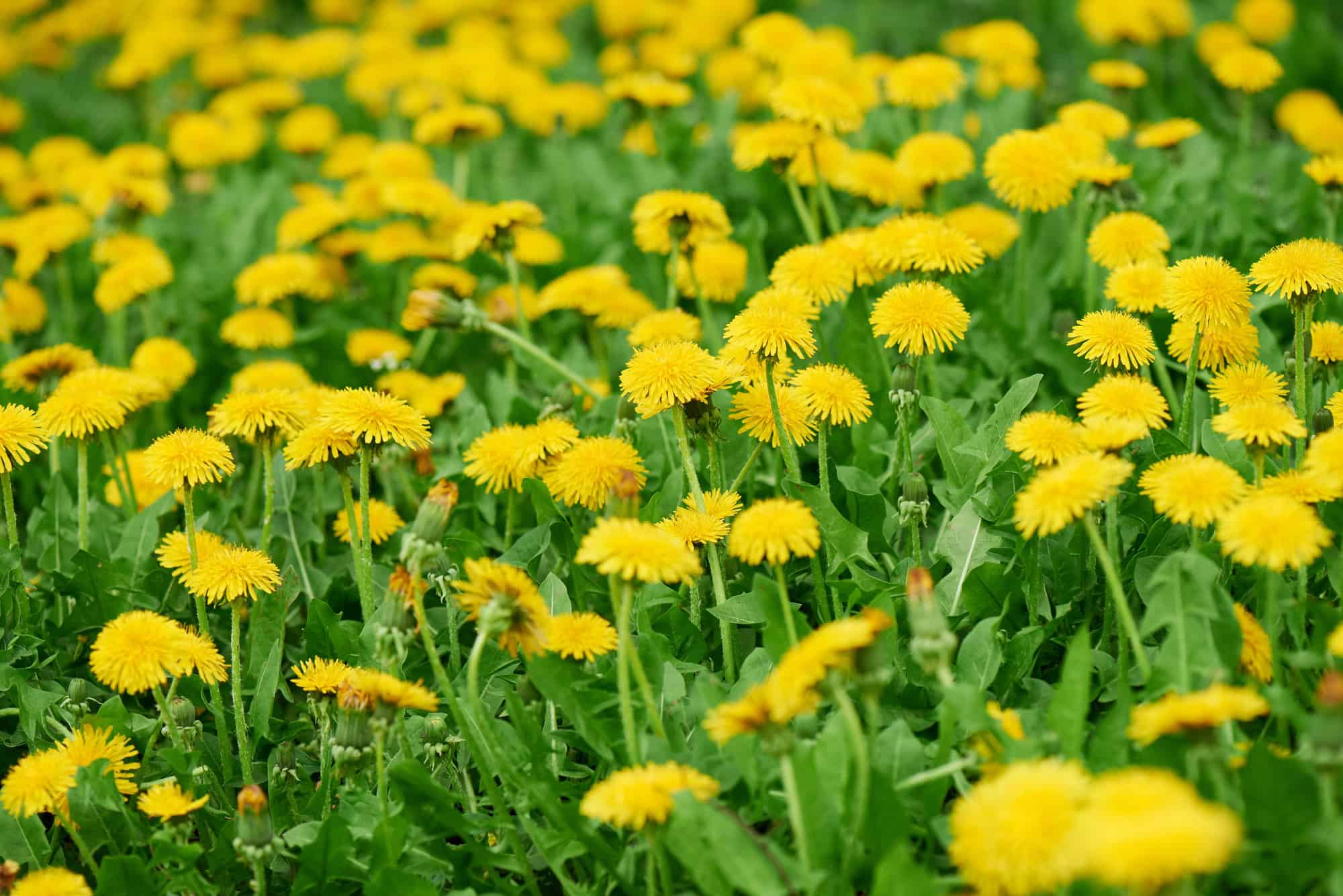
Yellow flower weeds are among the most visible and recognisable invaders in any lawn. A single bright yellow flower head poking above the grass is easy enough to ignore, but a lawn dotted with dozens of them sends a clear signal that something in the growing conditions is giving weeds an advantage over the grass. The first step to dealing with yellow flower weeds is identifying exactly which species you have, because the control method that works for one will not necessarily work for another. A dandelion and a buttercup look nothing alike up close, grow in different ways, and respond to different treatments.
This guide covers the most common yellow-flowered weeds found in lawns, how to tell them apart, why they appear, and the most effective way to remove each one.
Dandelion (Taraxacum officinale)
The dandelion is the most recognisable of all yellow flower weeds and the one most lawn owners encounter first. It is a perennial with a deep, fleshy taproot that can reach 300 millimetres or more into the soil, a rosette of jagged, tooth-shaped leaves that lie flat against the ground, and a single bright yellow flower head on a hollow stem that can appear from March through to November.
Dandelions are prolific seeders. Each flower head produces up to 200 seeds, each attached to a feathery parachute that carries it on the wind for hundreds of metres. A single plant left to flower and seed in your lawn can produce thousands of offspring in a single season, which is why early removal before the flower heads mature into the familiar white seed clocks is so important.
The deep taproot makes dandelions difficult to remove by hand. Pulling the plant out by the leaves almost always snaps the root, and the remaining portion regrows within weeks. Effective hand removal requires a long, narrow weeding tool pushed down alongside the root to loosen it before lifting the entire plant. For larger infestations, a selective herbicide containing MCPA or 2,4-D will kill dandelions without harming the grass. For a detailed removal guide, see our article on how to get rid of dandelions in lawn.
Creeping Buttercup (Ranunculus repens)
Creeping buttercup is the most common buttercup species in lawns and one of the most persistent yellow flower weeds to deal with. It has glossy, five-petalled yellow flowers about 20 to 25 millimetres across, deeply divided three-lobed leaves, and long creeping runners (stolons) that spread along the soil surface and root at intervals to form new plants. A single buttercup can colonise a large area in one growing season through this vegetative spread.
Buttercups thrive in damp, heavy, poorly drained soils and in areas of the lawn that stay wet for extended periods. If your lawn has a persistent buttercup problem, it is almost certainly a sign that the soil is too wet or too compacted. Improving drainage and aerating compacted areas will reduce the conditions that favour buttercup and make the lawn more hospitable to grass.
Creeping buttercup can be removed by hand if the infestation is small, but you need to trace and remove the entire network of runners to prevent regrowth. For larger areas, a selective herbicide containing fluroxypyr or MCPA is effective. Apply when the buttercup is actively growing and in full leaf, typically from April through to September. Two applications four to six weeks apart are usually needed for complete control.
Lesser Celandine (Ficaria verna)
Lesser celandine is one of the earliest yellow flower weeds to appear, often showing glossy, star-shaped flowers as early as February or March. The flowers have 8 to 12 narrow, shiny petals and sit on short stems above a carpet of heart-shaped, dark green leaves. The plant is low-growing, rarely more than 50 millimetres tall, and forms dense mats in damp, shaded areas.
What makes lesser celandine particularly difficult to control is its reproductive strategy. It produces small, grain-like tubers (bulbils) both at the base of the plant and in the leaf axils. These tubers drop off into the soil when the plant is disturbed, whether by hand weeding, mowing, or scarifying, and each one grows into a new plant the following spring. Attempting to dig out lesser celandine without extreme care often makes the problem worse by scattering tubers across a wider area.
Lesser celandine dies back naturally by late May or early June as the soil dries out and temperatures rise. The plant is dormant underground through summer, autumn, and winter, emerging again the following spring. This short window of active growth makes herbicide treatment tricky. A selective lawn herbicide containing fluroxypyr applied in March or April, while the plant is in active growth and before it sets seed and tubers, is the most effective chemical control. A second application the following spring is almost always needed to catch any tubers that survived.
Cat’s Ear (Hypochaeris radicata)
Cat’s ear is frequently confused with dandelion because the flower heads look similar at first glance. Both produce yellow, daisy-like flower heads on upright stems above a rosette of leaves. The differences become clear on closer inspection. Cat’s ear flower stems are branched, carrying two or more flower heads per stem, while dandelion stems are unbranched with a single head. Cat’s ear stems are solid, while dandelion stems are hollow. Cat’s ear leaves are hairy and roughly textured, while dandelion leaves are smooth and hairless.
Cat’s ear is a perennial with a taproot, though the root is shorter and less fleshy than a dandelion’s. It tolerates close mowing and poor soil conditions, which means it often appears in lawns that are cut too short or have not been fed for a long time. Improving the growing conditions for the grass, specifically raising the mowing height and feeding regularly, will reduce cat’s ear over time by allowing the grass to outcompete it.
For direct removal, a daisy grubber or narrow-bladed weeding tool will lift individual plants out by the root. For larger infestations, selective herbicides containing MCPA or clopyralid are effective. Apply when the rosette leaves are flat and actively growing for the best absorption.
Bird’s-Foot Trefoil (Lotus corniculatus)
Bird’s-foot trefoil is a low-growing perennial legume with clusters of bright yellow flowers, often streaked with orange or red, that appear from June through to September. The name comes from the long, narrow seed pods that radiate from a central point and resemble a bird’s claw. The leaves have five leaflets rather than three, though two sit at the base of the stem and are easily missed, making it look like a trifoliate plant similar to clover.
Bird’s-foot trefoil is most common in lawns on dry, chalky, or sandy soils and in areas that receive full sun. Like clover, it is a nitrogen-fixing legume, which means it can feed itself in nitrogen-poor soils where grass struggles. Its presence usually indicates low fertility and thin, open turf.
Control follows the same approach as for clover: improve the grass through regular feeding with a nitrogen-based fertiliser, raise the mowing height, and overseed thin areas to increase grass density. For chemical control, a selective herbicide containing fluroxypyr or clopyralid will kill bird’s-foot trefoil without harming the grass. Our guide on how to control clover in your lawn covers the cultural and chemical methods in detail, and the same approach applies to bird’s-foot trefoil.
Lesser Trefoil (Trifolium dubium)
Lesser trefoil, also known as yellow suckling clover, is a small annual weed with tiny yellow flower heads about 3 to 4 millimetres across, carried in rounded clusters from May through to July. The leaves are trifoliate with very small, oval leaflets, and the plant grows flat against the soil in loose mats. It is easily overlooked because of its small size, and many lawn owners do not notice it until the yellow flowers appear.
Because lesser trefoil is an annual, it completes its life cycle in a single season and dies off in late summer. It relies entirely on seed for reproduction, which means preventing seed set is the most effective control method. Mowing regularly before the flowers mature will stop the plant from seeding, and a well-fed, thick lawn will crowd it out over a couple of seasons without any chemical input.
If chemical control is needed, the same selective herbicides that work on clover and bird’s-foot trefoil will also kill lesser trefoil. For a broader look at clover and trefoil management, see our article on how to get rid of clover in lawn.
Black Medick (Medicago lupulina)
Black medick is a low-growing annual or short-lived perennial in the pea family with small, rounded clusters of tiny yellow flowers and trifoliate leaves. It looks similar to lesser trefoil, but the key difference is in the seed pods: black medick produces tightly coiled, kidney-shaped pods that turn black when ripe, which is where the common name comes from. The leaflets also have a small point or notch at the tip, unlike the rounded leaflets of true clovers.
Black medick is common on dry, poor, alkaline soils and in lawns that have been underfed or mown too short. Like other legumes, it fixes atmospheric nitrogen and can feed itself where grass cannot, so its presence is a strong indicator that the lawn needs better nutrition.
Control is simple. Regular feeding with a nitrogen-based lawn fertiliser and raising the mowing height will allow the grass to outcompete black medick within a season or two. Because it is primarily an annual, preventing seed set through regular mowing is the most effective non-chemical approach. Selective herbicides containing MCPA or clopyralid will kill it if chemical intervention is needed.
Hop Trefoil (Trifolium campestre)
Hop trefoil is similar to lesser trefoil but slightly larger, with flower heads about 8 to 12 millimetres across containing 20 to 40 individual flowers. When the flowers fade they turn light brown and persist on the plant, giving them the appearance of miniature hop cones, which is the source of the common name. The leaflets are 8 to 15 millimetres long with a slightly pointed tip.
Hop trefoil is an annual or short-lived biennial found most often on dry, sandy, or chalky soils in full sun. It tolerates drought well but does not compete strongly with vigorous grass. The control approach is the same as for lesser trefoil and black medick: improve grass health, mow before seed set, and use a selective herbicide if needed.
Smooth Hawkbit (Leontodon saxatilis)
Smooth hawkbit is another dandelion look-alike that produces single yellow flower heads on slender, unbranched stems above a rosette of narrow, toothed leaves. The flower heads are smaller than dandelion, typically 15 to 20 millimetres across, and the stems are solid rather than hollow. The leaves are narrower and less deeply lobed than dandelion, with a rough, slightly hairy texture.
Hawkbit is most common in lawns on poor, dry, acidic soils and in areas that are mown very short. It is a perennial with a short taproot that is easier to remove by hand than a dandelion. A daisy grubber pushed down beside the root and levered upward will lift the entire plant cleanly in most cases.
For chemical control, the same selective herbicides that target dandelions work equally well on hawkbit. Improving the overall health of the lawn through feeding and correct mowing will reduce hawkbit over time, as it cannot compete with thick, vigorous grass.
Why Yellow Flower Weeds Keep Coming Back
If you treat or remove yellow flower weeds but they reappear within a season, the underlying conditions that favour them have not been addressed. The three most common reasons for persistent yellow weed problems are low soil fertility, close mowing, and compaction.
Low fertility weakens the grass and opens gaps that weeds fill. Nitrogen-fixing species like bird’s-foot trefoil and the trefoils are direct indicators of nitrogen deficiency. Dandelions and cat’s ear are opportunists that exploit any thin or bare patch in the sward. A regular feeding programme two to three times per year will thicken the grass and close the gaps that weeds need to establish.
Close mowing weakens the grass further by reducing its leaf area and giving flat-growing weeds like buttercup and lesser celandine a competitive advantage. Raising the cutting height to at least 30 millimetres creates a denser, more shaded sward that weeds struggle to penetrate.
Compaction restricts grass root growth and creates the damp, poorly drained conditions that buttercups in particular love. Annual aeration, especially in heavily trafficked areas, loosens the soil, improves drainage, and allows the grass to develop a deeper, more competitive root system.
Addressing all three issues simultaneously, through feeding, correct mowing, and aeration, is the most effective long-term strategy for reducing yellow flower weeds. Herbicides provide a fast knockdown, but without cultural improvement the weeds will return. Our guide on spring weed control covers the full integrated approach.
Quick Identification Guide
If you are not sure which yellow flower weed you have, the following quick checks will narrow it down.
Single flower head on a hollow stem with a rosette of jagged, smooth leaves: dandelion. Multiple flower heads on a branched, solid stem with hairy leaves: cat’s ear. Glossy, star-shaped flowers with 8 to 12 petals and heart-shaped leaves: lesser celandine. Five-petalled glossy flowers with deeply divided leaves and creeping runners: buttercup. Clusters of pea-like flowers with five leaflets and long seed pods: bird’s-foot trefoil. Tiny rounded flower clusters on a flat-growing plant with trifoliate leaves: lesser trefoil, hop trefoil, or black medick. Check the seed pods to distinguish them: coiled and black means black medick, brown and hop-like means hop trefoil, and absent or very small means lesser trefoil.
A phone camera with a plant identification app can help confirm uncertain identifications. The Botanical Society of Britain and Ireland also maintains an online identification resource with photographs of all common species.
Yellow Flower Weeds: Frequently Asked Questions
What is the most common yellow flower weed in lawns?
The dandelion is the most common and most recognisable yellow flower weed in lawns. It is a perennial with a deep taproot that can survive close mowing, drought, and poor soil. It flowers from March through to November and spreads prolifically by wind-dispersed seed.
How do I get rid of yellow flower weeds without chemicals?
Hand removal with a long-bladed weeding tool is effective for tap-rooted species like dandelions and cat’s ear. For runner-spreading species like buttercup, trace and remove the entire stolon network. For annuals like lesser trefoil and black medick, regular mowing before seed set will prevent them from reproducing. In all cases, improving the grass through feeding, higher mowing, and aeration is the most effective long-term non-chemical approach.
Will mowing get rid of yellow flower weeds?
Mowing alone will not eliminate perennial yellow flower weeds like dandelions and buttercups, as they regrow from the root after cutting. However, regular mowing prevents annual species from setting seed and weakens perennials over time by repeatedly removing their foliage. Raising the mowing height to at least 30 millimetres also helps by allowing the grass to shade out low-growing weeds.
Why do I have so many dandelions in my lawn?
Dandelions exploit thin, bare, or underfed lawns. If the grass is not thick enough to prevent dandelion seeds from reaching the soil and germinating, they will establish. Regular feeding, correct mowing height, and overseeding thin areas will reduce dandelion numbers over time. For existing plants, hand removal or a selective herbicide containing MCPA or 2,4-D is effective.
Is lesser celandine the same as buttercup?
They are related but not the same. Lesser celandine (Ficaria verna) has glossy, star-shaped flowers with 8 to 12 narrow petals and heart-shaped leaves. Creeping buttercup (Ranunculus repens) has five broad petals and deeply divided, three-lobed leaves. Lesser celandine reproduces by tubers and is active only in spring, while buttercup spreads by runners and grows through the full season.
When is the best time to treat yellow flower weeds?
Apply selective herbicides when the weeds are actively growing and in full leaf, typically from April through to September. For lesser celandine, which is only active in early spring, treat in March or April before it dies back. For all other species, late spring through early summer gives the best results. Apply on a dry, still day with temperatures between 10 and 25 degrees Celsius.
Do yellow flower weeds come back after treatment?
If the underlying conditions that favour weeds, such as poor fertility, close mowing, or compaction, are not corrected, new weeds will establish from seed even after the existing plants are killed. Herbicide treats the symptom. Cultural improvement through feeding, mowing, and aeration addresses the cause.
Sources
- Royal Horticultural Society. “Weeds: Identification and Control.” RHS Gardening Advice. https://www.rhs.org.uk/weeds
- Botanical Society of Britain and Ireland. “Plant Identification Resources.” BSBI Plant Atlas. https://plantatlas2020.org/
- The Lawn Association. “Common Lawn Weeds and Their Management.” Technical Bulletins.
- Sports Turf Research Institute (STRI). “Selective Herbicide Efficacy on Broadleaf Lawn Weeds.” Applied Research. https://strigroup.com/
- Plantlife. “Wildflower Identification Guide.” Conservation Resources. https://www.plantlife.org.uk/