The moment a hot, dry spell puts your lawn into brown dormancy, a second lawn starts growing underneath it. Weeds that shrug off drought keep right on spreading while the grass sits idle, and by the time the rain returns they have claimed the bare ground the grass gave up. Five in particular exploit a stalled lawn: crabgrass, prostrate spurge, broadleaf plantain, black medic, and white clover. Knowing which one you are looking at, and why it is winning, is the first step to taking the lawn back.
None of these weeds are stronger than healthy grass in a fair fight. They win only when the grass steps aside, and summer dormancy hands them the opening. The good news is that the same weakness that lets them in also points to the cure, which is rarely a bottle of weedkiller and almost always a thicker, better-managed lawn. Here is how to spot the five, understand the trick each one uses, and close the door on all of them.
Why a Dormant Lawn Is an Open Invitation
Cool-season lawn grasses, the fescues, ryegrasses, and bents that make up most temperate lawns, do their growing in spring and autumn. When soil temperatures climb and rain stops, they shut down to survive, pulling energy back into the crown and letting the leaves brown off. A dormant plant is alive but paused, and a paused plant cannot compete for light, water, or space.
The weeds that take over are built for the opposite conditions. Several of them, crabgrass and spurge among them, use a different style of photosynthesis known as the C4 pathway, which runs at peak efficiency in fierce heat and bright sun, the very weather that flattens a cool-season lawn. Others, such as plantain and dandelion, drive a deep taproot far below the parched surface to water the grass roots cannot reach. Either way, the weed keeps growing thick and green while the lawn around it lies flat and brown.
Thin, weak turf makes it worse. Turf specialists at Rutgers and the University of California point to the same root cause: light, frequent watering and a sparse sward let sunlight reach the soil, and weed seeds need that light to germinate. A thick lawn shades its own soil and keeps the seeds in the dark. So a dormant, thinning lawn is not just failing to compete, it is actively rolling out a welcome mat of warm, lit, bare earth for every weed seed sitting in the ground.
Crabgrass and Prostrate Spurge Love the Heat
Crabgrass is the classic dormant-lawn invader. It sprouts from seed in late spring once the soil warms past about 15 degrees C (59 degrees F), then sprawls outward in a low, star-shaped clump of coarse, pale-green blades that lie flatter than the lawn around them. A single plant can throw thousands of seeds before it dies off in autumn, so one summer of neglect seeds several summers of trouble. It grows fastest in the exact heat that stops your lawn, which is why a brown lawn dotted with green stars is such a common July sight. The coarse texture gives it away even from a distance, standing proud of the finer grass around it in a colour half a shade too pale.
Prostrate spurge works the same warm-season angle but hugs the ground even tighter. It forms a flat mat of small oval leaves on reddish stems radiating from a central taproot, and snapping a stem reveals a milky white sap that marks it out from lookalikes. Spurge favours thin, dry, sun-baked ground and gaps in the lawn, and like crabgrass it races through its whole life cycle in a single hot season, setting seed within weeks. Both weeds share a weakness: they need bare, lit soil to establish, so a dense lawn stops them before they start.
Pulling either by hand works while plants are young and the soil is damp, as long as you get the crown. For crabgrass, the more reliable long-term answer is a pre-emergent treatment applied the following spring, which stops the seed germinating rather than fighting the grown plant. Keeping the lawn a little longer, at 4cm to 5cm (1.5 to 2 inches), shades the soil and cuts germination sharply, a free control that costs nothing but a mower setting.
Plantain, Black Medic and White Clover Move Into the Gaps
Broadleaf plantain is the flat rosette of broad, ribbed, oval leaves you find pressed into worn, compacted ground along paths and gateways. It thrives where the soil is packed hard and the grass is thin, and a stout taproot lets it drink from deep in the profile while the lawn wilts. Rat-tail flower spikes rise from the centre in summer, each one scattering seed. Plantain marks compaction as much as drought, so its arrival is a sign the soil underneath wants aerating along with removing the weed itself.
Black medic is the low, sprawling weed with clusters of tiny yellow flowers and leaves in threes, easily mistaken for clover at a glance. It favours dry, poor, hungry soil and spreads fast where turf is sparse, fixing its own nitrogen from the air so it prospers in the low-fertility ground that starves the grass. Its presence often hints that the lawn itself is short of nitrogen, which is worth a soil test before you treat the symptom.
White clover is the most familiar of the group, with its three round leaflets and white pom-pom flowers loved by bees. Like black medic it fixes nitrogen, so it stays green and growing through a drought that browns the grass, and it spreads by creeping stems that root as they go. Many gardeners now leave clover in on purpose for its drought resistance and pollinator value, and a clover-and-grass lawn stays greener through summer than grass alone. Whether it counts as a weed is a matter of taste, but left unchecked in a stressed lawn it can crowd the grass out of the thinnest areas.
How to Take the Lawn Back Without Making It Worse
The instinct in high summer is to spray, but that is the one move to hold off on. Selective lawn weedkillers work poorly on drought-stressed weeds with waxy summer coats, and spraying in a heatwave scorches the very grass you are trying to save, as the chemical stresses an already struggling plant. Wait for cooler, damper weather in early autumn, when both weeds and grass are growing actively, and any treatment works far better with far less risk.
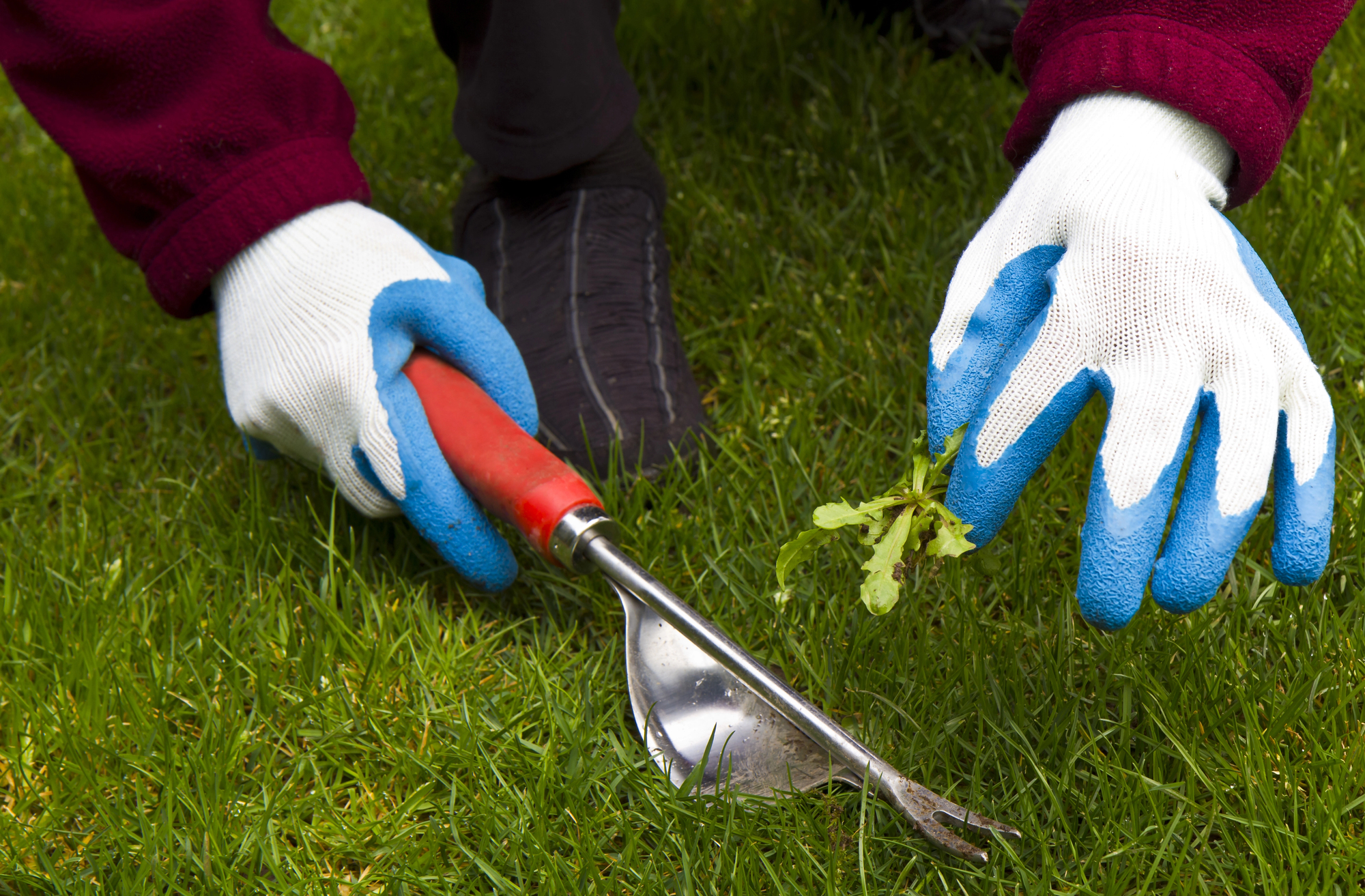
For now, dig out isolated weeds by hand after watering or rain, when the soil is soft enough to lift the whole taproot. A daisy grubber or an old kitchen knife gets under a plantain or dandelion crown for around £5/$7. Lifting the whole crown counts, as most of these perennials regrow from any root fragment left behind in the soil. Drop the pulled weeds in the compost rather than shaking their seed heads across the lawn. Water the bare scar left behind and drop in a pinch of matching grass seed, so the grass rather than the next weed fills the gap.
The real fix arrives in September. Once rain returns and the grass wakes, scarify to clear debris, aerate any compacted, plantain-prone strips with a garden fork or a hollow-tine tool, then overseed the bare ground thickly with a hard-wearing ryegrass or fescue mix at around 35g per square metre. A dense autumn lawn shades out next year’s weed seeds before they can germinate. Feed in autumn to build that density, keep the mower a notch high through the following summer, and water deep but seldom. Do that, and the five weeds lose the bare, lit, dry ground they depend on, and the lawn wins the fight on its own.