
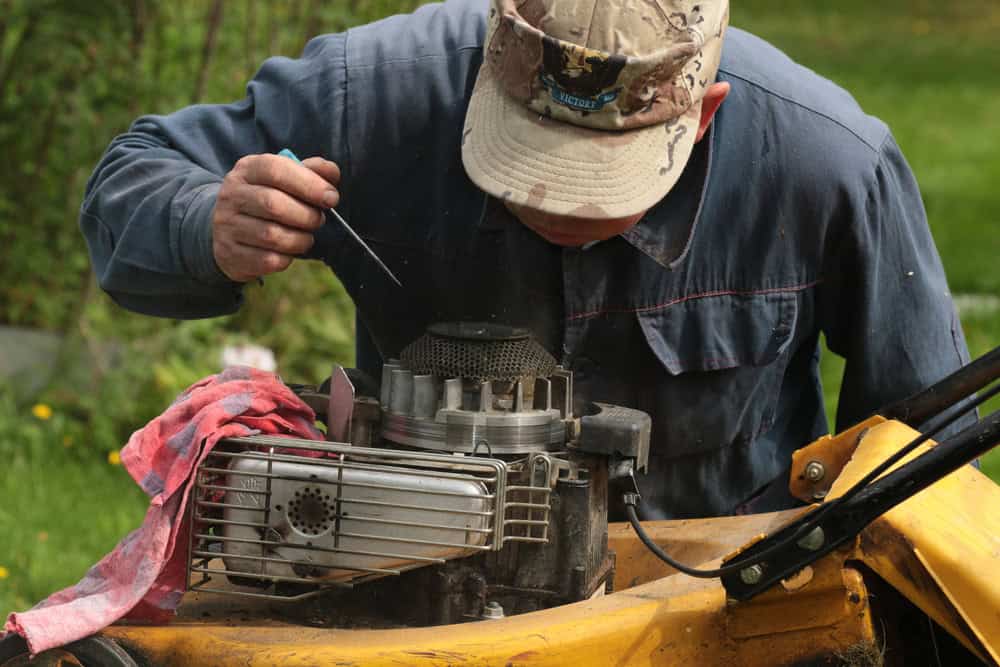
A clean oil change is the single piece of mower maintenance that decides whether your engine survives summer in good condition or starts smoking in mid-July. Petrol mower engines run hot, dirty and at constant high revs, and the oil that lubricates them breaks down faster than you would expect. Briggs & Stratton, the engine manufacturer in roughly seven out of every ten petrol mowers sold worldwide, recommends an oil change every 50 hours of use, or once per mowing season, whichever comes sooner. For a typical garden that means once a year, and late spring (before summer demand peaks) is the perfect moment.
This guide walks through the change from start to finish, with the technical detail that lets a complete beginner do the job in 30 minutes and the reasoning that lets you adapt to whatever engine sits on top of your deck.
Why Old Oil Wrecks Mower Engines
Engine oil does four jobs at once. It lubricates moving parts, carries heat away from the piston, suspends carbon and metal particles, and seals the gap between piston rings and cylinder wall. When oil ages, the additives that do those four jobs are depleted. Detergents that suspend carbon stop working, so soot drops out of solution and forms sludge in the sump. Anti-wear additives like zinc dialkyldithiophosphate (ZDDP) get consumed, leaving metal-on-metal contact at the cam lobes. Acidity rises as combustion byproducts contaminate the oil, and the oil itself starts to attack the bearings.
The visible signs are easy to miss. The oil on the dipstick turns black quickly even when fresh, so colour is a poor guide. The real giveaway is smell: old mower oil smells burnt, slightly fishy and acidic. Texture is the second clue. Rub a drop between thumb and forefinger and old oil feels gritty rather than slick. A mower running on degraded oil burns 10-15 percent more fuel for the same work, runs hotter, and shortens engine life from a typical 10-15 years to four or five.
Which Oil to Buy and How Much
Briggs & Stratton, Honda, Kohler, Loncin and Toro all use the same SAE viscosity grade system. For warm-weather use above 4 degrees C (40 degrees F), the standard recommendation is SAE 30. It is a single-grade oil that holds its film strength at high operating temperatures, which is what an air-cooled mower engine needs. Bottles cost £6-9 or $8-12 for 600ml at Halfords, Amazon, Home Depot, Lowe’s and most garage forecourts. Castrol GTX 30 Lawn Mower Oil and Briggs & Stratton SAE 30 are the two most widely stocked.
For cooler conditions, or if you store the mower outdoors and use it on cold mornings, SAE 5W-30 is the multi-grade alternative. The “5W” rating means it flows like a 5-weight at start-up but protects like a 30-weight once hot. Synthetic 5W-30 from Briggs & Stratton (around £12 or $15 for 600ml) is approved for use across the full temperature range and does not need changing more often than mineral oil.
Capacity varies by engine size. A typical 140-190cc walk-behind mower (3.5-6.5hp) takes 470-600ml (16-20 fluid ounces). Larger 7-8.75hp OHV engines on self-propelled and high-end mowers take up to 1.4 litres (48 fluid ounces). Ride-on mowers with twin-cylinder engines need 1.4-1.9 litres (48-64 fluid ounces). Check the manual for your specific engine model, which is stamped on the metal shroud above the spark plug. Overfilling is worse than underfilling: oil foams when the crankshaft whips through it, the foam loses its lubrication properties, and you can blow the crank seal in extreme cases.
The Step-by-Step Oil Change
The job takes 30 minutes including clean-up. Do it on a flat surface with the engine warm but not hot. Warm oil drains faster and carries more suspended particles out with it. Run the engine for two or three minutes then switch off.
Step one. Disconnect the spark plug lead. This is non-negotiable. A petrol mower can fire if the crankshaft turns over while you are working on it. Pull the rubber boot off the plug and tuck it away from the metal.
Step two. Empty the fuel tank or run it dry. Tipping a mower with fuel in it floods the air filter and carburettor. If the tank has more than half a litre in it, siphon it into a clean jerry can.
Step three. Place a drain pan (a baking tray, an old roasting tin, a £5 or $6 oil pan from Halfords) under the deck on the side opposite the air filter and carburettor. Tilt the mower so the spark plug points up and the oil filler points down toward the pan. Unscrew the oil filler cap and let the oil drain out. This takes two or three minutes. Some mowers have a dedicated drain plug on the underside of the sump (look for a square or hex bolt). If yours does, unscrew it rather than tipping.
Step four. While the oil drains, change the spark plug if you have not done it in the last two years. A NGK BPR5ES or Champion RJ19LM (around £4 or $5 each) is the standard part for most Briggs & Stratton and Honda engines, and a fresh plug saves at least 5 percent on fuel.
Step five. Replace the air filter at the same time. A paper element costs £6-10 or $8-13 and a clogged filter is one of the most common reasons a mower runs rough in late summer. The two-minute job now saves a half-hour diagnosis in August.
Step six. Right the mower and check the drained oil. Look for metal flakes (sign of bearing wear), milky appearance (water contamination, which means the head gasket is failing) or fuel smell (the float in the carburettor is leaking). If you see any of these, get the engine looked at before refilling.
Step seven. Pour in the new oil slowly through the filler. Use a funnel to avoid spills. Add about three-quarters of the rated capacity, wait two minutes, check the dipstick. Add the rest in small amounts until the dipstick reads at the upper mark. Do not overfill.
Step eight. Reconnect the spark plug lead, refill with fresh fuel, start the engine and let it run for two minutes. Check the dipstick one final time after the oil has circulated.
Why Doing It Properly Pays for Itself
A mower running on fresh SAE 30 cuts more cleanly because the engine maintains higher consistent RPM. Blade tip speed is what gives a clean cut, and degraded oil drops engine RPM by 100-200 under load. The visible result is fewer torn grass tips, less yellow-edge appearance after mowing, and a lawn that looks visibly better within 24 hours of the change.
Fuel economy improves by 8-12 percent for the same area mown. On a typical 200m2 lawn that means roughly half a litre of petrol saved per season, but the bigger value is in engine longevity. Mowers that get one oil change per year typically run for 12-15 seasons. Mowers that get no oil change at all rarely make it past five.
The professional groundsmen who maintain football and cricket grounds change oil every 25 hours rather than 50, and they get 20-year service life out of engines that should theoretically only last 10. That is the upper benchmark. For a back garden, once a year in late May or early June is the sweet spot.
The Mistakes That Wreck a Good Job
Skipping the spark plug disconnect is the dangerous one. Two seconds of carelessness can shear a fingertip.
Using car engine oil is the expensive one. Modern car oils contain low-zinc formulations designed for catalytic converters, which mower engines do not have. The reduced ZDDP means accelerated cam wear in air-cooled engines. Stick to oils labelled for small engines or for older car engines (API SL or earlier).
Tipping the mower the wrong way is the messy one. The carburettor side must point up, or oil floods the air filter, the spark plug fouls, and the engine takes 20 pulls to start. If you tip the wrong way, leave the mower on its wheels for an hour to drain back, then change the spark plug.
Mixing old and new oil is the slow-decay one. If you have not changed the oil in three years and you simply top it up, you have diluted fresh oil with degraded oil and the new oil deteriorates twice as fast. A proper drain and refill always beats a top-up.
Do the change this weekend, label the engine with a sticky note showing the date, and the mower runs through summer without complaint.