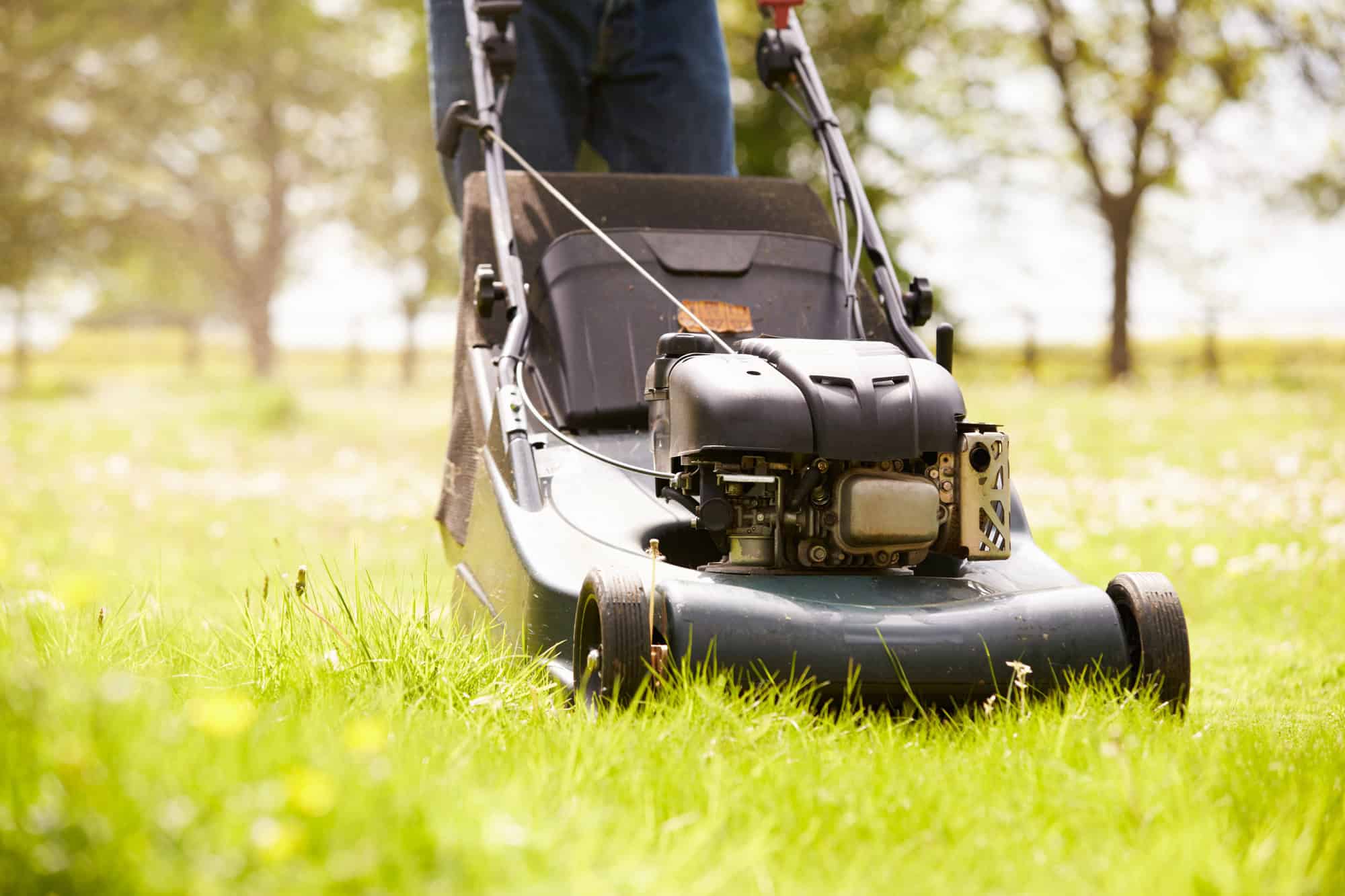
The single rule that prevents most slope mowing accidents is also the one people most often get backwards: if you use a walk-behind mower, cut across the slope, side to side, never straight up and down. If you use a ride-on mower or lawn tractor, do the opposite and drive up and down the face of the slope rather than across it. Those two opposite rules exist for the same reason, keeping the machine and the operator stable, and once you understand why, the rest of safe slope mowing falls into place.
Know How Steep Is Too Steep
Before you start, judge the gradient carefully, because no technique makes a dangerous slope safe. Most ride-on mower manuals set a firm limit of 15 degrees, and going beyond it risks the machine tipping or sliding. A simple field test for any slope is the rise-to-run ratio: a bank that drops one foot over every four feet of horizontal distance (about a 14 degree slope) is around the manageable limit for most lawn tractors and zero-turn mowers, while anything approaching one foot of drop for every three feet (closer to 18 degrees) is into truly hazardous territory and should not be ridden at all.
To estimate a slope without tools, stand at the bottom and pace it out, or lay a straight plank on the bank with a spirit level on top and measure the gap under the downhill end. If you are at all unsure whether a slope is within your mower’s limit, treat it as too steep and switch to a different tool, which is far cheaper than a damaged machine or an injury. Steep banks are also where the most serious mowing accidents happen, so this is not a place to push your luck.
Why the Direction Rule Flips Between Mower Types
With a walk-behind mower, the danger is the machine rolling back onto you or sliding downhill while you are below it. Mowing across the face keeps you to the side of the mower rather than directly downhill of it, so if it does slip it moves away along the slope instead of into your legs and feet. It is also easier to keep your own footing when you are walking along a contour than when you are pushing straight up a bank or backing down one. This is why the side-to-side rule is standard advice for push and self-propelled mowers.
A ride-on mower flips the logic because the threat is the machine rolling sideways with you on it. A tractor or zero-turn has a relatively high centre of gravity, and the moment you point it across a slope, gravity is trying to tip it over onto its downhill side. Driving straight up and down keeps the machine’s weight balanced evenly between its wheels and dramatically reduces the chance of a sideways rollover, which is the most dangerous thing a ride-on can do. The trade-off is traction on the climb, so you raise the deck and take it steadily rather than charging the hill.
Two factors quietly raise the risk for both machine types. The first is wet grass: a damp surface destroys traction, and lost traction is the leading cause of both rollovers on ride-ons and slips behind walk-behind mowers, so you should never mow a slope until the grass has dried. The second is tyre pressure. Soft, under-inflated tyres deform and lose their grip on an incline, making a slide or a tip far more likely, so check and set the pressures to the manufacturer’s figure before tackling any bank.
The Step-by-Step Method for a Safe Cut
Start by walking the slope first to clear stones, branches and hidden dips, any of which can throw a mower off line or stop a wheel dead and pitch the machine. Wear sturdy, closed shoes or boots with a deep tread, never trainers or open sandals, because your footing is the thing keeping you upright. Raise the cutting height a notch above your normal setting: longer grass on a slope is less likely to be scalped and the taller cut gives the roots more reach into the bank to hold the soil and resist erosion.
With a walk-behind mower, work in steady horizontal passes across the face, overlapping each pass slightly, and keep the mower to the downhill side so you are always stepping along the slope rather than below the machine. Move at a walking pace and never run. With a ride-on, point it straight up the fall line, raise the deck, and climb in a low gear; reverse straight back down or turn only on level ground at the top or bottom, never midway across the bank. Avoid sudden changes of speed or sharp turns on the incline, both of which can break traction and start a slide.
Take the catcher off if you can manage without it. A full grass bag or collection box adds weight high up and toward one side, raising the centre of gravity and reducing the safe angle the mower can handle, so mowing on the mulch or side-discharge setting and raking up afterwards is the safer choice on a noticeable slope.
It is also worth thinking about whether a steep bank needs to be lawn at all. Grass on a sharp slope is hard to mow, dries out fast because water runs off before it soaks in, and erodes in heavy rain. Replacing the turf with a tough, spreading ground cover, or planting it up as a low-maintenance border, removes the mowing hazard completely and often looks better. Where you want to keep some green, a no-mow or wildflower bank cut just once or twice a year with a strimmer is a safe and increasingly popular alternative to fighting a mower up and down the slope every week.
When to Put the Mower Away Entirely
Some banks are simply not mower territory, and the safest answer is a different tool. For a steep slope, a hover mower such as a Flymo (around £70/$90) floats on a cushion of air and can be swung across a bank on a rope from above, keeping you off the slope altogether. A strimmer or string trimmer handles the steepest banks and awkward edges where no wheeled mower belongs. For an owner who would rather not deal with a slope at all, many robot mowers are now rated for inclines, typically handling gradients of 35 to 45 percent (roughly 20 to 24 degrees) depending on the model, and will work a bank automatically once the boundary is set.
The common mistakes on slopes are easy to name and easy to avoid. Mowing across a bank on a ride-on invites a sideways rollover; mowing up and down with a push mower invites it to roll back onto you; cutting wet grass removes the traction that keeps either machine planted; and leaving a heavy full catcher on raises the tipping risk just when you least want it. Match the direction to the machine, wait for dry grass, keep the deck high, and know the gradient where you stop mowing and reach for a hover mower or strimmer instead. A slope is the one part of the garden where getting it wrong has real consequences, so the cautious approach is always the right one.
Finally, do not underestimate the physical side of slope mowing. Pushing a mower along a bank or holding a tractor steady on a climb is tiring, and fatigue is when footing slips and concentration drops, so split a large slope into sessions rather than forcing it all in one go on a hot day. Tell someone you are mowing a bank, keep children and pets well clear of the area below you, and never reach under or near the deck while the engine is running. None of this slows the job down by more than a few minutes, and all of it keeps a routine chore from turning into the kind of accident that slopes are responsible for every summer.