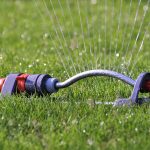

A sprinkler timer turns watering from a daily chore you forget into something the lawn does for itself before you are even awake. The whole point is to deliver the right amount of water at the right time of day without you standing over a hose, and the right setting for almost every lawn is the same: a deep soak two or three mornings a week rather than a light sprinkle every day. Get the timer programmed to do that and you not only save the effort, you grow a deeper-rooted, more drought-resistant lawn than hand-watering ever produces. The setup takes about twenty minutes, most of it spent working out how long each run needs to be.
Choosing the Right Type of Timer
There are three kinds, and the gap between them is convenience, not watering quality. The simplest is a mechanical dial timer that screws onto the tap and runs for a set number of minutes once you twist it, useful as an automatic shut-off but with no scheduling. The standard choice for most gardens is a digital battery-powered hose-end timer: it fits between the outdoor tap and your hose, runs on a couple of AA batteries, and lets you set a start time, a run duration, and which days of the week it waters. The most capable is a smart timer that connects to your home wifi and can be set from a phone, with the better models adjusting automatically using local weather so they skip a cycle after rain.
On price, a basic digital hose-end timer from a brand such as Hozelock or Orbit runs about £20 to £40 ($25 to $50). A smart wifi model costs more: the Orbit B-hyve sits around £40 to £48 ($48 for the two-port version), while the Rachio smart hose timer is roughly £85 to £110 ($110), often needing a separate wifi hub. They are sold at B&Q, Screwfix, Amazon, Home Depot, and most garden centres. For a single lawn the mid-range digital timer does everything you need; the smart versions earn their cost mainly through the weather-skip feature, which stops you watering a lawn the sky has just soaked.
Setting It Up Step by Step
Start by fitting the timer. Screw it onto the outdoor tap and hand-tighten the connection, then attach your hose to the timer outlet and run the sprinkler off the end. Fit the batteries before anything else, because the schedule will not hold without them; a typical hose-end timer takes two AA alkaline cells in a watertight compartment on the back, and a weak battery is the single most common reason a timer stops watering mid-season.
Next, set the current time and day on the timer. Every other setting is built on this internal clock, so if it is wrong the lawn will water at the wrong hour. Then program three things in turn: the start time, the run duration, and the frequency or which days it runs. Set the start time for early morning, ideally finishing by around 6am. Set the duration to the figure you work out in the next section. Set the frequency to two or three days a week, not daily. Finally, and this trips people up constantly, turn the dial or mode to Auto. Many timers sit in a manual or off position out of the box and will never run the schedule until you move them to Auto. Use the manual Water Now button to test that the sprinkler comes on and check for leaks at the fittings, and learn where the rain-delay or Cancel button is so you can pause the schedule when wet weather arrives.
Working Out How Long to Run It
This is the setting that decides whether the timer helps or harms, and you cannot guess it, because every sprinkler and water pressure delivers a different amount per minute. A healthy lawn needs roughly 25mm (about 1 inch) of water per week including rainfall, given as deep soaks rather than daily sips. To find your run time, do the catch-can test. Place a few straight-sided containers, empty tuna tins or small tubs, around the area the sprinkler covers. Run the sprinkler for 15 minutes, then measure the depth of water collected in each tin with a ruler. If you caught 5mm in 15 minutes, the sprinkler delivers about 20mm an hour, so to lay down 25mm across the week in two sessions you would run it for around 35 to 40 minutes per session, twice a week. The tins also reveal uneven coverage, so reposition the sprinkler if some tins are nearly empty.
On heavy clay, water can run off before it soaks in if you apply it all at once. The fix is the soak-and-cycle method: split the run into two shorter bursts with a gap between, for example two 20 minute runs an hour apart, so the first lot drains in before the second arrives. Most digital timers allow several start times a day, which makes this easy to program. Our guide to watering deeply so a lawn survives the driest weeks of summer goes into the soil science behind why this works.
A timer is set once but should not be left untouched for the whole summer, because the lawn needs different amounts as the weather shifts. In a cool, showery week the 25mm target is partly met by rain, so you can drop to a single weekly session or pause the schedule altogether. In a prolonged hot, dry spell the grass loses more to evaporation and transpiration, so you may need to add a third session or lengthen each run by ten minutes. The simplest rule is to keep watching the lawn and the rain: if footprints stay pressed into the grass instead of springing back, it is thirsty and needs more; if the surface stays soggy or moss starts to creep in, you are giving it too much. A smart timer with a weather feed makes these adjustments on its own, which is the main reason to pay extra for one, but a basic timer plus a five-second glance at the lawn each morning does the same job for free.
Why Morning, and Why Deep and Infrequent
Two settings on the timer do most of the work, and both rest on plant and soil science. Watering before dawn matters because of evaporation: in the cool, still air of early morning, almost all the water reaches the soil and soaks in, whereas water thrown in the heat of the day is lost to evaporation before the roots ever see it, and watering in late evening leaves the grass wet overnight, which encourages fungal disease. Our piece on watering so less evaporates and more soaks in sets out the timings in detail.
Deep, infrequent watering matters because of how roots respond to moisture. When you soak the soil to a depth of 10 to 15cm (4 to 6 inches) and then let the surface dry before the next session, the roots chase the water downward and the lawn develops a deep root system that can find moisture in a dry spell. Light daily watering does the opposite: it keeps only the top centimetre or two damp, so the roots stay shallow and the lawn becomes utterly dependent on the next sprinkle, browning within days if you go away. A timer set to soak two or three mornings a week trains a tougher lawn; a timer set to a few minutes every day trains a weak one.
The mistakes to avoid are now clear. Do not set the timer to daily, however tempting the neatness of it, because shallow daily watering builds shallow roots. Do not leave it running its full summer schedule through a wet spell, because watering on top of rain wastes water and drowns the surface; use the rain-delay button or a weather-aware smart timer. And do not skip the catch-can test and simply pick a round number of minutes, because a guess either starves the lawn or floods it. Spend the twenty minutes to fit the timer, run the test, set an early-morning soak two or three days a week, and switch it to Auto. From then on the lawn waters itself, correctly, while you sleep.