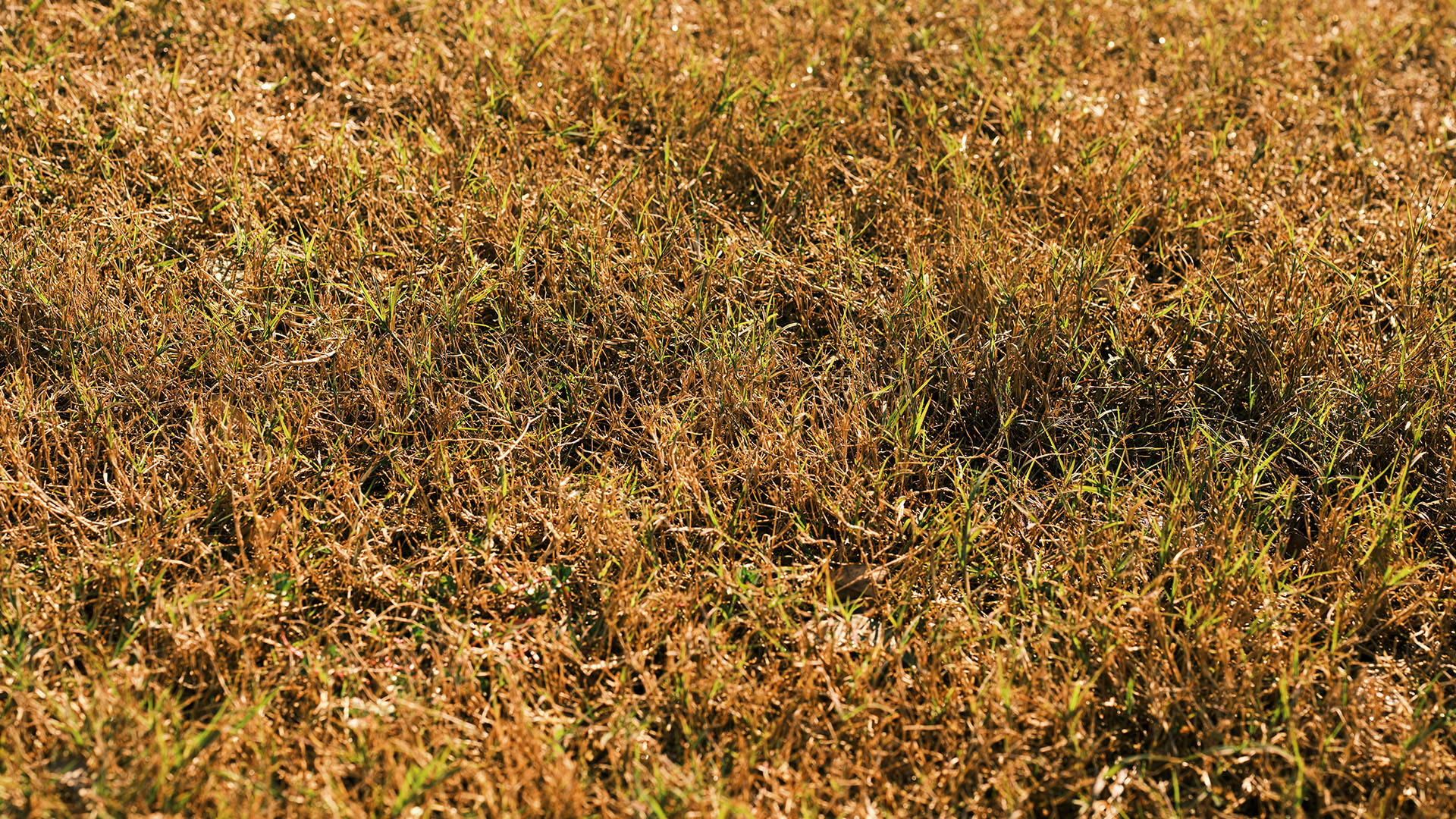
Half of every “I think my lawn has a disease” panic turns out to be drought stress. The other half is genuinely fungal, and reaching for the wrong fix wastes weeks of growing season. Before you spend money on a fungicide or pile on more nitrogen, the diagnosis takes about five minutes if you know what to look at.
The reason mistaking the two is so easy is that both produce brown patches, both can appear quickly, and both worsen in warm weather. The signals that separate them are subtle: the shape of the affected area, the appearance of individual blades, the time of day symptoms look worst, and what a hand trowel reveals two centimetres (about three quarters of an inch) below the surface.
What to Check Before You Diagnose Anything
Walk to the centre of the problem patch in the morning, ideally before 9am, while dew is still on the grass. Most fungal lawn diseases produce visible mycelium or coloured threads that only show up in moisture. By midday the evidence has dried back into the canopy and the patch looks like nothing more than dead grass.
Carry three things with you: a small hand trowel, a sharp kitchen knife, and a magnifying glass or the macro setting on your phone camera. Kneel down and run a hand backwards through the affected blades. If the leaves snap and crumble between your fingers, that points to drought. If they feel slightly slimy or have a damp, melted look at the base, that points to fungal infection.
Cut a plug of turf about 10cm (4 inches) square and 5cm (2 inches) deep with the kitchen knife. Pull it up and look at the roots. Healthy roots are white and reach 10cm or deeper. Drought-stressed roots are intact, white at the tip, and dry. Disease-affected roots are often short, dark brown or black, easily pulled apart, and may smell faintly sour. This single test settles half the diagnoses on its own.
The Shape and Edge of the Patch
Drought damage almost always follows a logical map of the garden. Patches appear where the soil is shallowest, where a path or buried hardcore sits underneath, where a south-facing slope catches midday sun, or where the irrigation pattern leaves gaps. The edges fade gradually into healthier grass over 20 to 30cm (8 to 12 inches) and the patches expand slowly over weeks.
Disease patches behave differently. Red thread, which affects around 85 percent of cool-season lawns at some point and is the single most common fungal problem, produces irregular pinkish patches anywhere from a few centimetres to half a metre (roughly 4 to 20 inches) across, with no logical reason for their location. Look closely with the magnifier and you will see fine coral or red needle-like threads protruding from the grass leaves themselves. Those threads are the fungus producing spores. Dry grass never grows red threads.
Dollar spot, more common on bermudagrass, fescue, and ryegrass in warm humid weather, produces straw-coloured circles 10 to 50mm (0.4 to 2 inches) wide, often roughly the size of a small coin. The patch edges are sharp and well-defined. Individual blades inside the patch show distinctive hourglass-shaped lesions, tan in the middle with a reddish-brown rim. Drought never produces banded lesions on individual blades.
Fusarium patch starts as orange or yellow patches the size of a tennis ball, then expands to 30cm (12 inches) or more. In damp weather you can spot white candyfloss-like mycelium at the patch margin, particularly in early morning. The patches often have a slightly sunken appearance compared with surrounding turf.
Leaf spot is the trickiest because it initially resembles drought or insect damage. Look at single blades under magnification: tan or grey oval spots with purple or dark brown margins, often with a small lighter centre, confirm the diagnosis. Drought turns whole blades uniformly tan from tip downwards.
What the Weather Has Done in the Last Two Weeks
Diagnosis without weather context is guesswork. Pull up a rainfall log for your area on the Met Office or your favourite weather app and look at the last 14 days.
Drought damage shows up after a stretch of warm, dry days where soil moisture has dropped below the wilting point. A useful rule of thumb is that an established lawn needs about 25mm (1 inch) of water per week in active growth. If your area has had less than 10mm in the previous fortnight and temperatures have run above 22 degrees C (72 degrees F), drought is a strong candidate before disease.
Fungal disease loves the opposite pattern. Red thread, dollar spot, and fusarium all explode after warm humid nights, particularly when daytime temperatures sit between 18 and 27 degrees C (65 to 80 degrees F) and overnight humidity stays above 80 percent. A run of muggy evenings after spring rain is the textbook trigger. If your patches appeared during or just after that kind of weather, fungus is far more likely than thirst.
The exception is fusarium patch, which can also strike in cool damp weather, particularly when an autumn nitrogen feed has been applied too late. If you remember feeding the lawn within the last six weeks and you are now seeing orange tennis-ball patches, fusarium is the prime suspect.
The Mistakes People Make When They Treat the Wrong Problem
If you assume disease and apply a fungicide to a drought-stressed lawn, you achieve nothing and the grass continues to brown. Worse, many fungicides are best applied to actively growing turf, and stressed grass absorbs less product. You waste 15 to 40 pounds or dollars on a bottle that does not fix the underlying issue.
If you assume drought and water heavily into what is actually red thread or dollar spot, you accelerate the infection. Fungal spores germinate on wet leaf surfaces, and a daily light sprinkle creates ideal conditions for the disease to spread. Within seven to ten days a small patch can quadruple in area.
If you assume disease and dump nitrogen onto a fusarium-infected lawn, you supercharge the problem. Fusarium feeds on succulent, nitrogen-rich growth, and the patches expand fast. The same is true of dollar spot to a slightly lesser degree.
The single best general response to red thread, where nitrogen deficiency is the underlying cause in most cases, is the opposite: a balanced summer feed at around 35g per square metre (roughly 1 pound per 1,000 square feet). Westland SafeLawn at around £12/$15 for 150 square metres of coverage, or Miracle-Gro EverGreen Complete 4-in-1 at around £19/$24 for 360 square metres, both deliver enough nitrogen to push the grass past a mild red thread outbreak without a fungicide. Water it in after 48 hours if no rain falls.
When to Call in a Fungicide and When to Wait It Out
Most home lawns recover from red thread, dollar spot, and minor leaf spot through cultural treatment alone. Raise the mowing height by 5 to 10mm (about a quarter of an inch), feed at the rate above, water deeply once a week instead of shallowly every day, and improve airflow by scarifying lightly in autumn. The Royal Horticultural Society and most university turf science departments recommend cultural fixes before chemical ones because lawn diseases are almost always symptoms of an underlying weakness in the sward.
Fungicides become worth the cost when an outbreak covers more than about 30 percent of the lawn, when patches are merging into bare ground, or when the same disease has returned three years running despite cultural fixes. Even then, products like Provanto Lawn Disease Control (around £12/$15 for 500ml, treating roughly 200 square metres) work best as a one-off knockdown alongside the cultural changes, not as a permanent crutch.
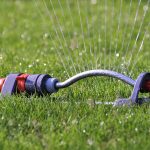
For drought stress, the only fix is patient deep watering. Apply 20 to 25mm (about an inch) once a week, ideally in early morning, soaking the top 10 to 15cm (4 to 6 inches) of soil rather than wetting the surface daily. A simple test: push a screwdriver into the lawn after watering. If it slides in easily to the depth of the handle, you have soaked deep enough. If it stops at 3 or 4cm (1.5 inches), you need to water longer next time.
The reason deep watering beats sprinkling is root architecture. Grass roots grow toward moisture. Light daily watering trains the roots to stay near the surface, where they cook in heat and dry out faster between waterings. Deep weekly watering pulls roots down to 15cm or more, where soil temperature stays cooler and moisture lingers, and the lawn becomes far more resilient to the next dry spell.
Take five minutes to diagnose before you reach for any product. The cost of getting it wrong is a worse-looking lawn six weeks from now and a chunk of money spent on the wrong bottle. The cost of getting it right is a sward that bounces back inside a fortnight.