If pale, glossy blades keep shooting up above the rest of your lawn within days of every mow, you are almost certainly looking at nutsedge. It is not a true grass, and that is exactly why it beats your turf in summer: it grows from underground tubers that store energy, it grows faster in heat than the grass around it, and it shrugs off mowing because it simply pushes up again. Pulling it by hand makes the problem worse. The only treatment that gives lasting control is a selective sedge herbicide applied while the plants are young, and the only way to keep it from coming back is to fix the wet, compacted conditions it loves.
How to Know It Is Nutsedge and Not Grass
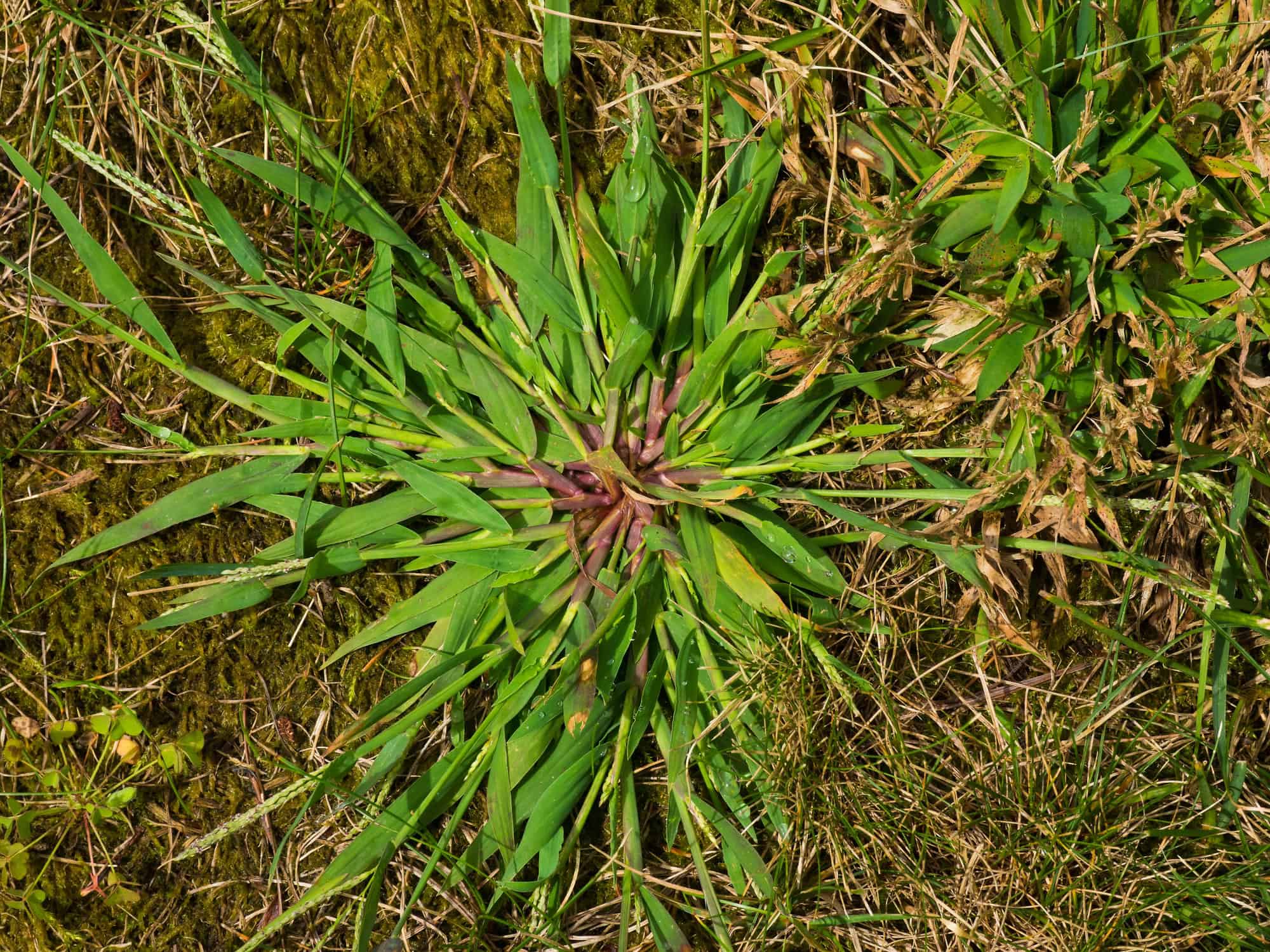
Nutsedge disguises itself as a grass, but three features give it away. First, the colour: it is a lighter, more yellow-green than most lawn grasses, so it stands out as a pale flush a day or two after cutting. Second, the speed: it grows upright far faster than turf, so it is usually the tallest thing on the lawn between mows. Third, and most reliably, the stem. Roll a stem between your finger and thumb and you will feel three distinct edges, because sedge stems are triangular in cross-section. There is an old groundskeeper saying that captures it: sedges have edges. True grasses have round or flattened stems and leaves that sit in two ranks; sedge leaves come off the stem in three ranks, arranged in a Y when you look down from above. Yellow nutsedge, the most widespread type, has glossy leaves that taper to a fine point and a seed head the colour of straw.
It is worth knowing there are two common types, because they behave slightly differently. Yellow nutsedge has yellow-green leaves with a long tapering tip and a straw-coloured seed head, and it tends to appear earlier in the season. Purple nutsedge runs darker green with a more abrupt leaf tip and reddish-purple seed heads, favours hotter spots, and is the harder of the two to control because its tubers form in chains along the rhizomes rather than singly. Both respond to the same systemic treatments, but purple nutsedge usually needs more repeat applications to exhaust its chained tubers. You will often spot either type first along paths, driveways and bed edges, or in any low corner of the lawn where water collects, because those warm, damp, compacted strips are where it gets its foothold before spreading into the open turf.
Getting the identification right is the difference between treating it effectively and wasting money, because the products that kill nutsedge are different from ordinary broadleaf weedkillers, and a standard lawn weed and feed will barely touch it.
Why It Outgrows Everything and Why Pulling Fails
The reason nutsedge wins in summer lies underground. Each plant produces a network of rhizomes that end in small, hard tubers, often called nutlets, which is where the plant gets its name. A single plant can produce hundreds of these tubers in one season, and each one is a fully stocked energy store capable of sprouting a new plant. The agricultural science is sobering: extension specialists report that once the tubers are established, complete eradication in a single season is unlikely, and a mature patch can carry vast numbers of dormant nutlets in the top 15 to 20cm (6 to 8 inches) of soil.
This is why hand-pulling backfires. When you pull a nutsedge plant, the stem snaps away but the tubers stay in the ground, and the act of disturbing them breaks their dormancy. One pulled plant can trigger several new shoots from the tubers left behind, so a patch you weeded in June can be thicker by July. It is also why nutsedge laughs at mowing. Cutting removes the top growth but takes nothing from the tubers, and the plant simply redraws on its underground reserves to grow back taller and quicker than the grass beside it. To get on top of nutsedge you have to reach those tubers, and the practical way to do that is a herbicide the plant carries down into them itself.
The Treatment That Actually Works
The reliable control is a selective post-emergent herbicide formulated for sedges. The most widely used active ingredient is halosulfuron-methyl, sold in products such as SedgeHammer Plus, with sulfentrazone and imazosulfuron as alternatives in some ready-mixed sedge treatments. These are systemic, which means the plant absorbs the chemical through its leaves and moves it down into the rhizomes and tubers, killing the storage organs that ordinary contact weedkillers never reach. A small bottle or a few pre-measured sachets cost roughly £15 to £22 (about $18 to $28) and treat a large area, available through Amazon, garden centres, and stores such as Home Depot and B&Q; a single 1.3 ounce bottle of concentrate makes up to 40 gallons of spray.
Timing and technique decide whether it works. Apply when the nutsedge is young, at the three to eight leaf stage, because small actively growing plants take up and move the chemical best. Most of these products need a non-ionic surfactant added to the tank, typically around two teaspoons per gallon of water, so the spray sticks to the waxy, water-shedding leaves rather than beading off. Spray on a dry, calm day when no rain is forecast for at least a few hours, and do not mow for several days either side so there is enough leaf area to absorb the dose and carry it downward. Expect to repeat the treatment after six to ten weeks, because the tubers do not all sprout at once and later flushes need their own application. Two seasons of consistent treatment is realistic for a heavy infestation, so patience is part of the plan.
Always read and follow the label rate for your particular product and grass type, because sedge herbicides are selective for turf grasses but can be sensitive to dose. Spot-spray the patches rather than blanket-treating the whole lawn, both to save product and to limit any check to the surrounding grass.
Stop It Coming Back by Fixing the Conditions
Killing the visible plants buys you a season; changing the conditions keeps it gone. Nutsedge thrives in soil that stays wet, and it spreads fastest where drainage is poor or where a lawn is watered little and often so the surface never dries. The single most useful change is to water deeply and less frequently, soaking the soil and then letting the top few centimetres dry between waterings, which favours deep-rooted grass over moisture-loving sedge. Our guide to watering deeply so a lawn survives the driest weeks of summer explains the method in detail.
Two further habits make a lawn hostile to nutsedge. Mow at the top of the recommended height for your grass so the turf casts shade across the soil surface, because sedge seedlings and sprouting tubers need light and warmth to establish, and a dense, taller sward starves them of both. Our advice on how high to cut a lawn in summer sets out the right heights. And relieve compaction and standing water, because hard, waterlogged ground is exactly the niche nutsedge exploits while ordinary grass struggles. Where one part of the lawn stays soggy after rain, improving the drainage there does more to end a nutsedge problem than any spray.
The mistake most people make is treating nutsedge as a one-off weeding job. Pull it and it multiplies; mow it and it races back; ignore the wet soil and it returns every summer no matter how often you treat the tops. Identify it correctly by the triangular stem and pale fast growth, hit it young with a systemic sedge herbicide and a surfactant, repeat through the season, and then take away the damp, compacted conditions it depends on. Do all four and a weed that once seemed unbeatable becomes a patch you clear once and rarely see again.