Summer grass seed is one of the most searched lawn care topics from June onwards, and for good reason. Bare patches appear as the heat dries out thin areas, heavy foot traffic from garden use wears through the sward, and the lawn that looked green enough in April suddenly looks tired and gappy. The instinct is to grab a box of seed and fill the gaps before they get worse. The problem is that summer is the hardest season to establish grass from seed, and doing it wrong wastes both time and money. Doing it right, however, can give you a repaired lawn heading into autumn that is thicker and stronger than it was before the damage appeared.
This guide covers when summer grass seed actually works, when it does not, which seed to choose, how to give it the best chance of germinating in the heat, and the mistakes that cause most summer sowings to fail.
Can You Sow Grass Seed in Summer?
Yes, but the success rate depends entirely on two things: watering and timing within the season. Grass seed needs consistent moisture to germinate, and in summer, high temperatures and low rainfall mean the soil surface dries out fast. A seed that dries out after it has started to germinate is dead. There is no recovery. This is why most summer sowings fail. The person scatters the seed, waters it once, and then goes back to normal life. Three days of warm weather with no rain later, the germinating seeds have dried out and nothing comes up.
If you can commit to watering the seeded area two to three times per day for the first two weeks, summer sowing is perfectly viable. If you cannot make that commitment, wait until early autumn when natural rainfall and cooler temperatures do the work for you.
Within the summer season, early June and late August are the best windows. Early June still has some of the residual soil moisture from spring and temperatures have not yet peaked. Late August is better still, as the worst of the heat has passed and autumn rain is approaching. July is the hardest month. Soil surface temperatures can exceed 35 degrees Celsius on a sunny day, which is above the optimum germination range for most cool-season grasses and pushes the watering demand to its peak.
Which Grass Seed to Choose for Summer Sowing
Not all grass species handle summer sowing equally well. The best choices are those that germinate quickly and tolerate heat stress, so the seedlings establish before the conditions overwhelm them.
Perennial Ryegrass
Perennial ryegrass (Lolium perenne) is the best option for summer sowing. It germinates faster than any other common lawn grass, typically within 5 to 10 days in warm soil, and establishes aggressively once it is up. The fast germination means the seedling spends less time in the vulnerable pre-emergence stage where drying out is fatal. Modern cultivars bred for turf use also have improved heat tolerance compared with older varieties. For a detailed profile of this species, see our guide on perennial ryegrass.
Tall Fescue
Tall fescue (Festuca arundinacea) is one of the most heat-tolerant and drought-tolerant cool-season grasses. It has a deep root system that accesses moisture well below the soil surface, which gives it a survival advantage in hot, dry conditions. Germination takes 10 to 14 days, slightly slower than ryegrass, but the seedlings are tough and handle heat better once established. Tall fescue is a good choice for lawns that bake in full sun through the summer months.
Fine Fescues
Fine fescues, including Chewings fescue and creeping red fescue, perform well in shade and on dry, sandy soils but are not the first choice for summer sowing in full sun. They germinate more slowly than ryegrass, typically 10 to 14 days, and the seedlings are finer and more vulnerable to heat stress. If you are overseeding a shaded area that stays cooler and moister through the day, fine fescues will work well. For a full-sun patch in the middle of the lawn, stick with ryegrass or tall fescue.
Seed Mixes
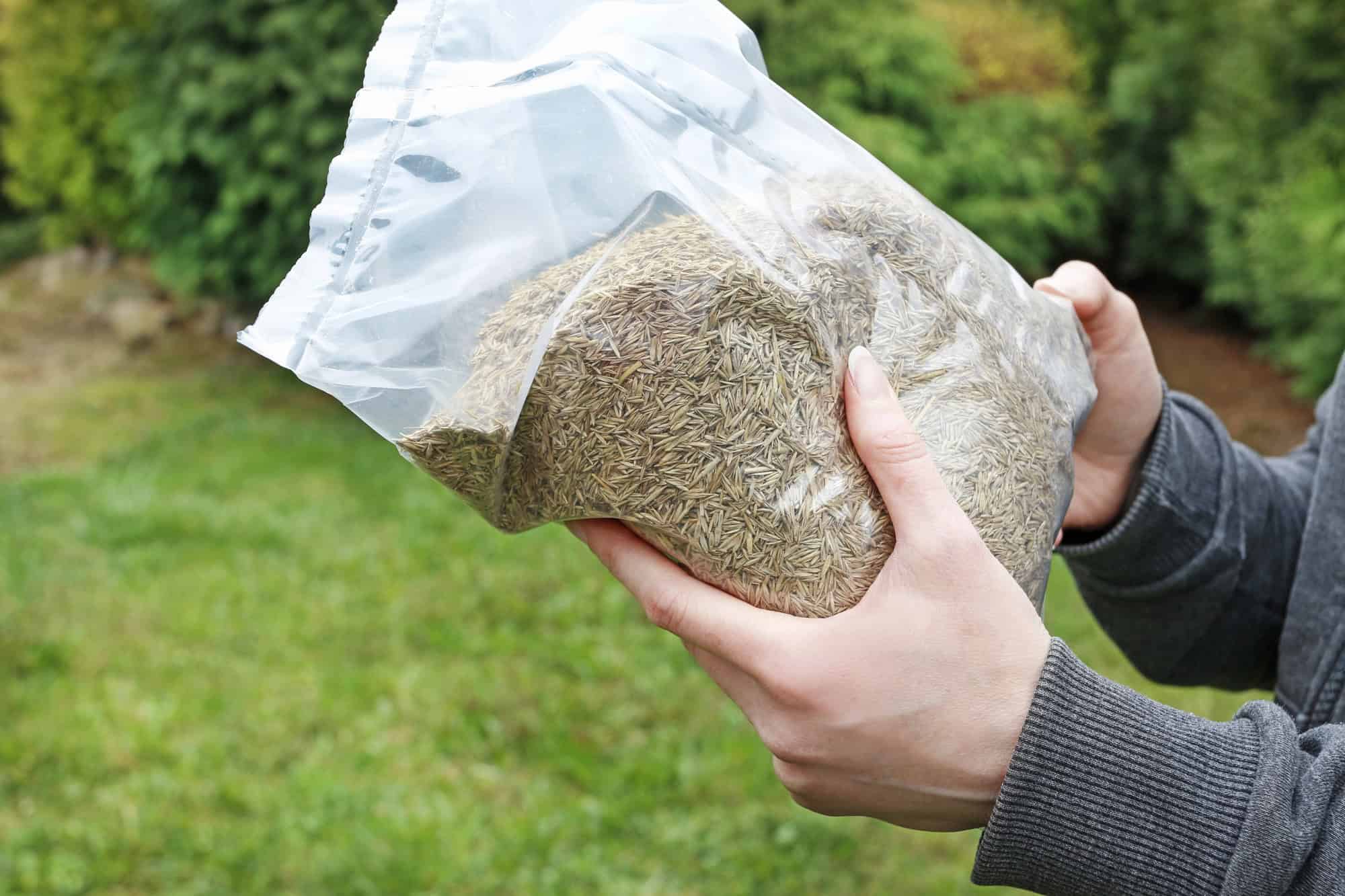
Most retail grass seed is sold as a mix of species rather than a single variety. For summer sowing, look for a mix with a high proportion of perennial ryegrass, at least 60 percent, and avoid mixes heavy in smooth-stalked meadow grass (Poa pratensis), which is slow to germinate at 14 to 21 days and struggles in extreme heat. A “quick repair” or “patch repair” mix from a reputable brand will usually be ryegrass-dominant and is a reliable summer choice.
How to Sow Summer Grass Seed
Preparing the Area
If you are repairing bare patches, rake the area to remove dead grass, thatch, and debris, and loosen the top 10 to 15 millimetres of soil with a hand fork or garden rake. The seed needs direct contact with the soil to germinate. Scattering seed onto a compacted or thatch-covered surface will produce poor results regardless of how much you water.
For larger areas or a new lawn, the full soil preparation described in our how to seed a new lawn guide applies. Dig or rotavate to 150 to 200 millimetres, rake to a fine tilth, firm by treading, and apply a starter fertiliser before sowing.
Sowing
Scatter the seed at the rate recommended on the packet, typically 25 to 50 grams per square metre for a new lawn or 15 to 25 grams per square metre for overseeding. Use the cross-hatching technique of two passes at right angles for even coverage. Rake the seed in lightly so it is covered by 2 to 3 millimetres of soil, then firm the surface by walking over it on planks or using a light roller.
For small patch repairs, a handful of seed scattered over the bare area and pressed into the soil with the back of a rake or the sole of your shoe is all that is needed. Do not overthink it. The most important thing is that the seed is in contact with moist soil.
Watering
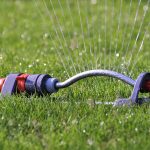
This is where summer sowing succeeds or fails. Water the seeded area immediately after sowing, then again in the early morning and late afternoon every day for the first 14 days. Each session should deliver enough moisture to keep the top 15 to 20 millimetres of soil damp, which typically means 10 to 15 minutes with a fine sprinkler. Do not soak the area. Waterlogging washes seed into puddles and creates conditions for fungal disease. The goal is a consistently moist surface, not a wet one.
On hot days above 25 degrees, a third watering around midday will prevent the surface from crusting over in the heat. This is tedious but it is the difference between a successful summer sowing and a failed one. If you are going away for a weekend or cannot maintain the schedule, set up a timer-controlled sprinkler before you sow. Leaving the seedbed unwatered for even 48 hours in a summer heatwave will kill the germinating seeds.
After the seedlings emerge and reach about 25 millimetres tall, reduce watering to once per day, then every other day from week three. By week four, the grass should have roots deep enough to tolerate a normal watering schedule. Our guide on how much water a lawn needs covers the transition to established-lawn care.
Protecting Summer Seedlings
Summer seedlings face threats that spring and autumn sowings do not. Heat, drought, and intense sunlight are the obvious ones, but there are a few others worth addressing.
Foot traffic is a bigger problem in summer because the lawn is in heavy use. Children, pets, garden furniture, and barbecue traffic all compact the soil and crush newly germinated seedlings. If possible, fence off or mark the seeded area for the first three to four weeks. Even a few bamboo canes and some string will remind people to walk around it.
Birds are less of a problem in summer than in spring because there is plenty of natural food available, but they will still scratch at freshly sown areas. A light covering of horticultural fleece or fine netting pegged over the seedbed deters birds and also provides a degree of shade that reduces moisture loss from the surface. Remove it once the grass is 25 millimetres tall.
Weeds germinate alongside the grass seed in summer, particularly annual meadow grass and various broadleaf annuals. Do not apply any herbicide to a newly seeded area. Pull weeds by hand if they are competing with the seedlings, and accept that some weed contamination is inevitable in a summer sowing. Once the grass is established and has been mown three or four times, you can assess whether a selective herbicide is needed. Our article on when to apply weed killer covers the safe timing.
Summer Overseeding vs Starting from Scratch
Overseeding, scattering seed into an existing lawn to thicken it up, is generally more successful in summer than sowing a new lawn from scratch. The existing grass provides shade at soil level, which reduces moisture loss and keeps the soil surface cooler than bare, exposed ground. The seedlings benefit from this microclimate and establish faster as a result.
If you are overseeding, mow the existing lawn short, to about 20 millimetres, and scarify or rake vigorously to remove thatch and expose bare soil. Scatter the seed at about half the new-lawn rate, rake in lightly, and water as described above. A thin top-dressing of compost over the seeded area improves seed-to-soil contact and helps retain moisture at the surface.
Starting a completely new lawn from seed in midsummer is the hardest option. The entire surface is exposed to the sun with no shade from existing grass, and the watering demand is at its peak. If you have the choice, prepare the soil in summer and wait until late August or early September to sow. You get the benefit of the warm soil and the approaching autumn rain without the extreme heat stress of July.
When Summer Sowing Is Not Worth It
There are a few situations where waiting for autumn is the smarter choice, even if the lawn looks bad right now.
If you are going on holiday within the next four weeks and nobody will be home to water, do not sow. The seed will dry out and die.
If a heatwave is forecast and daytime temperatures will exceed 30 degrees for a week or more, hold off. Soil surface temperatures in full sun can reach 40 degrees or above in those conditions, which is above the lethal threshold for most cool-season grass seedlings even with regular watering.
If the area you want to seed is in full sun with no shade and the soil is heavy clay that bakes hard and cracks in the heat, summer sowing is an uphill battle. Clay soils form a hard crust on the surface when they dry, which physically prevents seedlings from pushing through. Wait for autumn when rain softens the surface naturally.
If the lawn damage is caused by a fungal disease that is still active, sowing new seed into infected soil will produce seedlings that catch the same disease. Treat the infection first, wait for it to clear, and then sow. Our guide on lawn diseases covers identification and treatment.
Feeding Summer Grass Seed
Apply a starter fertiliser at the point of sowing, just as you would for a spring or autumn sowing. A product with a higher phosphorus content relative to nitrogen, such as an NPK ratio of 10-18-10 or 5-10-5, promotes the root development that summer seedlings need to survive the heat. Do not use a high-nitrogen quick-release fertiliser, as the concentration can burn delicate seedling roots in warm soil.
Do not feed again until the grass has been mown at least three times and is well established, typically six to eight weeks after sowing. At that point, a light application of a balanced lawn fertiliser at half the normal rate will sustain the young grass through the rest of the summer and into autumn.
The First Mow
Wait until the grass reaches 60 to 75 millimetres tall, which in summer conditions with adequate watering is usually three to four weeks after sowing. Set the mower to its highest setting and remove no more than a third of the blade length. Use a sharp blade to avoid pulling seedlings out of the soil. Lower the cutting height gradually over subsequent mows, aiming for your preferred maintenance height by the fourth or fifth cut.
Avoid mowing in the heat of the day. Early morning or late afternoon, when the grass is not heat-stressed, produces a cleaner cut and reduces the risk of the freshly cut leaf tips drying out and browning. Our guide on how to achieve the perfect cut covers mowing technique in more detail.
Summer Grass Seed Frequently Asked Questions
Can you put grass seed down in June?
Yes. Early June is one of the better summer windows because soil temperatures are warm enough for fast germination but the extreme heat of July has not yet arrived. You will still need to water two to three times per day for the first two weeks. Choose a ryegrass-dominant seed mix for the fastest germination.
Can you put grass seed down in July?
You can, but July is the most challenging month. High soil surface temperatures and low rainfall push the watering demand to its peak. If you can commit to watering two to three times per day and the forecast does not show a prolonged heatwave, it will work. If you have any doubt, wait until late August.
Can you put grass seed down in August?
Late August is one of the best times to sow. The worst of the summer heat has passed, autumn rain is approaching, and soil temperatures are still warm enough for rapid germination. Many lawn care professionals consider late August the start of the best sowing window of the year.
What is the fastest germinating grass seed for summer?
Perennial ryegrass is the fastest, typically germinating in 5 to 10 days in warm summer soil. Its speed reduces the vulnerable period where the seed can dry out before emerging. Look for a seed mix with at least 60 percent perennial ryegrass for the best summer results.
How often should I water summer grass seed?
Two to three times per day for the first 14 days, keeping the soil surface consistently moist without waterlogging. On very hot days, a midday watering in addition to morning and afternoon sessions prevents the surface from drying out. Reduce to once per day after the seedlings emerge and are growing actively.
Why did my summer grass seed not germinate?
The most common cause is the seedbed drying out between waterings. Even one afternoon of the surface baking dry in summer heat can kill germinating seeds. Other causes include seed buried too deeply, old seed that has lost viability, soil surface temperatures above 35 degrees, and seed scattered onto thatch or compacted soil without proper preparation.
Should I wait until autumn to seed my lawn?
If you cannot commit to the intensive watering schedule that summer sowing requires, yes. Early autumn, from late August through September, is the best time to sow grass seed. Warm soil, cooler air, and increasing rainfall create ideal conditions with far less effort than a midsummer sowing.
Can I overseed in summer?
Yes, and overseeding is generally more successful than sowing a new lawn in summer because the existing grass shades the soil and reduces moisture loss. Mow short, scarify, scatter seed at half the new-lawn rate, and water consistently for two weeks.
Sources
- Royal Horticultural Society. “Lawns: Sowing Seed.” RHS Gardening Advice. https://www.rhs.org.uk/lawns/seed-sowing
- The Lawn Association. “Summer Lawn Establishment.” Technical Guidance Notes.
- Sports Turf Research Institute (STRI). “Grass Species Performance Under Heat Stress.” Applied Turf Research. https://strigroup.com/
- British Seed Houses. “Seasonal Sowing Guide for Amenity Grass.” Professional Guidance. https://www.britishseedhouses.com/
- Germinal Seeds. “Cultivar Selection for Summer Establishment.” Species Performance Data. https://www.germinal.com/