Thatch is one of those words you hear thrown around at garden centres without ever being told what it is, why it forms, or when you should care. Most lawns have a thatch layer of some thickness. A small amount is helpful; a moderate amount is harmless; once it crosses about 12mm (half an inch) it starts choking your grass. The fastest way to know which category you fall into is a 30-second screwdriver test that anyone can do without spending a penny. This article explains what thatch is at the biological level, the simple test that tells you the exact thickness of yours, and the difference between dethatching and scarifying, so you can pick the right treatment without damaging an otherwise healthy lawn.
What thatch actually is
Thatch is the spongy, tan-coloured layer of dead and dying organic material that sits between the green grass blades and the dark soil below. It is made up of grass stems, crowns, stolons and roots that decompose more slowly than the soft leaf clippings most people imagine. Penn State turf science research has shown that thatch is dominated by lignin-rich tissues, the same compounds that make wood resistant to decay, which is why it accumulates even in well-fed lawns where soil biology is active.
A healthy lawn has a thatch layer of 3 to 12mm (an eighth to half an inch). At that thickness it acts as a natural mulch, insulating crowns against frost, conserving moisture, and cushioning footfall on the surface. Cross 12mm and the same layer turns from helpful to harmful. The roots of the grass plants start to grow into the thatch itself rather than into the mineral soil, which leaves them exposed to drought and temperature swings. Water cannot penetrate easily, so it runs off rather than soaking in. Fungal disease finds a home in the damp, airless mat. Mowers begin to scalp the lawn because the cutting deck sinks into the soft layer with each pass.
The screwdriver test for thatch (and why it tells you more than just thickness)
You need one long flat-blade screwdriver, ideally 150 to 200mm (6 to 8 inches) in length. Push it through the lawn vertically, applying steady firm pressure. Three things to watch for:
- How easily it enters. In a healthy lawn with low thatch and uncompacted soil, the screwdriver slides in to its full length without much effort. If it stops at 50 to 75mm (2 to 3 inches), the issue is usually soil compaction rather than thatch alone.
- The spongy layer at the top. Pull the screwdriver out, wiggle a slight gap and look at the soft brown mat between the green blades and the firmer soil. That is your thatch.
- The thickness of that layer. A reading under 12mm (half an inch) is fine. Between 12 and 25mm (half and one inch) is moderate and benefits from light raking or dethatching. Anything over 25mm (an inch) is a barrier that needs proper mechanical scarifying.
For a more precise reading, dig out a small triangular plug of turf about 80 to 100mm (3 to 4 inches) deep using a hand trowel. You will see the green leaf layer at the top, then a clearly defined band of dense brown material, then the soil. Measure the brown band with a ruler. This is the gold standard test that lawn care professionals use before recommending scarifying because it removes any ambiguity about what you are looking at. If the brown band is over 12mm thick, you have a thatch problem. If it is under, leave it alone.
The difference between dethatching and scarifying
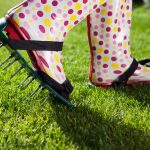
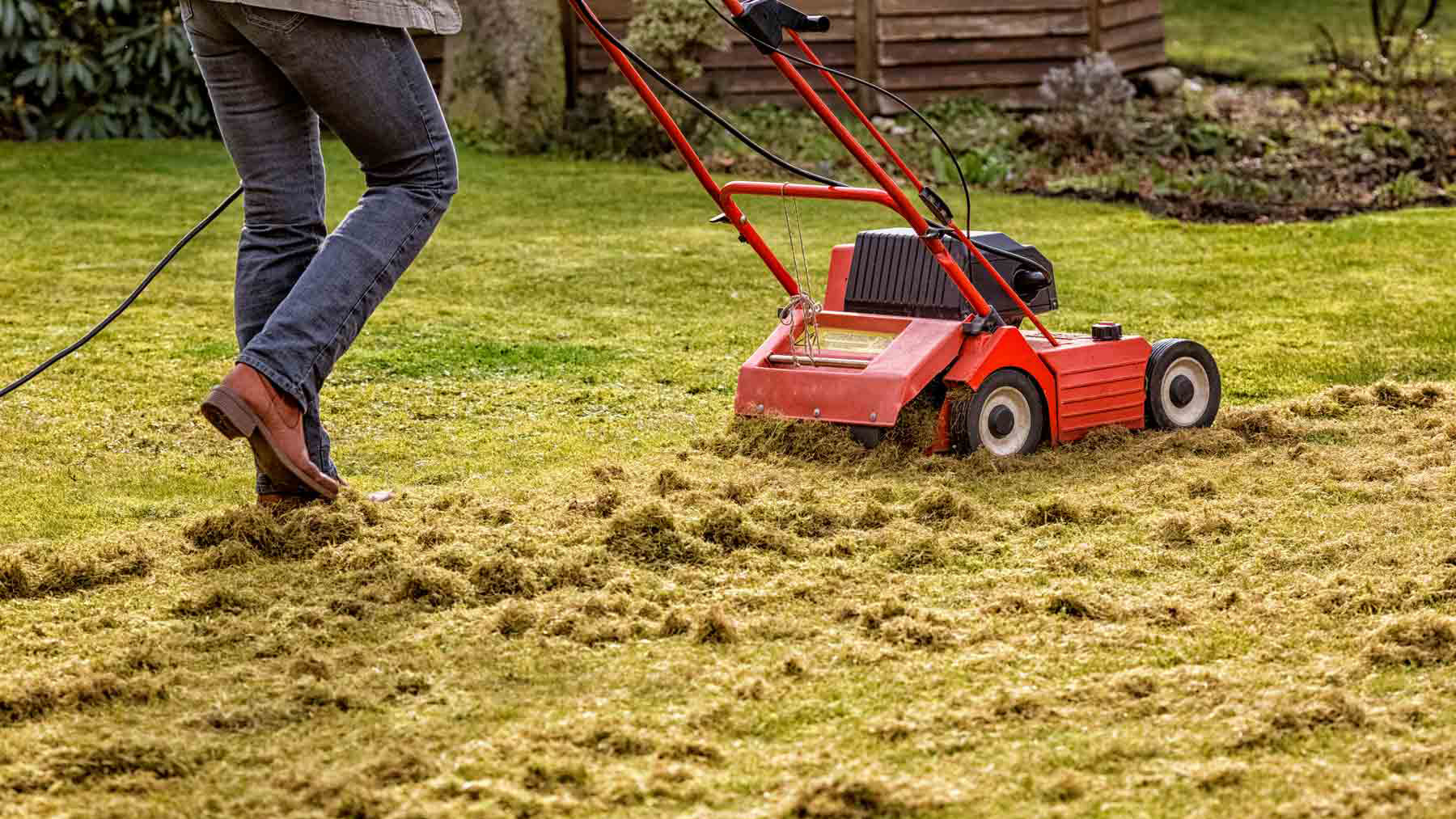
The two words are often used interchangeably, but the tools and the impact on the lawn are different. Dethatching is the lighter operation: a spring-tined rake or a powered lawn rake with flexible wire tines pulls dead material out of the upper few millimetres of the thatch layer without disturbing the soil beneath. Scarifying is more aggressive: a powered scarifier or hand scarifier uses fixed steel blades that slice vertically through the thatch and into the top 5 to 10mm (a quarter inch) of soil, ripping out the heavy mat in one pass.
Use a dethatcher when thatch is between 12 and 20mm (half and three-quarters of an inch). The Bosch AVR 1100 powered lawn rake (around £160/$200) is a popular wire-tine option for domestic lawns. Use a scarifier when thatch is over 20mm. The Einhell GC-SC 2240 P (around £220/$270) and the Greenworks 14-inch corded dethatcher/scarifier (around £170/$210) both have switchable cassettes for spring rake and steel blade modes, which makes them flexible across a range of thatch depths. Available at B&Q, Home Depot, Amazon, Screwfix or any large garden centre. For a small lawn under 50m², a manual spring-tined rake (under £20/$25) does the same job with more effort.
When to dethatch or scarify and why timing is everything
The single most common mistake is dethatching at the wrong time of year. Pull a thatch mat out of a stressed or dormant lawn and the grass cannot recover. The University of Maryland Extension and the Royal Horticultural Society both recommend early autumn for cool-season grasses (ryegrass, fescue, bent, smooth-stalked meadow grass), with early spring as a secondary window. Autumn works best because the grass is actively growing, soil temperatures are still warm, weed germination has slowed, and the lawn has six to eight weeks to recover before winter dormancy.
Late May is generally too late for cool-season grasses because the next 12 weeks are likely to bring heat and drought stress. If you dethatch now and a hot dry spell follows in June, the lawn will not have the moisture reserves to fill in the gaps and you end up with a thinner, weedier lawn rather than a healthier one. The exception is warm-season grass (bermuda, zoysia, St Augustine), which is just entering its active growth phase and tolerates dethatching well in late spring.
What causes thatch to build up in the first place
If your lawn has crossed the 12mm threshold, the underlying cause is usually one of four things. Each has a corresponding fix that, applied consistently, prevents the thatch from coming back after the next scarify.
- Overfeeding with high-nitrogen fertiliser. Heavy nitrogen drives leaf growth faster than soil microbes can decompose the resulting dead tissue. Drop your annual nitrogen application to about 100 to 150g per square metre of total N split across two or three feeds per year instead of monthly applications.
- Overwatering. Waterlogged soils are anaerobic and suppress the bacteria that break down organic matter. Switch to one deep weekly soak of 25mm (1 inch) rather than daily sprinkling.
- Compacted soil. Foot traffic, clay subsoil and heavy mowers compress the upper soil profile and starve microbes of oxygen. Aerate annually with a hollow-tine fork or powered aerator. A hollow-tine pull-behind aerator costs around £90/$110 to hire for a day at most tool hire firms.
- Acidic soil. Soil pH below 5.8 slows microbial activity. A £6/$8 soil pH test kit from Amazon or any garden centre takes two minutes and tells you whether to apply a light dressing of garden lime (calcium carbonate) to bring the pH back into the 6.0 to 7.0 sweet spot.
What happens if you ignore a heavy thatch layer
Once thatch passes 25mm (an inch), several things go wrong at once. Surface water no longer reaches the root zone, so the lawn becomes drought-prone even in average summers. Roots grow upward into the thatch chasing oxygen and moisture, which leaves them shallow and unstable, and patches lift in chunks when you tug at the surface. Fungal diseases such as fusarium patch, red thread and dollar spot establish much more easily because the damp mat retains spores. And the lawn becomes mower-resistant: the blades sink, the cut height is inconsistent, and you end up with patches of scalped grass next to long stalks. A heavy thatch lawn rarely fixes itself, because the underlying conditions that produced the thatch are still in place.
The end goal is a thatch layer of around 6mm (a quarter inch). At that thickness the lawn looks dense, springs back under foot, retains moisture during dry spells, and resists disease without any chemical intervention. The screwdriver test takes 30 seconds, costs nothing, and tells you exactly where your lawn sits on that scale. Run it once now to know whether you need to plan a scarifying session for September, and again in two years to track whether your watering and feeding changes have brought the layer back down.