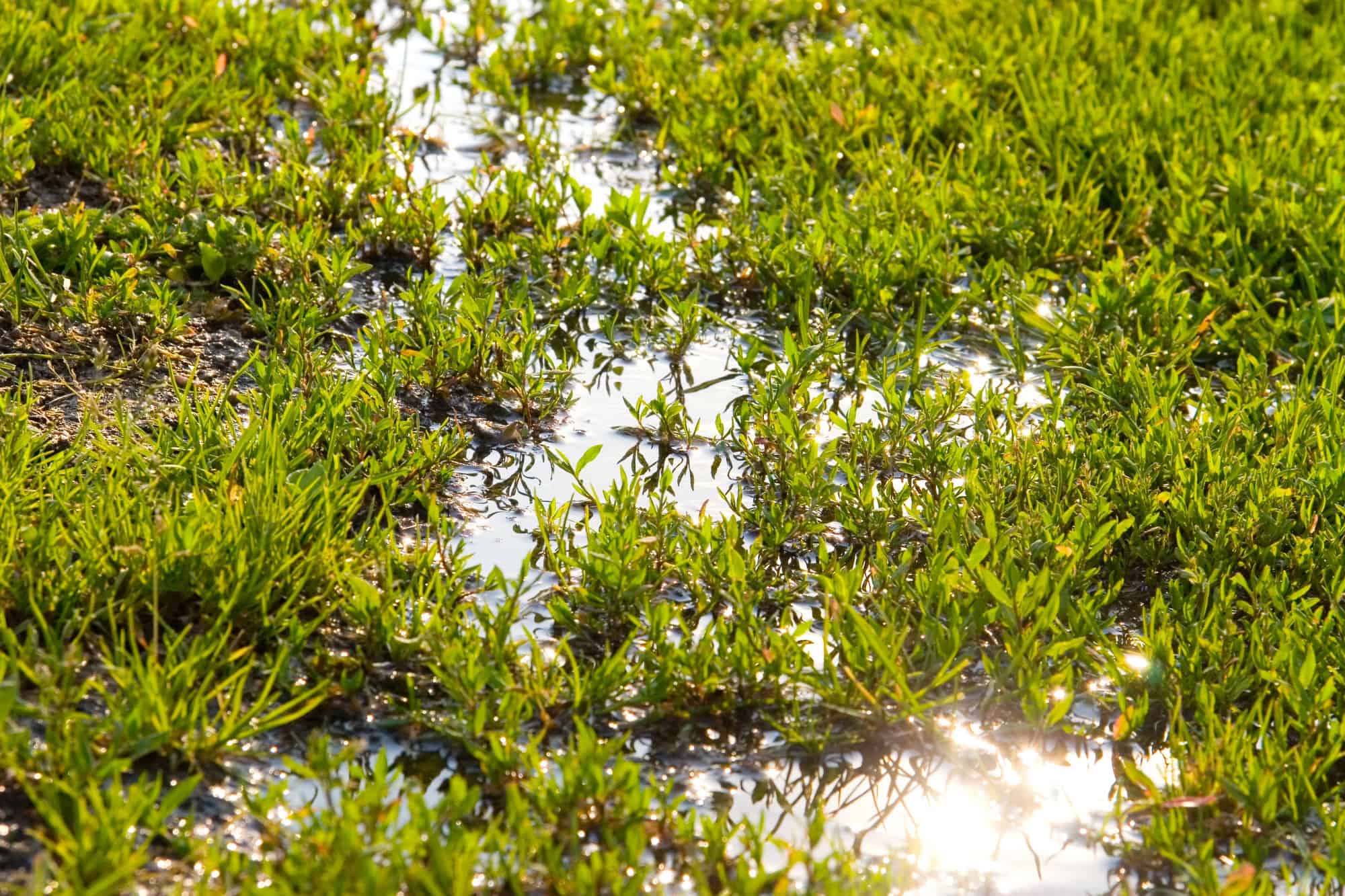
The first proper rain after a dry spell sometimes brings a faint sour smell off the lawn that lifts within an hour and disappears by the next day. Most gardeners notice it, dismiss it as wet earth, and forget about it. It is not wet earth. That sour, slightly eggy, almost sewage-like smell is hydrogen sulphide and other anaerobic gases venting from soil that has lost most of its oxygen. The lawn is telling you the drainage is failing, and the longer you ignore it the harder the fix becomes. A lawn that smells sour in May is almost certainly the same lawn that turns yellow in July and gets red thread in September.
What the Smell Actually Means
Healthy lawn soil contains about 25 per cent air by volume, held in microscopic pores between soil particles. That air supplies oxygen to grass roots, to earthworms, and to the aerobic bacteria that break down thatch and recycle nutrients. When soil is compacted, waterlogged, or layered with old thatch, those pores collapse or fill with water and the oxygen level drops. Anaerobic bacteria take over from aerobic ones. Aerobic bacteria produce carbon dioxide and clean compost smells. Anaerobic bacteria produce hydrogen sulphide (which smells like rotten eggs), butyric acid (which smells like vomit) and methane. When rain saturates compacted soil, those gases are pushed out of the surface as fresh water displaces them, and that is the smell you notice.
The reason this is serious for the lawn is that grass roots cannot survive long in anaerobic conditions. Within 48 hours of soil dropping below about 10 per cent oxygen, root tips die back. The plant compensates with shallower roots, which need more frequent watering and dry out faster in summer. Anaerobic soil also locks up iron, manganese and potassium because the chemical reactions that release these nutrients only happen in oxygenated soil. So the lawn is hungry, thirsty and rootless, even though it looks green in spring.
How to Tell Where the Drainage Is Actually Failing
Before throwing money at solutions, identify the cause. The smell is a symptom, and the underlying problem is usually one of three things: compacted soil from foot traffic, a thatch layer choking the surface, or a heavy clay subsoil holding water like a bowl. The diagnostic test is the screwdriver test, and it takes five minutes. After the next decent rain, push a long screwdriver or a piece of 6mm rebar into the lawn at five or six points across the area that smelled. If you struggle to get past 50mm (2 inches) anywhere, the soil is compacted. If the probe sinks in easily but pulls out wet with a smelly white-grey residue, you have anaerobic soil that is wet but not necessarily compacted. If the lawn feels spongy underfoot and the probe bounces back, you have a thatch layer.
The second test is to dig a 30cm (12 inch) deep hole with a spade and look at the layers. A healthy lawn shows dark crumbly topsoil for the first 100 to 150mm (4 to 6 inches), then lighter subsoil with visible structure beneath. A failing lawn typically shows 30 to 50mm (1.2 to 2 inches) of dead-looking topsoil, then a grey or rust-orange band where waterlogging has stripped iron out, then heavy clay or builder’s rubble below. The grey or rust band is called gleying and is the unmistakable signature of long-term waterlogging.
The Hollow-Tine Aeration That Fixes Most Cases
For compacted soil and most cases of moderate waterlogging, hollow-tine aeration is the single most effective treatment. The technique removes 100mm (4 inch) plugs of soil from the lawn on a grid pattern, leaving small cylindrical holes that fill with topdressing and become permanent drainage channels. Unlike spiking, which just pushes the surrounding soil sideways and can compact it further, hollow-tining physically removes material and replaces it with something better.
For a 50 square metre lawn, a manual hollow-tine fork costs around £30/$40 and works fine if you are willing to put in the time. Plan on two to three hours of work for a lawn that size. Push the fork in to its full depth, lever it slightly, pull out, and move on, leaving holes on roughly 15 by 15cm (6 by 6 inch) centres. For larger lawns, hire a petrol hollow-tine aerator from a tool hire shop for around £45/$60 per day, or pay a contractor £80 to £150/$100 to $190 for a one-off treatment on an average front lawn.
Once the holes are open, brush a free-draining topdressing into them. Use a 70:30 mix of horticultural sand and sieved sandy loam, applied at around 4kg per square metre. The sand keeps the channels open under foot traffic and dramatically improves vertical water movement. Topdressing without aerating beforehand does almost nothing because it sits on the surface. Topdressing into open hollow-tine holes turns each hole into a permanent drainage path that lasts for years.
Thatch, the Hidden Cause Most People Miss
If the screwdriver test showed sponginess rather than hardness, the cause of the sour smell is probably thatch rather than compaction. Thatch is the layer of dead and partly-decomposed grass stems, runners and roots that builds up between the green leaf and the soil surface. A thin layer of 5 to 10mm (a quarter inch) is normal and helpful. Anything over 15mm (just over half inch) starts trapping water against the soil surface and creating exactly the anaerobic conditions that produce the sour smell. Lawns that get heavily fed and lightly watered build thatch faster than lawns that are managed leanly, because the grass produces leaf tissue faster than the soil microbes can break it down.
The fix for excess thatch is autumn scarification with a powered scarifier. A petrol or electric scarifier with steel blades cuts vertically through the thatch layer and pulls it out. For a typical 50 square metre lawn, hire a Bosch ALR 900 (around £20/$25 per day) or a petrol Allett scarifier (£35/$45 per day). Set the blades to just nick the soil surface. You will pull out astonishing quantities of brown debris from a thatched lawn, sometimes filling six or seven garden waste bags from a small area, and the lawn will look thin and shocked for two weeks before recovering with stronger growth.
When the Subsoil Is the Real Problem
If aeration and scarification do not fix the smell, you have a structural drainage problem and a heavier intervention is needed. Lawns laid on top of builder’s rubble, heavy clay subsoil, or old concrete bases will never drain well no matter how often you aerate the top. In these cases you have three options. The cheapest is to live with a wet lawn in winter by stopping feeding, raising the mower height, and accepting the lawn will be slow in spring. The middle option is to install a French drain across the wettest line of the lawn, a gravel-filled trench 300mm (12 inches) wide by 600mm (24 inches) deep, lined with a perforated 100mm (4 inch) pipe running to a soakaway or surface water drain. Plan on around £150 to £250/$190 to $310 per 10 metre run in materials, plus a weekend of digging.
The most thorough option is full lawn renovation: strip the turf, dig out 200 to 300mm (8 to 12 inches) of subsoil, lay a free-draining base of crushed stone and sharp sand, top with 150mm (6 inches) of sandy loam, and re-turf. This costs £25 to £40 per square metre/$30 to $50 in materials and is a job for a landscaper, but it solves the problem permanently and is sometimes cheaper than fighting bad drainage for ten years with annual aeration and ruined lawns.
The sour smell is a symptom you can act on. Five minutes with a screwdriver tells you which treatment to apply, and most lawns recover from anaerobic stress within one season of proper aeration. Ignore the smell, and the lawn will be in worse shape every spring until something more expensive than a fork is needed to bring it back.