
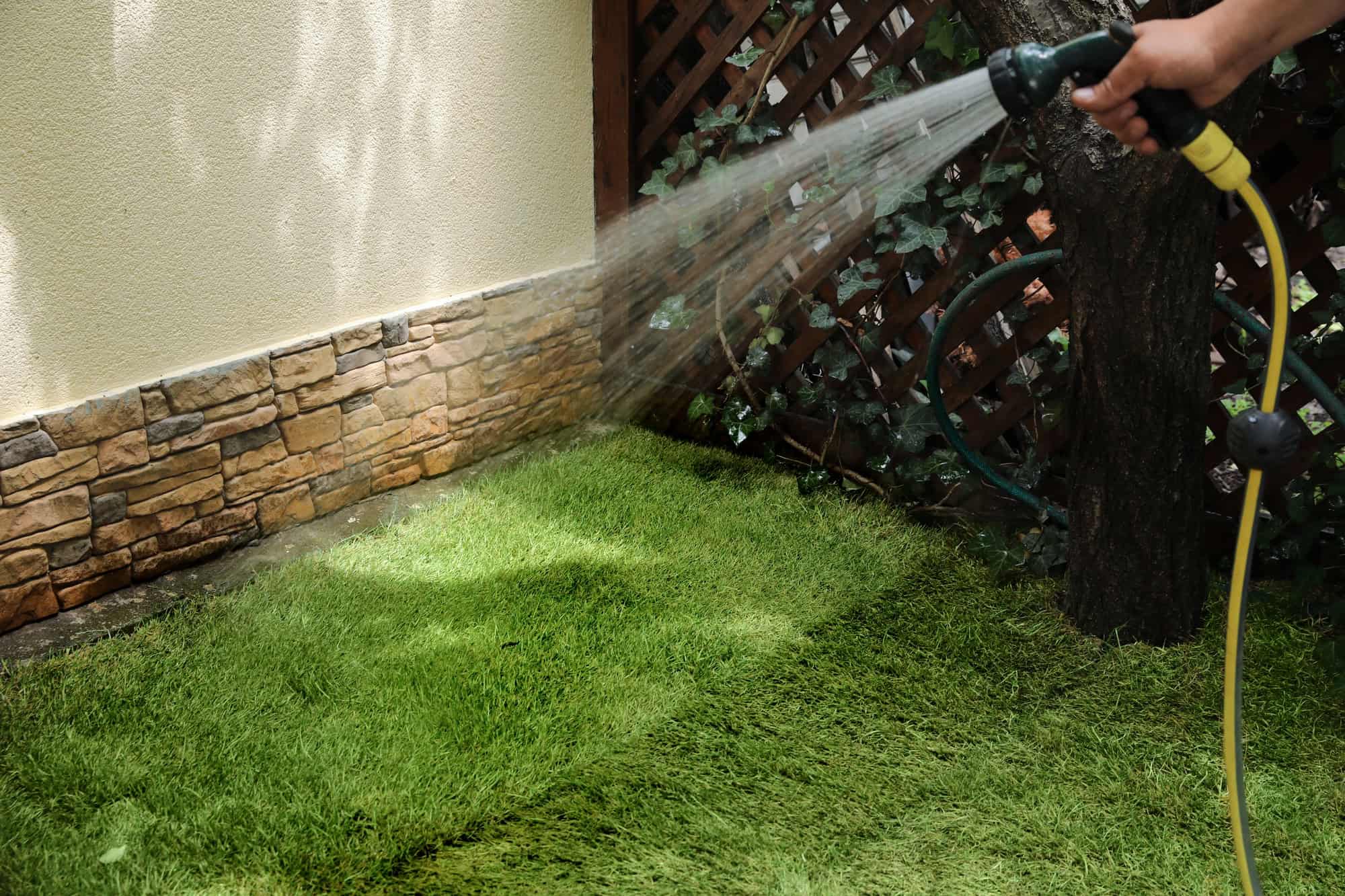
Lay new turf in the middle of summer and the job is only half done when the last roll is down. Fresh turf has no roots into the soil beneath it, so in hot weather it can dry out and die within days unless you water it hard and often from the moment it is laid. Water within half an hour of laying, soak it daily and sometimes twice daily for the first two weeks, then taper off as the roots take hold over the following month. Keep off it, hold back the mower until it has anchored, and even a summer lawn will establish.
Turf is living grass cut with only a thin layer of soil and root attached. The grower has severed it from the ground it grew in, so for the first few weeks it behaves like a cut flower in a vase: it can only take up the water that reaches the thin root layer, and it has no deep roots to fall back on when the surface dries. In spring or autumn the weather does much of the watering for you. In summer, every drop is your responsibility, and the margin for error is small.
Why summer turf needs so much water so fast
A freshly laid turf has been harvested with roots only a centimetre or two deep, and those roots have been cut. Until new roots grow down and knit into the soil below, the turf cannot draw on the moisture reserves in the ground; it survives only on water held in its own thin soil layer and in the top of the bed beneath it. In hot, sunny, breezy weather that thin layer dries out remarkably quickly, sometimes within a single afternoon, and once turf dries to the point of going crisp and shrinking at the edges it rarely recovers.
The biology you are racing against is root growth. New roots only push into the soil while the join between turf and bed stays consistently moist; let it dry and the roots stop, the turf shrinks, the seams open into visible gaps and the edges curl and brown. Keep that join damp and roots will start to anchor within a week or two and the turf becomes progressively more self-sufficient. The whole watering strategy is built around keeping the underside of the turf and the top of the soil bed continuously moist for long enough for those roots to take hold.
It is worth saying plainly that summer is the hardest time to lay turf, and turf growers generally advise against laying from late spring to early autumn for exactly this reason. If you have a choice, early autumn is far kinder, with warm soil for rooting and cooler, damper air to ease the water demand. If the turf is already booked or already down, the watering regime below is what carries it through.
How much to water, and when
Start before the turf even goes down by watering the prepared soil bed so the turf is laid onto moist, not dust-dry, ground. Then water the turf itself within about half an hour of laying each section, because the cut roots begin to dry the moment they are exposed. The first watering is the heaviest: apply enough that the water soaks right through the turf and into the soil beneath, which you can check by lifting a corner to confirm the underside and the bed below are both wet, not just the surface. A common mistake is a light sprinkle that wets the grass blades but never reaches the roots, which does almost nothing.
For the first two weeks in summer, water every day, and in very hot or windy spells twice a day, early morning and early evening, so the turf never dries between waterings. Avoid watering in the midday heat, when much of it evaporates before it soaks in. As a rough guide, aim to deliver around 25mm (1 inch) of water across the area each day in hot weather, adjusting up in a heatwave and down if rain falls. Through the third and fourth weeks, as roots begin to anchor, cut back to watering every two or three days but water more deeply each time, which encourages roots to chase the moisture downward rather than sitting at the surface. After about four to six weeks, once the turf has knitted in, you can shift to the deep, infrequent soak you would give an established lawn. Our guide to watering so less evaporates applies in full once the lawn is established.
Check rooting rather than guessing at the calendar. After two to three weeks, gently try to lift a corner of the turf. If it resists and you can feel it gripping the soil, roots are taking hold and you can begin tapering the water. If it lifts away cleanly with no resistance, it has not rooted yet and needs more time and consistent moisture before you ease off.
Hold off on feeding new turf for the first few weeks as well, which surprises people who want to give it every advantage. Good turf is grown with enough nutrient in its soil to support the first flush of root growth, and adding a high-nitrogen feed too early pushes leaf growth at the expense of the roots you actually need, while the salt in a granular feed risks scorching turf that is already under water stress. Wait until the turf has rooted and had its first cut, usually around four to six weeks in, then apply a balanced or slightly nitrogen-led feed when the soil is moist, or use a dilute liquid feed sooner if the turf looks pale. A light liquid seaweed during establishment is the exception, as it supports rooting without forcing soft top growth.
Keeping off it, the first cut, and common mistakes
Stay off new turf as much as possible while it roots, because footsteps press the turf down unevenly, create depressions and disturb the delicate new root contact. If you must walk on it to water awkward corners, lay a scaffold board or plank to spread your weight rather than treading directly. Keep children and dogs off entirely for the first few weeks.
Hold off mowing until the turf has rooted firmly, usually around three weeks in summer, confirmed by that gentle tug test. The first cut should take off only the very tips, no more than the top third of the growth, with the mower set high and the blade freshly sharpened so it shears cleanly rather than dragging at turf that is not yet fully anchored. A blunt blade or a low cut on young turf can lift whole sections. After the first cut or two, return gradually to a normal mowing height and routine.
If a patch does fail despite your best efforts, do not panic or relay the whole lawn. Lift the dead piece, loosen and re-level the soil beneath, and either drop in a fresh offcut of turf if you kept any spare or, if the weather has cooled by then, sow grass seed into the gap and keep it watered as you would the rest. Small repairs blend in within a few weeks once the surrounding turf is growing again. Trying to patch in the hottest, driest part of summer often just kills the repair too, so for anything beyond a tiny gap it is usually better to wait for the cooler, damper conditions of early autumn.
The mistakes that kill summer turf are nearly always about water. Letting it dry out even once in the first fortnight can be fatal, so a forgotten weekend or a holiday with no one to water is the usual cause of failure. Equally, standing water from over-watering a poorly drained bed rots the roots, so the target is consistently moist, never flooded. Laying onto dry, unprepared soil, walking on it too soon, and mowing too early or too short round out the list. Get the water right and stay off it, and turf laid in the heat of summer will still root in and give you a thick, even lawn by the time autumn arrives.