
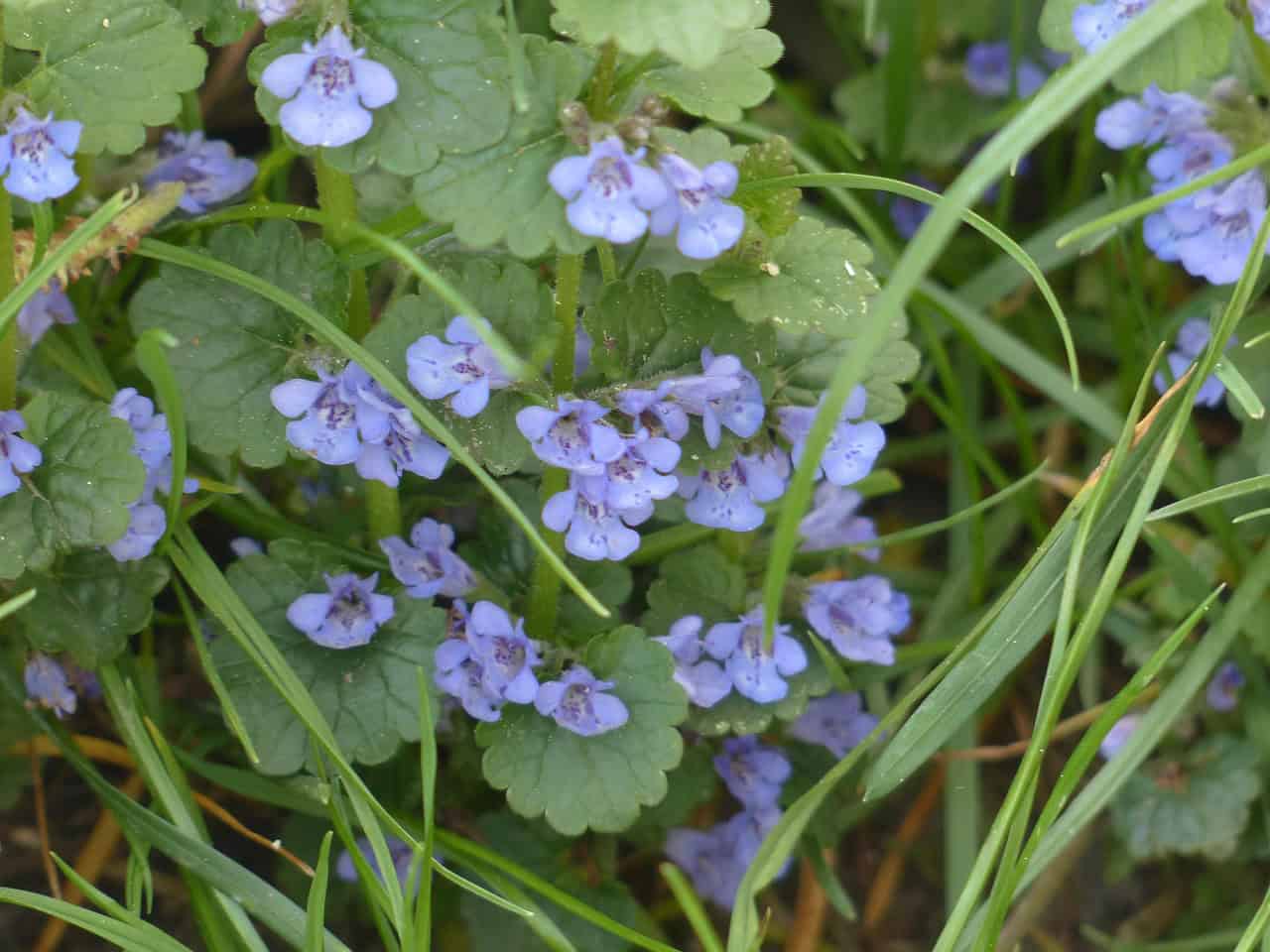
- Creeping Charlie, also called ground ivy, roots at every joint along its trailing stems, so any scrap of runner left on the soil grows into a new plant.
- Lift every runner from damp, loosened soil and bag it, or smother a thick patch under black plastic held down with no gaps for a year or more.
- Borax can stunt and yellow the grass and a power rake spreads the runners, and the weed returns unless you cut the shade and wet soil that let it in and thicken the grass.
One Missed Runner Grows the Whole Mat Back
The scalloped green mat is still creeping out from under the hedge, however often you pull it. Creeping Charlie comes back for one reason: every joint on its trailing stems can put down roots and start a fresh plant. Tear the leaves off and leave a length of runner in the soil, and you have replanted it.
The fix comes in two halves. First, get every runner out. Wet hard ground until it is moist, loosen it with a fork, lift each root cluster whole, bag every scrap and go back over the ground with a trowel. Where the patch is too thick to pull, cover it with black plastic that reaches 15 to 30 cm (6 to 12 in) past the leaves on every side, hold it down with bricks or rocks, and leave it in place. Second, deal with the shade and the wet soil that let it in, then thicken the grass so the weed has no gap to creep into.
Leave the borax in the cupboard and the power rake in the shed. Borax is hard to dose safely on a home lawn and stays in the soil, and a power rake scatters the nodes so they grow into new plants.
What Creeping Charlie Is and Why It Picked Your Lawn
Creeping Charlie is a perennial in the mint family. The leaves are bright green, round or kidney-shaped with scalloped edges, and they grow in opposite pairs on a square, four-sided stem. Turf specialists at Kansas State University put the leaves at ½ to 1½ inches (1.3 to 3.8 cm) across, on creeping stems up to 2½ feet (76 cm) long. Crush a handful and it gives off a strong smell of mint. In spring it carries small, funnel-shaped flowers in bluish purple or lavender. People often mix it up with henbit, which is a winter annual.
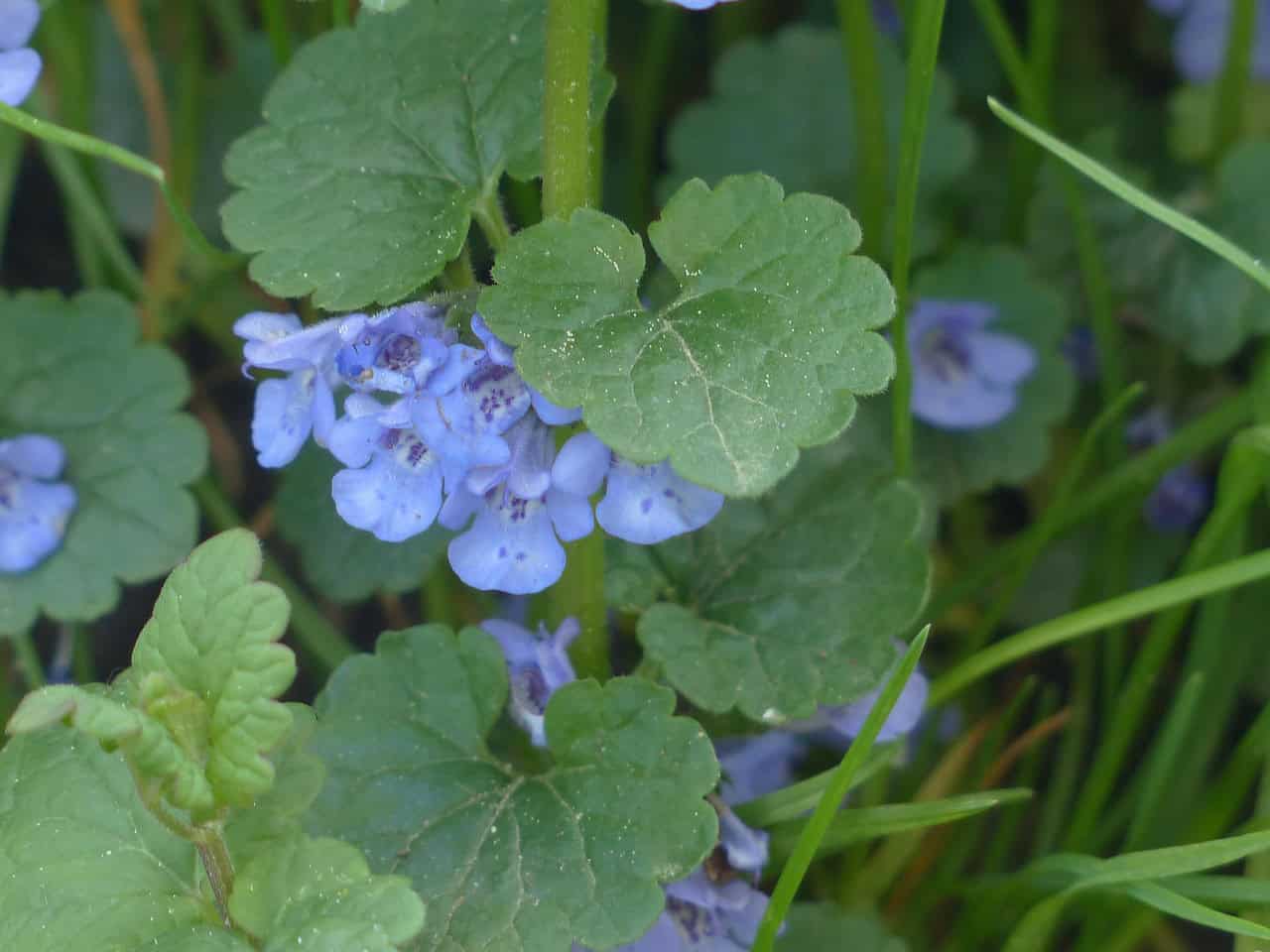
Early settlers brought this European native over in the 1800s as a groundcover for shade. It spreads three ways: by seed, by underground rhizomes and by creeping stems, called stolons, that run along the surface and root at each node. Penn State Extension notes that most new plants come from those nodes, not from seed.
Hard autumn frosts kill back the leaves and stems, but the crowns live through the winter and push out new leaves and stems in early spring. A brown, frosted mat in December is not a dead one.
Creeping Charlie favours moist soil and thin turf, and it often gets going in the shade, under trees and shrubs, before it runs out into the sunny parts of the lawn. Kansas State links it to shaded sites with poorly drained, fertile soil. The plant is the symptom. Paul Tukey, founder of Safelawns.org, summed it up: “You can kill the messenger all day long, but it doesn’t change the message that something is wrong with your soil.” A patch of this weed tells you the same thing as other weeds that reveal soil problems: too much shade, too much water, or both.
How to Pull It Out So It Stays Out
Pulling by hand suits a small patch or a few early runners, and it is the method to use around children, pets or edible plants. Penn State Extension is blunt about the reason most attempts fail: hand removal rarely works unless the runners come out with their nodes attached.
Put on gloves first. The plant can irritate skin, and some people are allergic to it. Cut back the leaves, stems and loose trailing vines so you can see where the rooted parts sit, and drop every trimming straight into a waste bag. A cut piece left on the ground can root again.
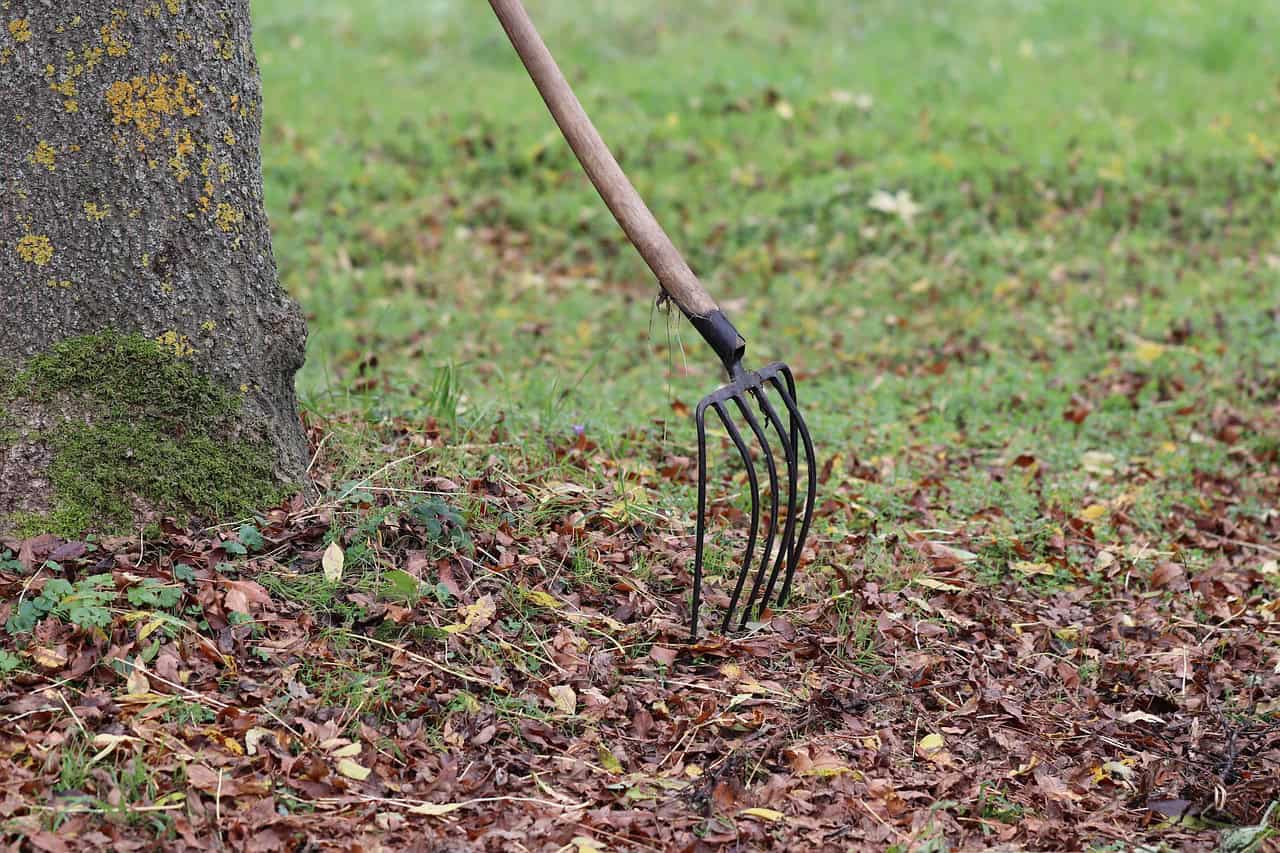
Next, soften the ground. You cannot pull the roots out whole from hard, dry soil. Water the area until it feels moist to the touch but not soggy, then wait about half an hour for the water to soak in. Then loosen the soil around the patch with a garden fork or pitchfork.
Grip each root cluster at its base and ease it upward. If it resists, stop pulling and loosen the soil again with the fork, so the whole cluster comes up with its roots. Roger Cook, the This Old House contractor, puts the goal simply: “The more you can get up of the root system, the better off we’ll be.” Bag everything for the bin. Do not compost it and do not burn it.
Finish by working over the ground with a trowel or hand cultivator and lifting any rhizomes you missed. Expect to need several passes. Where the weed has run through a large area, the stem network is too extensive to clear by hand.
Pulling from dry soil, leaving trimmings on the grass and stopping after one pass all leave live nodes behind.
How to Smother a Patch Without Weedkiller
Smothering works by cutting off light completely and for a long time. Creeping Charlie copes with shade, but it still needs some sun, so a cover that blocks every bit of light starves it. Anything under the cover dies too, grass included, so lay it carefully. The method works best on small patches.
Cook favours black plastic sheeting over cardboard or newspaper, and he does not pretend it is quick: “Spread black plastic sheeting over the top of the groundcover and weigh it down with rocks. Wait a year, maybe two, for the plants to die, then dig out all the dead roots.”
The roots fan out under the soil beyond the leaves you can see, so the sheet must reach 15 to 30 cm (6 to 12 in) past the vines and leaves on every side. Take a square patch 1 metre (3 ft 3 in) across. Adding that margin on each side means a sheet 1.3 to 1.6 metres (4 ft 3 in to 5 ft 3 in) across, which is 1.7 to 2.6 square metres (18 to 28 square feet) of plastic to cover 1 square metre (11 square feet) of visible weed.
Any gap ruins it. Hold every edge down with bricks or rocks so wind cannot lift the sheet and let light in. The roots survive under a cover longer than you expect, so resist lifting it early. The job is done when the creeping Charlie underneath is brown and shrivelled. Then pull out the dead roots, bag them, and leave nothing on the lawn.
Reseed the bare patch between mid-August and mid-September, the best time to sow a lawn, as thin turf is where this weed takes hold.
Why Borax and a Power Rake Backfire
Borax gets passed around as an organic cure, but research at the University of Wisconsin and Iowa State University found it usually works poorly and can harm the grass and other plants, leaving them stunted and yellow.
Borax contains boron, which plants need in tiny amounts and which turns toxic in larger doses. Creeping Charlie is extremely sensitive to boron, so in principle a dose should kill the weed before it hurts the grass. The trouble is the soil. How much boron a lawn’s soil makes available to plants changes with soil type and pH, so the right dose for your patch is hard to pin down. Too little gives poor control; too much harms the grass around it. Boron also does not break down or fade from the soil, so repeat or heavy doses can leave bare ground where nothing grows.
A power rake, also called a dethatcher or vertical mower, slices into the soil and roots so the runners can be combed out with a rake. The University of Wisconsin-Madison extension warns that it can make things worse: it scatters nodes across the lawn and sets them growing as new plants. It also tears out grass, so you might have to reseed afterwards. If you go down that route, do it between mid-August and mid-September, which is also the best time to reseed.
How to Stop It Coming Back
Change the conditions first. Let more light in by pruning low tree branches up. Improve drainage where water sits, or water less often. Kansas State’s advice for control without chemicals comes down to two things: less shade and drier soil.
Then make the grass harder to push through. Mow regularly at 5 to 9 cm (2 to 3½ in); This Old House suggests 7.6 cm (3 in) with the clippings left on the lawn. Feed to suit your grass type, water deeply and less often, and overseed in autumn with a shade-tolerant grass under trees. Our piece on why grass struggles under trees covers that problem in full. A ½-inch (1.3 cm) layer of finished compost raked into the turf also helps; one cubic yard (0.76 cubic metres) covers about 600 square feet (56 square metres).
Penn State Extension says denser turf slows the spread but does not always hold back ground ivy once it is established. In deep shade, stop fighting for grass and plant a low-light groundcover such as pachysandra, periwinkle or sweet woodruff, or hostas, which compete well with weeds.
When to give up and call someone
If there is more creeping Charlie than grass, starting again can be easier: clear everything and reseed the whole area, and our guide to reclaiming a lawn overrun by weeds walks through that rebuild. For a widespread infestation, a lawn care professional is worth a call.
The last resort is a broadleaf lawn weedkiller containing triclopyr, applied after the first frost in autumn, when the plant moves its food reserves down to the roots and carries the chemical with it. It cannot go on vegetable or flower beds. Wear gloves and goggles, follow the label, spray only with no rain forecast for 24 hours, and do not mow for at least two days. “Don’t be surprised if it takes more than one application to complete the job,” Cook warns. Even then, the Wisconsin extension authors Susan Mahr and John Stier note that spraying can run on for many years, and they offer a calmer option: “It may be easier to just learn to live with it, and periodically knock back the weed when it becomes too dense.”
Sources
- This Old House: How To Get Rid of Creeping Charlie
- University of Wisconsin-Madison Division of Extension: Creeping Charlie
- Penn State Extension: Lawn and Turfgrass Weeds: Ground Ivy
- Kansas State University: Ground Ivy
