The lawn care industry has spent the last decade convincing homeowners that aeration requires a petrol-powered core aerator, a tow-behind plug machine or at minimum a hired electric model. For lawns over 200m2 (about 2,000 sq ft) that is true in practice, because covering the ground by hand becomes impractical. But for a typical front or back lawn under that size, an ordinary garden fork from the shed does a job that is technically equivalent and in some respects better than a rented machine, at a fraction of the cost and with none of the hassle.
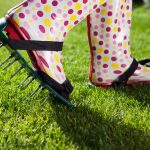
The reason this works comes down to what aeration actually achieves and what most home machines deliver. The point of aerating is to break up surface compaction in the top 10cm (about 4 inches) of soil so that air, water and root growth can move through it. Penn State Extension and Cornell Turfgrass Program both note that compaction is overwhelmingly a problem of the upper few inches, not deeper. A garden fork pushed firmly into the soil reaches that exact zone. A hired electric aerator typically penetrates 5 to 7cm (about 2 to 3 inches) at best, which is less depth than a fork can achieve. The professional petrol core aerators reach 8 to 10cm, similar to a fork, but cost £80/$100 to hire for a day plus collection and return time. For a 50m2 (about 500 sq ft) lawn, the fork is faster.
What Compaction Looks Like and How to Test for It
Before you spend any time aerating, confirm that the lawn actually needs it. Compaction shows up in three ways. Water pools on the surface after rain rather than soaking in within minutes. The grass colour is duller and grows slower than expected even when fed. And weeds like plantain, broadleaf dock and creeping buttercup start to dominate, because their tap roots can punch through compacted soil where grass roots cannot.
The simplest physical test is the screwdriver test. Take an ordinary flathead screwdriver with a 15cm (about 6 inch) shaft and push it straight down into the lawn surface using only the force of your hand, no body weight. On healthy uncompacted soil, the shaft will sink in at least 10cm (about 4 inches) without much resistance. On lightly compacted soil it will stop at 5 to 7cm. On heavily compacted soil it will refuse to go in more than 2 or 3cm and you can feel the resistance immediately. Test in five or six places across the lawn, including high-traffic areas near gates, paths and washing lines. If two or more spots fail the test, the lawn needs aeration.
Garden Ninja and the RHS both note that a moist soil is essential for accurate testing. Test the day after a good rain or the day after watering. Bone-dry soil resists everything and gives false positives. Saturated soil collapses and gives false negatives. Slightly moist soil tells the truth.
The Right Fork and the Right Technique
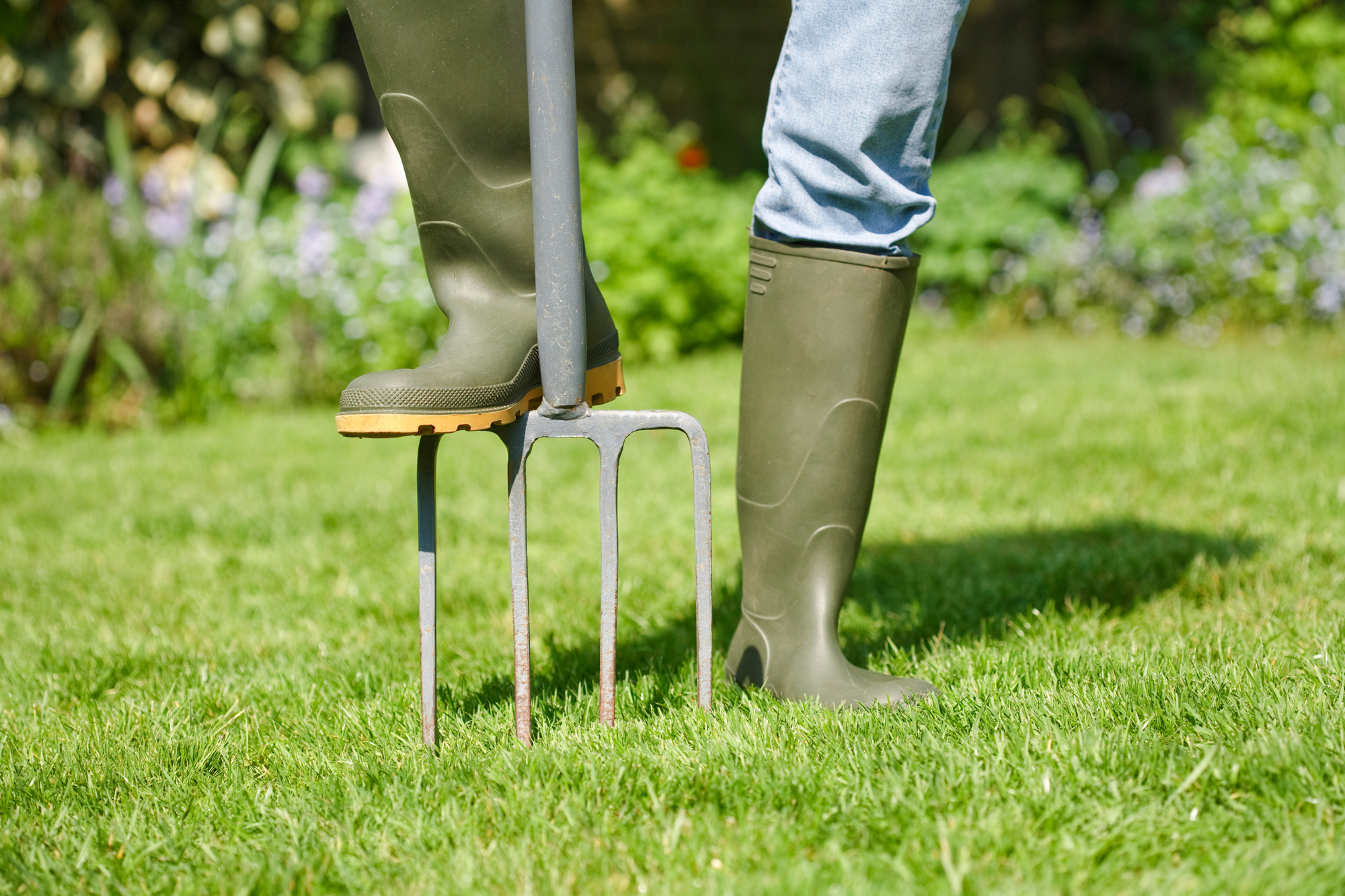
An ordinary 4-tine digging fork from any hardware store works perfectly for this. Spear and Jackson, Wilkinson Sword, Bulldog and Wolf-Garten all sell forks in the £20/$25 to £40/$50 range. If you already own one, you do not need to buy anything. Avoid using a border fork, which has shorter tines designed for shallow flower bed work. You need the full 25 to 28cm (about 10 to 11 inches) tine length of a digging fork to penetrate properly.
The technique that makes hand aerating effective and quick is the rocking method, not the levering method that most online guides describe. Drive the tines straight down into the soil using a combination of hand pressure and a controlled step onto the shoulder of the fork. Aim for 10 to 15cm (about 4 to 6 inches) of penetration. Do not lever the fork backwards toward you. Levering pushes the soil sideways and actually creates a new compacted ring around the hole. Instead, pull the fork straight back up the way it went in, then move 10cm (about 4 inches) sideways and repeat.
The Lawn Man, a UK lawn care service, makes the same point in their technical advice. Levering damages roots and worsens compaction at the edges of the hole. Vertical insertion and vertical withdrawal preserves the channel and breaks up the soil only where you want it broken up. The technique takes a few minutes to learn and then becomes automatic.
Why Solid Tines Beat Hollow Tines for Most Home Lawns
The professional debate about whether to use solid tine aeration (which just opens holes) or hollow tine aeration (which removes plugs of soil) usually concludes with hollow tine for serious compaction. That is true for sports turf and golf greens, where soil is compacted to a depth and density a domestic lawn rarely sees. For a typical home garden, solid tine aeration done annually does the job and avoids the downsides of hollow tining.
Hollow tining pulls plugs of soil and grass onto the surface that need to be raked off or left to break down over a week, leaving the lawn looking patchy in the meantime. The holes also fill more slowly with new root growth. Solid tine aeration leaves the lawn looking essentially the same once you have walked off it, and the channels close gradually as roots grow into them. For an annual maintenance aeration, solid tines through a fork are perfectly adequate.
Where hollow tining clearly wins is on heavy clay soils that have not been aerated for many years. If you have rock-hard clay that fails the screwdriver test at every spot, consider hiring a hollow tine aerator once to relieve the worst of it, then maintain with annual fork aeration after that. For everyone else, the fork is enough.
How Long It Actually Takes
This is the part that surprises people who have never tried it. A 50m2 (about 500 sq ft) lawn at the standard spacing of 10 to 15cm between holes contains roughly 2,500 to 5,000 aeration points. That sounds like a lot until you start. With a steady rhythm of step, push, withdraw, move, you can complete about 800 holes per hour at a relaxed pace. A 50m2 lawn at 10cm spacing is finished in about 45 minutes to an hour. Bigger spacing at 15cm cuts that to about 30 minutes.
A hired electric aerator covers the same ground in about 20 minutes once you have it set up, but you have spent 30 minutes collecting it from the hire shop and 30 minutes returning it, plus loading and unloading. Net time saved is zero for a small lawn. The fork wins purely on logistics.
For larger lawns over 200m2, the maths flips and a hired machine becomes the right tool. For everything smaller, the fork is faster, cheaper and produces a comparable result. Professional groundskeepers at clubs with limited budgets often still aerate fringe areas and difficult corners by hand for the same reason.
What to Do Immediately After
The aeration itself is only half the job. What you do in the 24 hours after determines how much benefit you get.
Top dressing is the next step that nearly every home gardener skips. Brush a thin layer of sandy loam or sieved compost across the lawn using the back of a leaf rake or a brush. The mixture falls into the open channels and stays there, replacing compacted topsoil with a free-draining medium that lets roots grow downward. Westland Lawn Top Dressing comes in 25 litre bags at around £15/$19 from B&Q, Wickes or Amazon. A 50m2 lawn needs about 50 litres (two bags).
Water lightly after top dressing, around 10 to 15mm (about 0.4 to 0.6 inches) of water spread evenly. This settles the top dressing into the holes and washes any surface residue off the grass blades. Avoid heavy watering, which would compact the new dressing back down.
Hold off on feeding for at least a week. The lawn is putting energy into root growth in the newly opened channels, and a nitrogen feed at this stage diverts that energy back into leaf growth. A week later, a light feed will accelerate the recovery and you will see thicker greener grass within two weeks. Late May is the last sensible window for aeration before summer dormancy slows everything down, so doing it now sets the lawn up for the rest of the season.
For a small lawn, the entire job from screwdriver test to top dressing fits comfortably into a single Saturday morning, costs less than £20/$25 if you need to buy top dressing and already own a fork, and produces a lawn that drains better, grows thicker and stays greener through the dry weeks ahead. The hired machine is impressive theatre, but the ordinary garden fork does the same job for the same lawn, faster.